

Logistics teams often receive shipment information through emails, booking forms, bills of lading, delivery documents, customer portals, and spreadsheets. Even with a TMS, ERP, or warehouse platform, employees may still need to read information in one place, check it, and enter it again somewhere else.
For Chicago logistics companies, logistics data entry automation is less about replacing an entire software stack and more about reducing repeated movement of operational information. Well-designed multi-agent AI workflows for logistics can help by assigning document reading, extraction, validation, system lookup, record preparation, and exception handling to specialized agents that work together. People can remain involved where judgment or approval is required.
Understanding Data Flow Across Logistics Operations
Manual entry persists because logistics information often crosses systems that were not designed as one continuous workflow. A booking request may arrive by email, supporting details may sit in a PDF, customer data may live in an ERP, and the shipment record may need to be created or updated in a TMS.
That is where AI data entry automation for logistics can help. The system is not inventing shipment information. It is moving existing information into the right operational context after checking that required data is present and suitable for the next step.
The same issue appears in TMS data entry automation. A user may open an email, identify shipment details, check a customer record, confirm required fields, and then enter information into the TMS. What looks like one data-entry task is actually a chain of reading, validation, lookup, and system interaction.
What a Multi-Agent Data-Entry Workflow Actually Looks Like
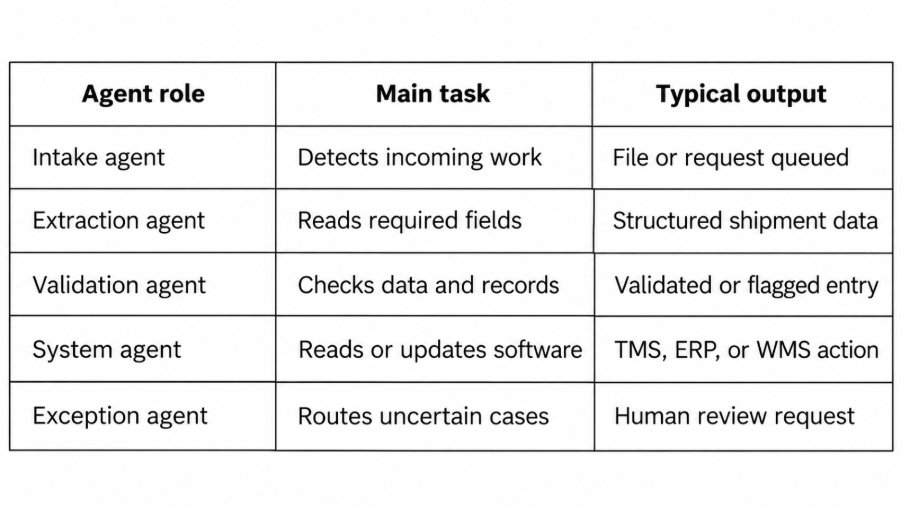
Multi-agent AI systems for logistics divide a larger process into smaller responsibilities. Instead of asking one component to read a document, validate it, update several systems, and handle every exception, the workflow can coordinate specialized agents with narrower roles.
This is the practical idea behind AI agents in logistics and agentic AI in logistics. An agent does not need unrestricted autonomy. It can operate inside an orchestrated process with defined tools, permissions, validation rules, and handoff points.
Organizations considering Generative and Agentic AI development can design those responsibilities around the workflow rather than treating every agent as an independent decision-maker.
1. Intake Agent
The intake agent detects new work, such as an email, uploaded document, portal submission, API event, or monitored file, and passes it into the workflow.
2. Document and Extraction Agent
This agent identifies the document or message type and extracts the fields required for the process. The extracted values should still be checked against data-quality and required-field rules.
3. Validation Agent
The validation agent compares extracted information with business rules or existing records. It can identify missing fields, invalid formats, unexpected values, or conflicts.
4. System Agent
A system agent reads from or prepares an approved update for a TMS, WMS, ERP, CRM, or another logistics application. Its access should be limited to the actions required for that workflow.
5. Exception Agent
When information is incomplete, conflicting, or outside defined rules, an exception agent routes the case to the correct queue instead of forcing the process to continue.
6. Human Review
A person reviews cases that require judgment, correction, clarification, or approval. Human review is part of the workflow design.
Example: From Shipment Email to a Reviewed TMS Record
A useful way to understand logistics workflow automation is to follow one shipment request. Suppose a logistics company receives a booking request by email with a supporting document attached.
- The intake agent recognizes the new email and sends it into the workflow.
- A document agent identifies the document type.
- An extraction agent converts the required fields into structured shipment data.
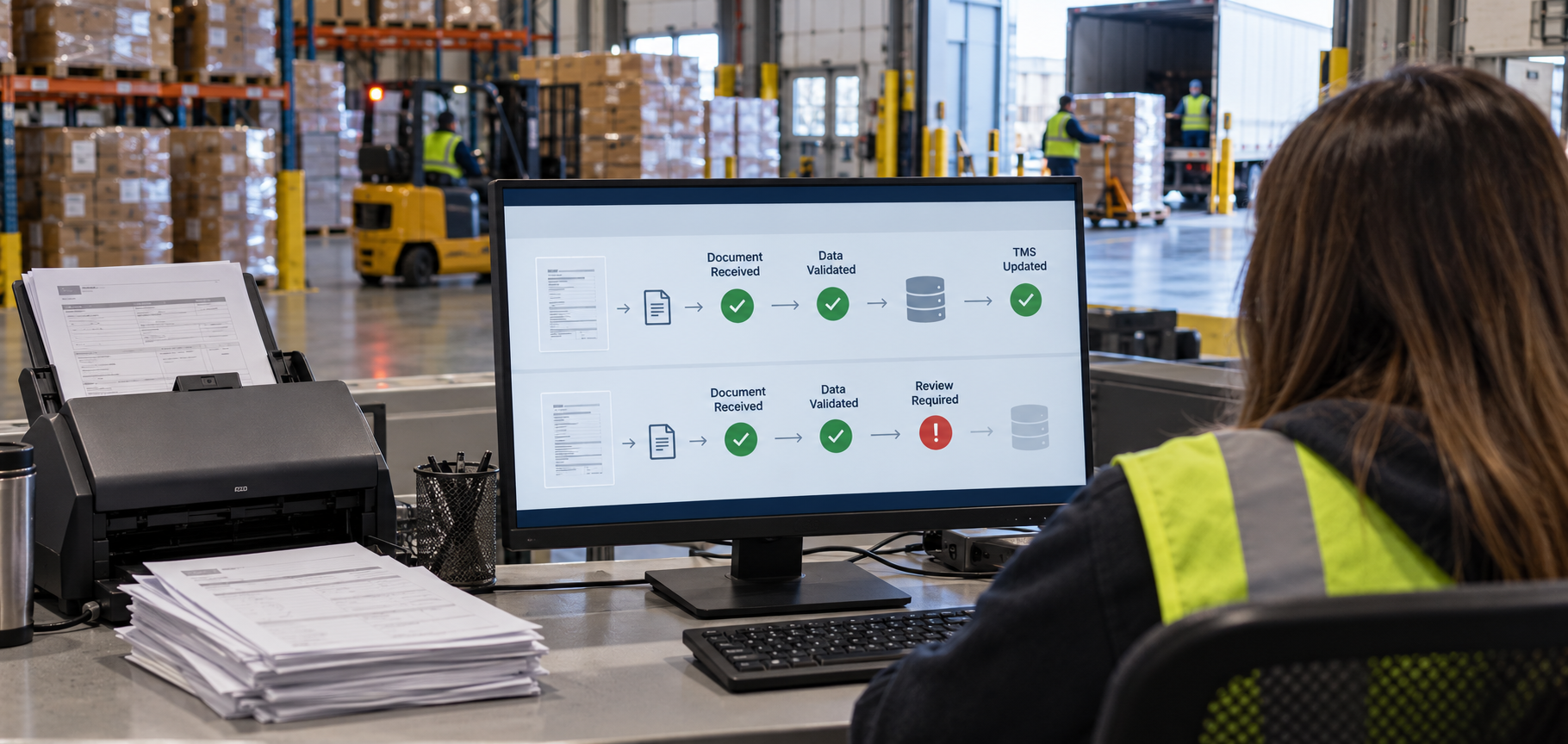
- A validation agent checks required information against business rules and available records.
- A system agent prepares the corresponding TMS record or update.
- If a field is missing or conflicts with an existing record, the exception agent routes the case for review.
- A logistics employee approves, corrects, or rejects the proposed update according to company policy.
This is where automated document processing for logistics becomes more useful than simple text extraction. The workflow connects extracted information to validation, operational systems, and exception handling.
A company building this process may need transport and logistics software development that works with the TMS, ERP, WMS, portals, APIs, and internal data sources already used by the operation.
Validation and Human Review Matter More Than Full Automation
AI extraction can encounter incomplete documents, conflicting values, duplicate records, unusual formats, or information that does not match existing operational data. A reliable workflow therefore needs clear rules for what happens when the next action is uncertain.
Routine, sufficiently validated actions can proceed when they meet predefined rules and permissions. Ambiguous or consequential cases can be routed to a person.
The NIST Artificial Intelligence Risk Management Framework 1.0 supports this governance approach. It states that roles and responsibilities for human-AI configurations and oversight should be clearly defined, and notes that human-AI arrangements can range from highly autonomous to fully manual depending on context. This is general AI risk-management guidance, not a logistics-specific rule, but the principle is useful: organizations should decide in advance where people supervise, approve, or intervene in AI-supported processes.
The Workflow Has to Work with the Systems You Already Use
The value of AI-powered logistics operations depends heavily on integration. If an agent can read a shipment document but cannot securely retrieve the related record or pass validated data into the correct system, manual work simply moves to another point.
A practical design may connect email, document storage, APIs, TMS, WMS, ERP, CRM, internal databases, and customer or carrier portals. The implementation should account for authentication, permissions, data formats, master data, audit logs, error handling, and the actions each agent is allowed to perform.
For example, one agent may have read-only access to customer records, while another can prepare a TMS update but cannot finalize it without approval. The goal is to give each component only the access needed for its defined role while keeping the workflow traceable.
When Multi-Agent AI Is More Complex Than You Need
Multi-agent AI is not automatically the best choice for every repetitive process. If a workflow simply copies a small set of fields between two stable systems, an API integration, deterministic workflow, RPA process, or conventional document-processing pipeline may be simpler to build and maintain.
A multi-agent approach becomes more relevant when work crosses several document types, systems, tools, validation steps, and exception paths. The architecture should match the process. Adding more agents to a simple workflow does not make the automation better.
A Practical Implementation Path for Chicago Logistics Companies
A Chicago logistics company does not need to begin by automating an entire operation. A better starting point is one repetitive workflow where employees repeatedly read, copy, validate, or re-enter the same information.
A practical sequence is:
- Identify one high-friction data-entry workflow.
- Map every source and destination system.
- Separate deterministic steps from steps requiring interpretation.
- Define each agent or automation component's responsibility.
- Limit access and permissions by role.
- Define validation, exception, and human-review rules.
- Test with controlled operational data and realistic exceptions.
- Review errors before expanding the scope.
Working with an AI development company in Chicago can be relevant when the project requires custom orchestration, integration with existing logistics applications, or a controlled path from pilot workflow to production use.
Frequently Asked Questions
What are AI agents in logistics?
They are software components designed for bounded tasks such as reading information, calling approved tools, checking records, preparing system actions, or routing exceptions within a defined workflow.
How can AI reduce manual data entry in logistics?
AI can extract information from documents and messages, validate required fields, check existing records, prepare updates, and route uncertain cases to employees instead of requiring every record to be keyed manually.
Can AI agents connect with TMS, ERP, and WMS systems?
Yes, where suitable APIs, databases, integration services, or controlled automation interfaces are available. The practical approach depends on each system's architecture, authentication, permissions, and supported integration methods.
What happens when an AI agent finds incorrect or missing shipment information?
The workflow should not guess. It can flag the mismatch, preserve the available context, and route the case to the appropriate review queue for correction or approval.
How is multi-agent AI different from RPA?
RPA is generally suited to predefined, deterministic steps in stable interfaces. Multi-agent workflows can coordinate more variable inputs, tools, validation steps, and exception paths. The right choice depends on process complexity.
Reduce Re-Entry Without Rebuilding Every Logistics System
Multi-agent AI can be useful when logistics data entry spans multiple documents, applications, validation steps, and exceptions. The objective is not unrestricted autonomy. It is to reduce repetitive movement of information while maintaining access controls, validation, traceability, and human review where required.
Theta Technolabs can design these workflows around existing logistics systems using technologies available in its AI stack, including Python, REST APIs, and AWS. The agent layer can connect with current applications instead of requiring every platform to be replaced.
To discuss how multi-agent AI workflows can be integrated into your logistics operations, contact us at sales@thetatechnolabs.com.


_The%20Impact%20of%20Cross-Platform%20Apps%20on%20Real%20Estate%20Market%20Trends%20in%20Dallas_Q3_24-1.jpg)
_How%20AI%20is%20Enhancing%20Construction%20Site%20Surveillance%20and%20Security%20in%20Dallas_Q3_24-1.jpg)
_Web%20Apps%20for%20Retail%20and%20eCommerce_%20Streamlining%20Operations%20and%20Reducing%20Costs_Q3_24.jpg)
_Enhancing%20Driver%20Safety%20and%20Compliance%20with%20Web%20Apps%20in%20the%20Logistics%20Sector_Q3_24.jpg)


_Integrating%20Chatbots%20Into%20Your%20Application.jpg)
_How%20much%20does%20it%20cost%20to%20create%20an%20android%20app%20in%202024%20for%20Startups_%20A%20detailed%20guide_Q2_24.jpg)
_Key%20Trends%20in%20Healthcare%20Software%20Development%20for%20the%20Future_Q2_24.jpg)
_Best%20iOS%20App%20Development%20Company_%20Enhancing%20User%20Engagement%20with%20Push%20Notifications_Q2_24.jpg)
_Chatbots%20for%20Event%20Management%20and%20Hospitality%20Services_Q1_24.jpg)
_Choosing%20the%20Right%20App%20Development%20Company_%20A%20Comprehensive%20Guide_Q1_24.jpg)