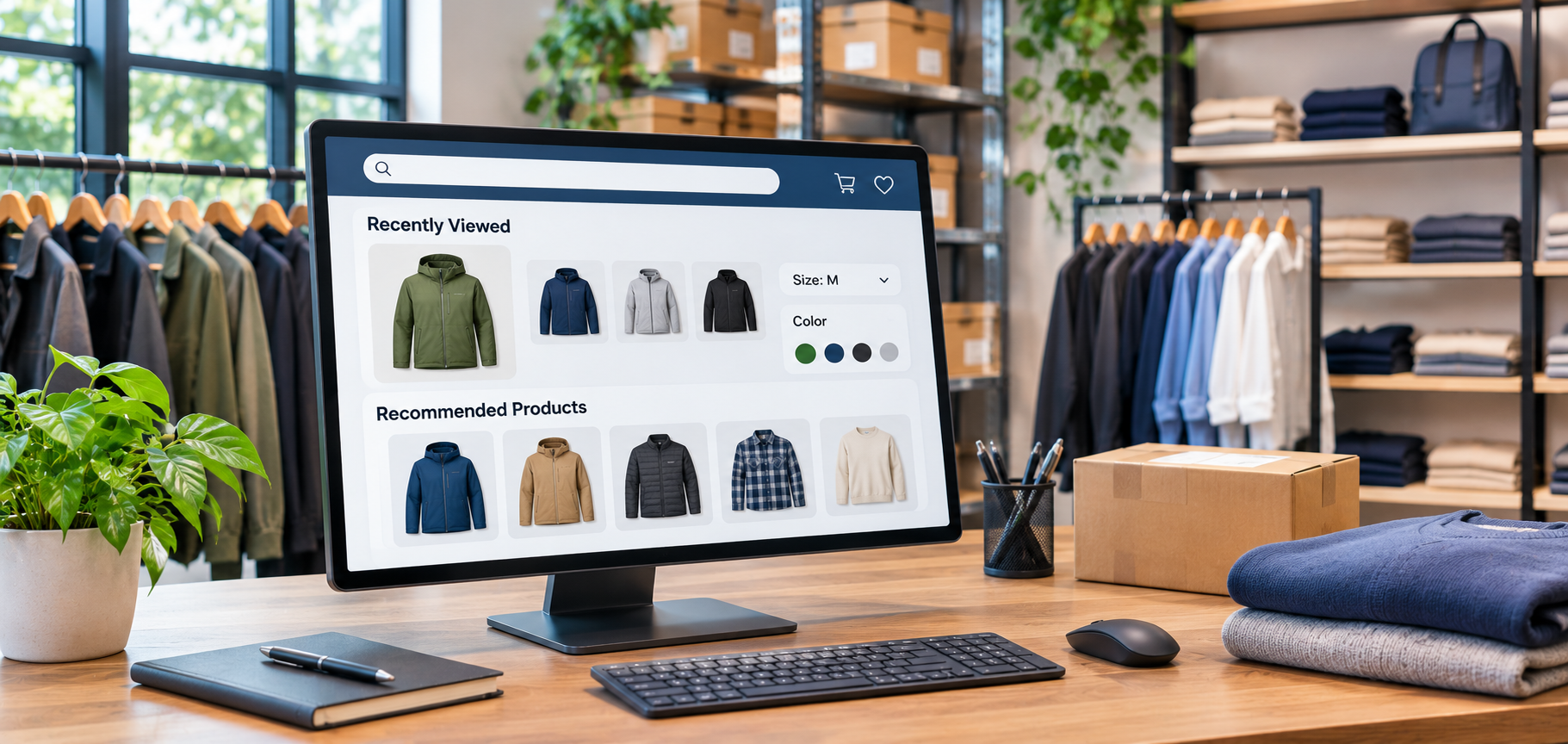


A shopper opens a San Francisco clothing store's website and compares three waterproof jackets before leaving without buying. When she returns, the homepage shows the same jackets alongside a few suitable alternatives. That can be useful. But if the store keeps showing jackets for weeks after she bought one as a gift, the recommendations begin to feel careless.
This is the challenge behind AI personalization: behavior data can make online shopping easier, but a click does not tell a retailer everything about a customer. San Francisco e-commerce businesses need to decide which signals matter, how to use them, and when to stop relying on them.
What Is AI Personalization in E-Commerce?
AI personalization uses patterns in customer interactions to choose more relevant products, search results, or on-site content. Those interactions might include recent searches, product views, selected sizes, purchases, or items added to a cart.
It is not the same as showing every visitor a “Popular Products” row. A personalized recommendation considers some context about that shopper or session. A visitor searching for hiking boots might see different suggestions from someone browsing raincoats.
For retailers investing in retail and e-commerce software solutions, the practical goal is better product discovery, not collecting the largest possible profile. A recommendation should help a customer decide what to view next, while leaving room to browse without being tracked unnecessarily.
Which Customer Behavior Data Is Actually Useful?
Not every event on a website deserves equal weight. Retailers should start with signals that have a clear connection to the shopping task.
Searches and Product Views
Search terms often reveal immediate needs. Someone who searches for “waterproof commuter backpack” gives a more specific signal than someone who opens a product page by accident. Repeated views and comparison activity may also indicate interest, but they are not proof of buying intent.
Cart and Checkout Activity
Items added to a cart can help the store suggest compatible accessories or make it easier to continue shopping. Yet an abandoned cart has many possible explanations: shipping costs, a phone call, uncertainty about sizing, or simply browsing. It should not automatically trigger aggressive recommendations.
Purchases and Stated Preferences
Purchase history can help avoid recommending items the customer already owns, or suggest suitable replacements and accessories. Explicit preferences, such as a selected shoe size or a saved favorite category, can be more reliable than an inferred interest.
These signals also have different lifetimes. A selected size may remain useful across visits, while a temporary search for a birthday gift may become irrelevant almost immediately. Retailers should decide how long each signal is needed instead of treating every event as permanent knowledge.
How AI Turns Behavior Data into Recommendations
A useful recommendation system has several stages. AI contributes to matching and ranking products, but the surrounding data and business rules are equally important.
1. Collect Only the Needed Events
An online store might record that a visitor searched for “linen shirt,” opened two product pages, and selected medium. The system does not need the visitor's precise location, contact list, or unrelated browsing history to suggest similar shirts.
Each event should have a clear purpose and an appropriate retention period. The business must also respect relevant privacy choices and rules for the technologies collecting those events.
2. Match Behavior With Product Information
The store needs a reliable catalog with categories, attributes, sizes, prices, and availability. Search and browsing signals have little value if product descriptions are inaccurate.
A shopper looking at lightweight jackets should not repeatedly receive heavy winter coats simply because both products share the word “jacket.” Product attributes help the system understand the difference.
3. Rank Useful Options
Recommendation methods can range from simple rules to machine learning that identifies patterns across shopping sessions. Some compare product attributes; others learn which products are commonly viewed or purchased together.
Through machine learning development services, retailers can develop recommendations suited to their catalog and available data. Smaller stores may benefit from clear product rules first.
4. Apply Business Checks Before Display
The highest-ranked suggestion is not always the best one to show. Retailers should filter out unavailable products, incompatible accessories, duplicates, and items that conflict with explicit customer preferences.
Finally, the store can display a small group of relevant products and provide a way to change the results. A visible “Not interested” or “Show different items” option is sometimes more helpful than another round of silent predictions.
Practical Ways to Use Personalization in an Online Store
More relevant product discovery. A visitor browsing outdoor clothing could see jackets grouped by selected size, weather protection, and price range, rather than a random mix of trending items.
Better on-site search. When someone searches for “everyday work bag,” recent category choices might help rank appropriate backpacks or totes. Exact terms and filters should still work without relying on personalization.
Useful complementary suggestions. A customer viewing a camera might see compatible memory cards, provided the store has verified compatibility. The goal is to solve a shopping need, not simply increase the number of products shown.
Theta Technolabs' personalized shopping experience case study describes recommendations informed by browsing patterns and purchase history. It is an example of the capability, not a claim that the project was delivered for a San Francisco retailer.
Using Behavior Data Responsibly in California
A useful recommendation can become uncomfortable when a shopper cannot tell why information is being collected or how long it will be kept. San Francisco businesses should address those questions before launching personalized features.
The California Privacy Protection Agency's FAQ explains that browsing history, purchase records, and inferences about preferences can count as personal information. It also describes rights under the California Consumer Privacy Act (CCPA), including opting out of the sale or sharing of personal information for cross-context behavioral advertising. Those obligations depend on the business and its actual data practices.
Explain the purpose. Tell shoppers, in ordinary language, what information supports product recommendations. Avoid vague statements that everything is collected to improve the experience.
Limit collection and retention. Keep only information needed for a defined purpose and delete or de-identify it when no longer required, subject to applicable requirements.
Respect customer choices. Provide appropriate privacy notices and controls. Do not confuse first-party, on-site recommendations with cross-context advertising; they can involve different data uses and legal considerations.
Protect the information. Limit access, secure integrations, and avoid exposing individual browsing histories in dashboards or test environments. Review vendor data flows and seek legal advice where needed.
Responsible personalization is not about removing every useful feature. It is about giving the shopper value without making their behavior available for unrelated uses.
Common Mistakes That Make Recommendations Less Useful
One mistake is treating a single click as a lasting preference. Someone buying a gift may never want similar products again. The system should give recent, repeated, and explicitly stated signals appropriate weight.
Another is overpersonalizing the whole website. If every section repeats the same category, a shopper may struggle to discover something new. Keep some space for broader browsing and editorial choices.
New visitors create another challenge because there is little behavior history. Category choices, relevant popular products, and ordinary search filters can provide a good starting experience without forcing account creation.
Finally, recommendations must adapt when the catalog changes. An outdated product feed can undermine even a technically strong recommendation system.
How Can Retailers Measure Whether It Works?
Start with a clear comparison. Show one group a conventional product row and another a personalized version, where testing is appropriate, then examine more than clicks.
Useful measures include product discovery, add-to-cart rates, completed purchases, returns, and complaints about irrelevant suggestions. Check whether results differ for new versus returning customers. A high click rate is not meaningful if customers regularly return the recommended products.
Also monitor privacy complaints and preference controls. Better recommendations should improve the shopping experience, not create another obstacle.
Frequently Asked Questions
How does AI use customer behavior data in e-commerce?
AI can analyze searches, product views, cart activity, and purchase patterns to rank relevant products or content. Recommendations should also use accurate catalog information and respect customer privacy choices.
What customer behavior data can online stores use for personalization?
Useful data may include on-site searches, viewed products, selected sizes, saved preferences, and purchase history. Retailers should collect only what they need for clear purposes and follow applicable privacy requirements.
Can e-commerce businesses personalize shopping without collecting unnecessary personal data?
Yes. Stores can use session-level searches, selected filters, and product attributes to offer relevant suggestions. They do not need an extensive personal profile for every recommendation.
How can retailers measure whether AI personalization is working?
Retailers can compare product discovery, add-to-cart activity, completed purchases, returns, and recommendation feedback. Testing against a non-personalized experience helps reveal whether the suggestions are genuinely useful.
Conclusion
Behavior data can help online stores recommend more relevant products, but only when those signals are interpreted carefully. A viewed item is not a promise to buy, and a recommendation should never replace a shopper's own choices. Reliable product data, sensible ranking, privacy controls, and regular testing matter as much as AI itself.
Theta Technolabs helps e-commerce businesses build practical personalization features that support product discovery while keeping the customer experience in focus.
For implementation discussions, contact us at sales@thetatechnolabs.com.





_How%20Cloud%20Solutions%20Are%20Enhancing%20Remote%20Patient%20Monitoring%20in%20Healthcare_Q4_25.jpg)
_Streamlining%20Appointment%20Scheduling%20with%20Cloud%20Computing%20in%20Dallas%20Healthcare_Q4_25.jpg)
_The%20Impact%20of%20Cross-Platform%20Apps%20on%20Real%20Estate%20Market%20Trends%20in%20Dallas_Q3_24-1.jpg)
_How%20AI%20is%20Enhancing%20Construction%20Site%20Surveillance%20and%20Security%20in%20Dallas_Q3_24-1.jpg)
_Web%20Apps%20for%20Retail%20and%20eCommerce_%20Streamlining%20Operations%20and%20Reducing%20Costs_Q3_24.jpg)
_Enhancing%20Driver%20Safety%20and%20Compliance%20with%20Web%20Apps%20in%20the%20Logistics%20Sector_Q3_24.jpg)


_Integrating%20Chatbots%20Into%20Your%20Application.jpg)
_How%20much%20does%20it%20cost%20to%20create%20an%20android%20app%20in%202024%20for%20Startups_%20A%20detailed%20guide_Q2_24.jpg)
_Key%20Trends%20in%20Healthcare%20Software%20Development%20for%20the%20Future_Q2_24.jpg)
_Best%20iOS%20App%20Development%20Company_%20Enhancing%20User%20Engagement%20with%20Push%20Notifications_Q2_24.jpg)
_Chatbots%20for%20Event%20Management%20and%20Hospitality%20Services_Q1_24.jpg)
_Choosing%20the%20Right%20App%20Development%20Company_%20A%20Comprehensive%20Guide_Q1_24.jpg)