

Distribution centers run on timing. A single delay in picking, a missed maintenance window, or an inventory count that's off by a few pallets can ripple through an entire day's shipments. For manufacturing and logistics operations working out of Chicago, one of the busiest freight and distribution hubs in the country, the margin for that kind of friction keeps shrinking. AI-driven IoT analytics is becoming one of the more practical ways to close that gap, not by replacing warehouse teams, but by giving them visibility they didn't have before.
This article looks at how that actually works: the sensors involved, the way the data gets turned into decisions, and what it realistically takes to get started.
Why Warehouse Scale and Complexity Make AI/IoT Valuable in Chicago
Chicago sits at the intersection of major rail lines, interstate freight corridors, and air cargo routes, which is part of why it remains one of the largest concentrations of distribution and fulfillment activity in the U.S. That scale isn't a problem on its own. It's simply a lot of moving parts. But as warehouse networks grow larger and more interconnected, small inefficiencies that were once easy to absorb start to compound. A picking delay in one zone, a maintenance issue that goes unnoticed for a shift, or inventory counts that lag reality by even a few hours can add up quickly across a high volume operation.
This is exactly the kind of problem AI-driven IoT analytics is built to catch early. Because Chicago distribution centers operate within such a dense concentration of logistics activity, even minor operational blind spots scale fast, which makes continuous, sensor based visibility more valuable here than in a smaller, lower volume facility.
The Sensor Layer: What IoT Actually Captures
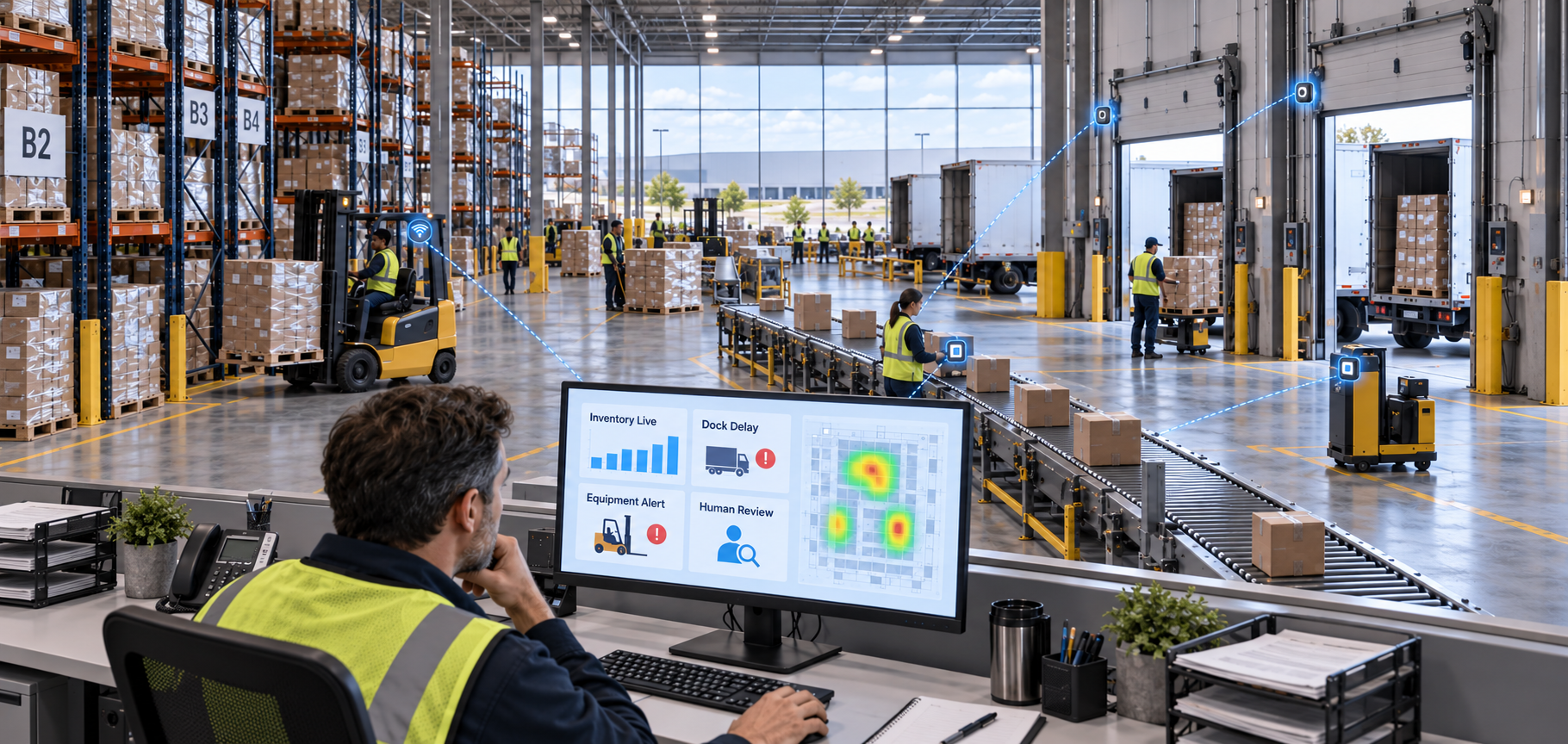
Before AI can optimize anything, it needs a steady stream of real data, and that starts with IoT sensors for warehouses placed throughout the facility. In a typical distribution center, this includes:
- Dock and door sensors that track loading and unloading times and trailer dwell time
- Temperature and humidity sensors, especially relevant for facilities handling perishable or sensitive goods
- RFID and motion sensors that track inventory movement and picking activity in real time
- Equipment sensors on forklifts, conveyors, and racking systems that monitor vibration, usage hours, and early signs of wear
None of this data is useful in isolation. The value comes from feeding it into a system that can interpret patterns across hundreds of sensors at once, which is where IoT development services in Chicago come in, connecting these physical inputs into a usable data pipeline rather than isolated readings on separate screens.
From Data to Decisions: How AI-Driven IoT Analytics Works
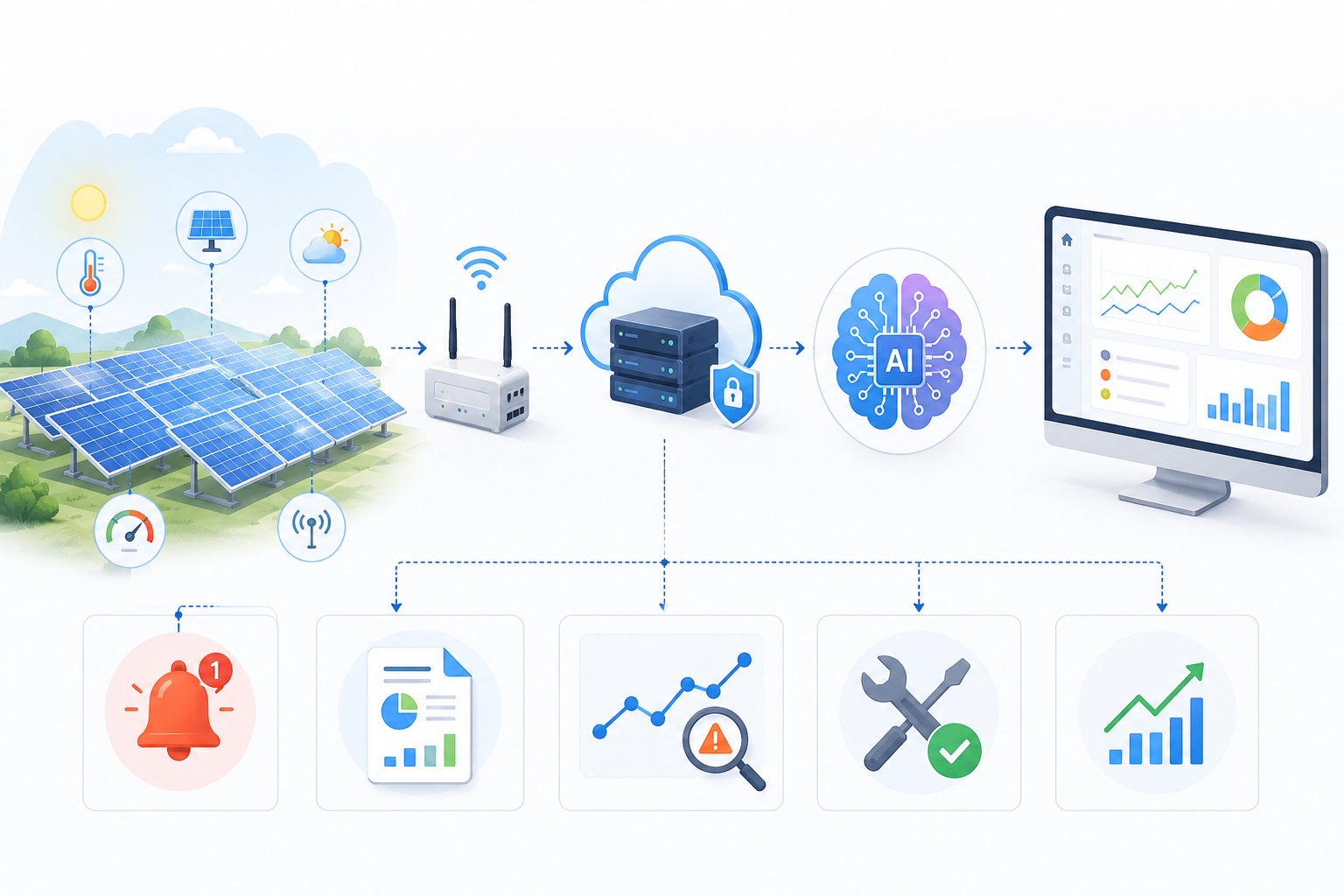
The general flow looks like this: sensors collect continuous data, that data moves through a pipeline into a centralized system, an AI model analyzes it against historical patterns, the system surfaces a dashboard view or triggers an alert, and a human makes the final call on what to do about it.
That last step matters. AI-driven IoT analytics isn't about full autonomy. It's about compressing the time between "something is off" and "someone knows about it." A forklift that's showing early vibration anomalies gets flagged before it breaks down mid-shift. A dock that's running slower than usual gets noticed in real time instead of showing up in next week's report. In practice, this is the difference between reactive warehouse management and one that can course-correct the same day a problem starts.
Core Use Cases Inside the Warehouse
Predictive Maintenance
Rather than servicing equipment on a fixed schedule regardless of actual condition, sensor data lets teams service machinery based on how it's actually performing. This reduces unplanned downtime without over-servicing equipment that's running fine. This is what people mean by predictive maintenance warehouse strategies.
Real-Time Inventory Visibility
RFID and motion data give a live picture of stock levels and movement, instead of relying on periodic manual counts that are often outdated within hours. This kind of real-time inventory visibility changes how quickly teams can react to shortages or overstock.
Smart Space and Layout Optimization
Movement pattern data can highlight where travel distances or congestion are slowing down picking, informing layout adjustments that reduce wasted motion over time. This is a core piece of smart warehouse technology.
Demand Forecasting
By combining historical sales data with real-time inventory signals, AI models can produce more responsive forecasts than static, spreadsheet based planning allows, feeding directly into broader logistics data analytics.
According to McKinsey research on AI adoption in distribution and supply chain operations, distributors that have embedded AI into planning and warehousing have reported measurable reductions in inventory levels and logistics costs, along with meaningful gains in usable warehouse capacity without adding new physical space. These aren't guaranteed outcomes for every facility, but they illustrate the scale of impact AI in distribution centers can realistically have when applied thoughtfully.
What This Looks Like for a Mid-Size Chicago Facility
Not every distribution center operates at the scale of a national retailer, and most AI/IoT adoption doesn't need to either. For a mid-size facility, this often starts small: a handful of sensors on the equipment most prone to failure, or RFID tracking on the highest-turnover inventory categories. The dashboard doesn't need to cover the entire operation on day one. It needs to answer one or two questions the team currently can't answer quickly. From there, the system expands as the data proves useful, rather than requiring a full facility-wide rollout upfront.
Getting Started: A Practical Path
For teams considering warehouse automation Chicago projects, a reasonable sequence looks like this:
- Identify where visibility is weakest today. Usually maintenance timing, inventory accuracy, or picking efficiency.
- Pilot sensors on one workflow rather than the whole facility, to validate the data pipeline and see real results.
- Build the dashboard around decisions your team actually needs to make, not every metric that's technically available.
- Scale gradually, adding sensor coverage and use cases as the initial pilot proves its value.
Working with a partner experienced in both the IoT hardware side and the AI modeling side, such as an AI development company in Chicago, can shorten this path considerably, since the sensor integration and analytics layer need to work together from the start rather than being bolted together later.
Frequently Asked Questions
How does AI improve warehouse operations?
AI improves warehouse operations by analyzing real-time data from IoT sensors to catch inefficiencies, like equipment wear, inventory gaps, or slow workflows, earlier than manual tracking would. This allows teams to act on issues the same day rather than discovering them in a weekly report.
What IoT sensors are used in AI-driven warehouse analytics?
Common sensors include dock and door sensors, temperature and humidity sensors, RFID and motion sensors for inventory tracking, and equipment sensors that monitor vibration and usage on machinery like forklifts and conveyors.
Is AI-driven IoT analytics practical for mid-size distribution centers, or only large ones?
It's practical for mid-size facilities too. Most implementations start with a small sensor rollout on one workflow, such as equipment maintenance or high-turnover inventory, rather than a full facility-wide system from day one.
How long does it take to see ROI from AI/IoT in a warehouse?
This varies by facility and scope, but starting with a focused pilot on a single high-impact workflow often shows measurable results within a few weeks to a few months, since it's easier to track before-and-after performance on a narrower set of operations rather than a full-scale rollout.
Final Thoughts
AI-driven IoT analytics isn't about replacing the judgment of an experienced warehouse team. It's about giving that team better information, sooner. For Chicago distribution centers operating at scale, even modest improvements in visibility can translate into real operational gains over time. If you're evaluating where to start, our team at Theta Technolabs works on both the IoT sensor integration and AI analytics layer, and can help map out a pilot suited to your facility. Reach out at sales@thetatechnolabs.com.


_Best%20iOS%20App%20Development%20Company_%20Enhancing%20User%20Engagement%20with%20Push%20Notifications_Q2_24.jpg)
_Chatbots%20for%20Event%20Management%20and%20Hospitality%20Services_Q1_24.jpg)
_Choosing%20the%20Right%20App%20Development%20Company_%20A%20Comprehensive%20Guide_Q1_24.jpg)