A fleet vehicle can report an engine fault while it is still finishing a delivery. The maintenance team receives the diagnostic code, the dispatcher sees the vehicle on a map, and the workshop has an inspection appointment recorded elsewhere. If those records never meet, the fault may become another notification that nobody owns.
Connected fleet platforms help Houston transport, field service and industrial operators connect vehicle signals with inspection records, maintenance history and dispatch plans. Their value comes from turning raw data into a decision a technician can verify. This article explains which signals matter, how to avoid misleading alerts and how software can support maintenance without claiming to replace the mechanic.
A fault code is the starting point for maintenance
Modern vehicles produce information through onboard diagnostic systems, telematics units and connected accessories. The available data varies by make, model, vehicle type and vendor. It may include fault codes, engine hours, mileage, fluid-related warnings, voltage information and selected temperature readings.
Vehicle telematics data is useful because it gives the maintenance team context. An engine warning appearing once during a brief journey is different from a persistent fault reported during heavy operation. But the platform should not label every unusual reading as a component failure. Sensor limitations, poor signal quality and model-specific diagnostic definitions can change the meaning.
For heavy commercial vehicles, SAE J1939 data may provide standardized message structures, while equipment-specific meanings still require appropriate documentation. The application needs a mapping layer that identifies the vehicle and interprets each signal correctly. A general-purpose dashboard cannot safely assume that every code has an identical significance across manufacturers.
Connect the signals that explain service needs
Useful fleet maintenance insights usually combine several categories of information rather than relying on a single sensor.
Diagnostic events
Track active and cleared fault codes with timestamps, severity classifications supplied by the vehicle system and any related operating conditions. Keep the original diagnostic identifier. A technician must be able to inspect the source rather than depend only on a rewritten alert message.
Use and exposure
Mileage, engine hours, idle periods, trip patterns and load conditions can help maintenance teams assess how equipment is being used. Engine-hour monitoring can be especially relevant for vehicles or machines that spend substantial time operating while stationary. Service rules should follow the manufacturer's requirements and the fleet's approved maintenance program.
Inspection and repair history
Previous work orders, component replacements and driver-reported defects help explain whether a warning is new, recurring or already under repair. If a sensor reports an issue while the vehicle is in the workshop, the system should recognize the existing work order instead of generating a duplicate case.
Dispatch availability
Maintenance planning affects customer commitments. A vehicle assigned to a long route may need attention earlier than one parked near a service facility. Connecting dispatch status helps staff coordinate a safe inspection window without making the assumption that logistics priorities override safety.
Build a clear path from alert to work order
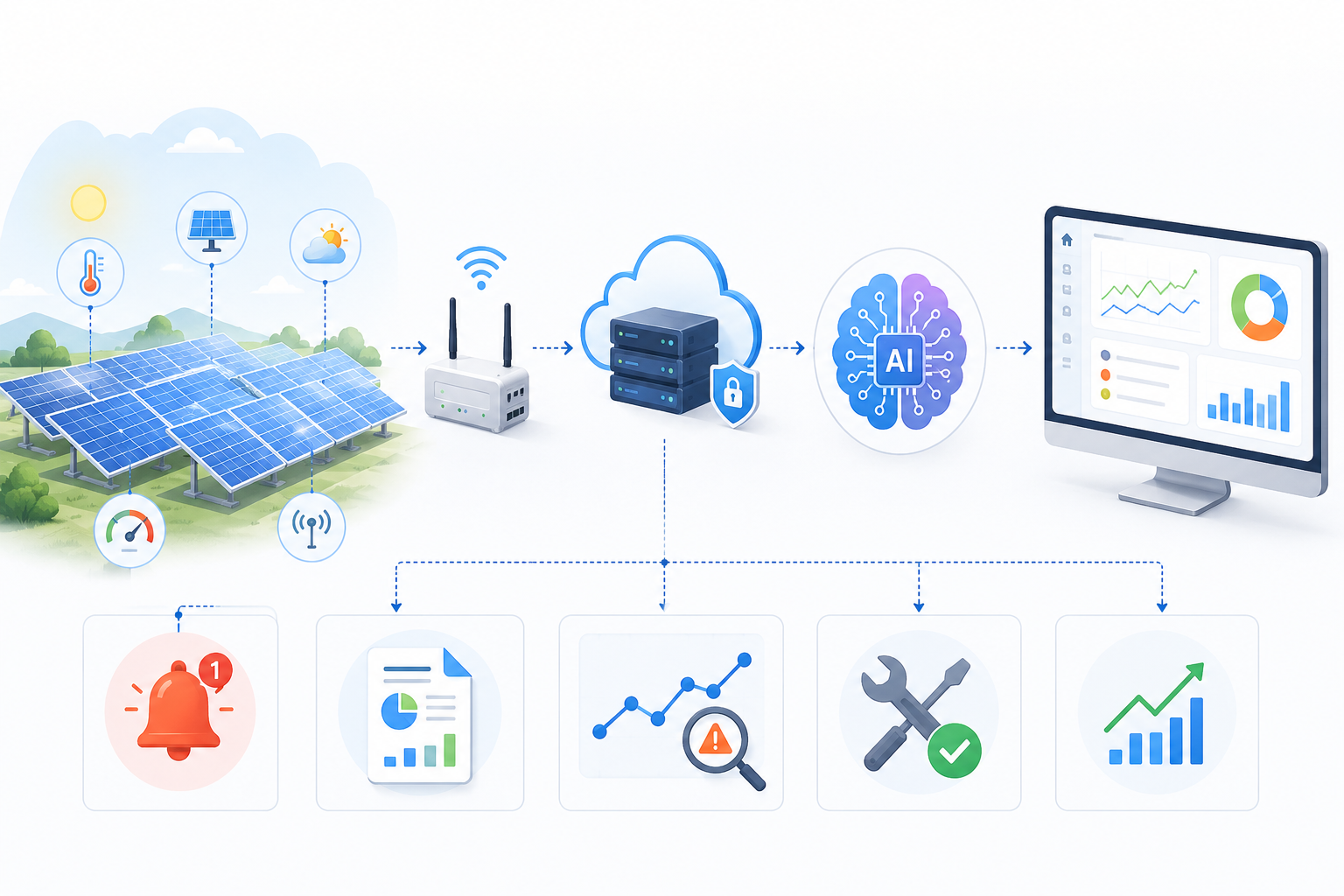
A practical workflow starts when the telematics gateway receives a diagnostic event. The system validates the vehicle identifier, timestamp and source. It groups related events, checks whether the warning is still active and looks for an existing maintenance case.
Next, a rules engine assigns a preliminary category. Safety-critical conditions should follow the fleet's established escalation procedure. Less urgent conditions may be reviewed against manufacturer guidance and the vehicle's service history. Predictive fleet maintenance can add statistical risk estimates where there is enough suitable historical data, but prediction should support inspection decisions rather than certify that the vehicle is safe.
The application then creates a review task with the fault details, recent operating history and any related inspection notes. A qualified employee decides whether the vehicle needs immediate assessment, a workshop booking or continued monitoring under an approved policy. If work is authorized, the system records the decision and links it to a service order.
This is where IoT application development services in Houston can have practical value: integrating devices, alerts and maintenance workflows into one controlled application rather than adding another isolated feed.
Prevent notification overload
A fleet manager cannot act on a stream of identical alerts from the same vehicle. The platform should distinguish a new fault, a repeated observation and a worsening condition. That requires rules for event grouping, hysteresis where appropriate and an explicit record of acknowledgement.
Diagnostic trouble code monitoring should preserve the original event history even when a screen collapses duplicate messages. Otherwise a technician may miss a fault that began occasionally and became persistent. Do not suppress a safety alert solely because a similar event was previously acknowledged.
Alert rules should also consider transmission gaps. If a cellular connection drops outside the city, the next upload may contain older messages. The application must show event time separately from upload time to avoid presenting delayed information as an incident happening now.
Operators running across Houston, its industrial corridors and more remote Texas routes should build around variable connectivity. Local buffering in the telematics unit, secure retransmission and clear data freshness indicators are more valuable than promising uninterrupted live monitoring.
Make the service record the source of truth
Maintenance information often lives in workshop software, a fleet-management system or a spreadsheet. A connected solution should link to whichever system actually records inspections, parts usage, repair completion and vehicle release. If the dashboard says a fault is resolved but the workshop has not closed the repair, the two systems need reconciliation.
A properly designed vehicle maintenance dashboard answers specific questions: Which vehicles need review? What evidence supports the warning? Who owns the case? Is a repair scheduled? Has an authorized person released the vehicle? It should not replace those answers with one opaque “health score.”
Vehicle data becomes more useful when fleet operators can connect diagnostic alerts with maintenance planning. For example, engine fault codes, mileage, operating hours and temperature readings can help maintenance teams identify vehicles that require attention. The US Department of Energy explains how telematics systems support vehicle maintenance through fault monitoring, engine condition tracking and scheduled service alerts. For Houston fleet operators, integrating this information into a connected fleet platform can help maintenance teams prioritize inspections and plan servicing based on actual vehicle usage.
Consider record design early. Keep the vehicle ID, maintenance event, person making the decision, linked evidence and completion date together. Store a clear status history so supervisors can see whether a vehicle was held, repaired or returned to service.
Put data quality ahead of complicated predictions
Data gaps are common. Telematics hardware may be installed inconsistently, driver inspection records may use different vehicle names and repair descriptions may lack standardized codes. Predictive models trained on that information can produce convincing but unreliable outputs.
Start with an equipment master record. Connect each telematics device to one vehicle and track replacements. Normalize units and time zones, flag missing values and record configuration changes. Use a repair taxonomy that maintenance staff understand. Fleet data integration becomes easier to trust when mechanics can trace each dashboard finding back to a real source.
Once that foundation is stable, compare model recommendations with actual workshop findings. Track false alarms, overlooked defects and recommendations that technicians repeatedly reject. Review outcomes by vehicle class and duty cycle; a rule tuned to a delivery van should not automatically govern a heavy truck or industrial service vehicle.
For organizations considering custom logistics software, the first priority should be a dependable event-to-case workflow. Advanced prediction can follow when data quality and operational ownership are strong enough to support it.
Keep dispatch and maintenance decisions distinct
Dispatchers need to know whether a vehicle is available, but they should not edit diagnostic findings or certify safety. Maintenance supervisors need the full technical record, while drivers need a simple way to report a symptom and view the next instruction. Role-based screens reduce confusion.
Secure device credentials, encryption and access logs are essential when platforms connect vehicle locations, driver assignments and commercial routes. Fleet monitoring software should limit who can see precise location history and define how long it is retained. Third-party integrations need documented permissions and a way to revoke access.
A shared integration layer based on IoT and BLE consulting and development can connect supported gateways with web or mobile apps. Bluetooth Low Energy may serve nearby accessories, while cellular connectivity typically supports off-site vehicle reporting. The communication method should match the equipment, not be selected because it sounds modern.
Frequently asked questions
Can fleet telematics predict breakdowns?
It can identify patterns associated with elevated maintenance risk when suitable data exists. It cannot guarantee that a vehicle will not fail, and technician inspection remains important.
Do all commercial trucks provide the same diagnostic data?
No. Available signals depend on the vehicle, controller, diagnostic protocol and telematics integration. The software should clearly show unsupported fields rather than invent values.
Can a fleet platform automatically take a vehicle out of service?
It can flag conditions and apply an organization's approved dispatch restrictions, but safety decisions must follow applicable rules and qualified review. Automatic status changes need careful controls.
What should be measured after deployment?
Review alert usefulness, time to acknowledge defects, duplicate cases, completed inspections, unplanned workshop visits and whether service records match the actual vehicle status.
Putting the information to work
Connected fleet maintenance is most useful when diagnostic events reach the right people with enough context for a sound decision.
Theta Technolabs develops custom connected fleet management solutions using IoT, MQTT, secure API integrations and cloud-based monitoring dashboards to help Houston fleet operators monitor vehicle conditions, manage maintenance alerts and coordinate service schedules. To discuss your fleet monitoring and maintenance software requirements, contact us at sales@thetatechnolabs.com.





_How%20Cloud%20Solutions%20Are%20Enhancing%20Remote%20Patient%20Monitoring%20in%20Healthcare_Q4_25.jpg)
_Streamlining%20Appointment%20Scheduling%20with%20Cloud%20Computing%20in%20Dallas%20Healthcare_Q4_25.jpg)
_The%20Impact%20of%20Cross-Platform%20Apps%20on%20Real%20Estate%20Market%20Trends%20in%20Dallas_Q3_24-1.jpg)
_How%20AI%20is%20Enhancing%20Construction%20Site%20Surveillance%20and%20Security%20in%20Dallas_Q3_24-1.jpg)
_Web%20Apps%20for%20Retail%20and%20eCommerce_%20Streamlining%20Operations%20and%20Reducing%20Costs_Q3_24.jpg)
_Enhancing%20Driver%20Safety%20and%20Compliance%20with%20Web%20Apps%20in%20the%20Logistics%20Sector_Q3_24.jpg)


_Integrating%20Chatbots%20Into%20Your%20Application.jpg)
_How%20much%20does%20it%20cost%20to%20create%20an%20android%20app%20in%202024%20for%20Startups_%20A%20detailed%20guide_Q2_24.jpg)
_Key%20Trends%20in%20Healthcare%20Software%20Development%20for%20the%20Future_Q2_24.jpg)
_Best%20iOS%20App%20Development%20Company_%20Enhancing%20User%20Engagement%20with%20Push%20Notifications_Q2_24.jpg)
_Chatbots%20for%20Event%20Management%20and%20Hospitality%20Services_Q1_24.jpg)
_Choosing%20the%20Right%20App%20Development%20Company_%20A%20Comprehensive%20Guide_Q1_24.jpg)