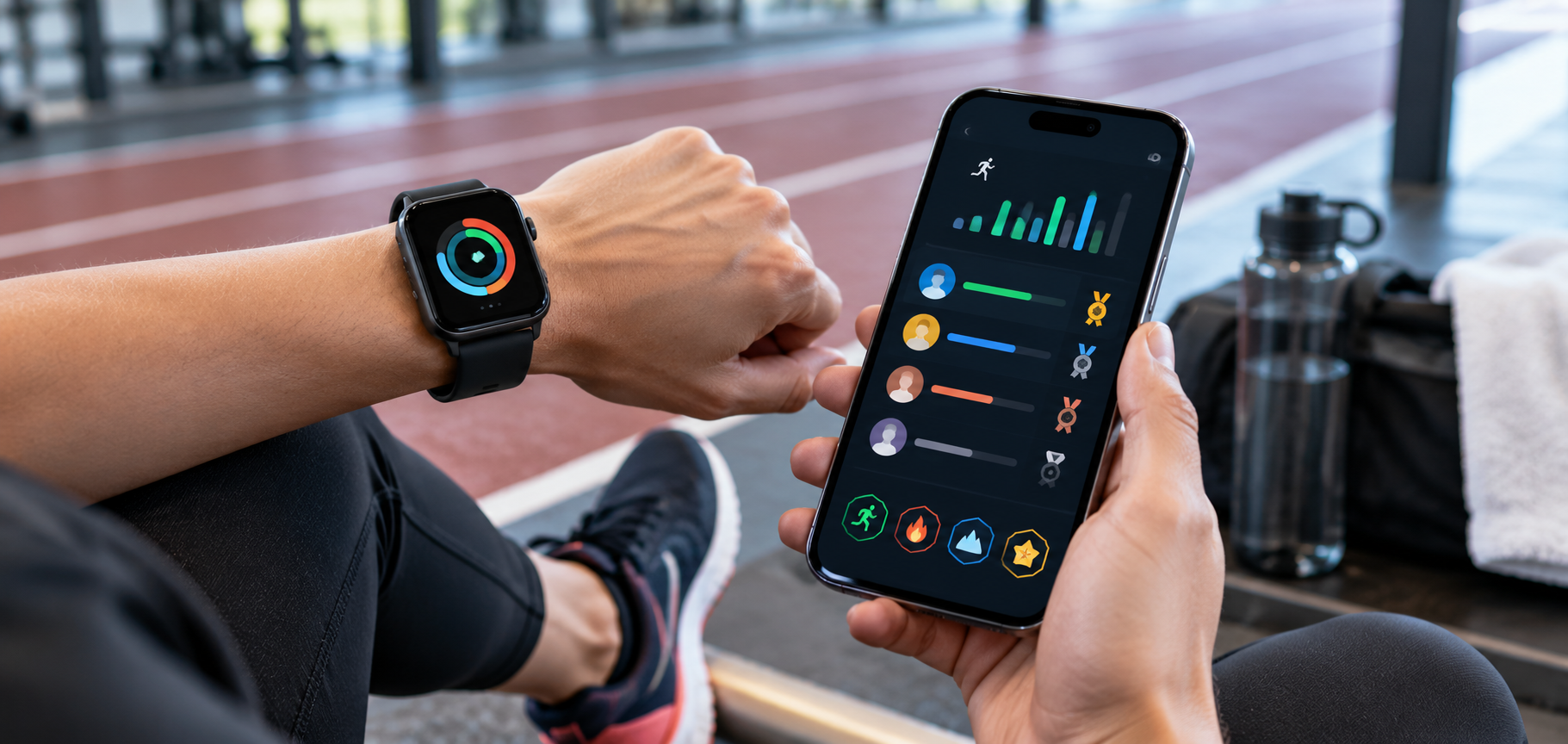


A fitness challenge can bring together people who record activity through different watches, phones, and fitness apps. But collecting step counts is only the beginning. To run a credible competition, the software must know which records belong to each participant, which activities qualify, when a challenge starts and ends, and how corrections affect the score.
Wearable fitness challenge app development therefore involves device connectivity, data processing, competition rules, and participant-facing features. A useful fitness gamification platform turns permitted activity information into understandable progress without assuming every device reports identically. Here is how to develop the main components and test them as a connected system.
Define Challenge Rules Before Building the Platform
Choose the activities and challenge formats
Begin with the kind of experience the product is meant to offer. A walking group may need daily step goals and a shared ranking. A workplace wellness program may prefer team participation and individual progress against personal goals. A running community may use distance or completed workouts instead of raw steps.
For step challenge app development, define the eligible data type, supported devices, and challenge period before deciding how screens will look. Specify whether manual entries count, whether indoor activity is included, and how participants are notified of the rules. A challenge based on steps should not silently award equivalent scores for cycling or other activities that use different measurements.
Agree on participation and scoring rules
Decide who can join, how teams are formed, which timezone defines the challenge deadline, and how ties are handled. A leaderboard based on total steps rewards a different outcome from one based on meeting a personal target. Neither approach is automatically fairer for every audience.
Define these rules in a challenge configuration rather than burying them inside the mobile app. That allows authorized organizers to change formats without changing the logic for past competitions.
Connect Wearable Activity Data to the Fitness Application
Use the supported mobile health data platforms
Apple HealthKit integration can allow an authorized iPhone application to read supported activity records that the user has permitted it to access. An Apple Watch may contribute records through Apple's health ecosystem, but the application must still request the appropriate permissions and handle unavailable data. Permission to read one category does not mean unrestricted access to the user's other health information.
On Android, Health Connect integration provides access to supported activity records through a consistent interface on eligible devices. Apps must request relevant permissions. The fitness platform should check device and API availability and explain what participants can do when their activity source is not supported.
Decide when direct device connections are needed
Some products receive activity through health platforms; others integrate manufacturer APIs or talk to compatible hardware directly. Wearable app integration through Bluetooth Low Energy (BLE) can be appropriate for a supported custom tracker, but BLE data characteristics and pairing behavior depend on the device. Direct access to a watch's sensors cannot be assumed simply because it uses Bluetooth.
Direct wearable connections may require BLE development services to handle device pairing, sensor data exchange, and connection reliability. For a consumer challenge app, health-platform integration may require less device-specific work when participants use different established wearable brands.
Validate and Synchronize Activity Data Before Calculating Scores
Handle overlap, late arrivals and missing records
Reliable activity data synchronization needs a consistent policy for source records. A participant may carry a phone while wearing a watch. Adding every raw step record from both devices could count the same movement more than once. Some health ecosystems offer their own aggregation and source-priority handling.
For example, Google's official Health Connect integration guide explains its standardized health-data access and permission model. For cumulative step totals, Android guidance recommends aggregation rather than naively summing raw records. The challenge application should use the platform's supported aggregation where appropriate, then apply its own eligibility and scoring rules to the result.
Store enough provenance to explain a score, such as source, activity type, covered period, sync time, and record identifier where available. Do not equate a missing update with inactivity. A watch may be offline, an app may not have synced, or the user may have disabled a permission.
Support permission changes and data corrections
Participants can change access permissions and may edit or delete records in a health app. The challenge system needs to respond when authorized data is revised, rather than permanently treating its first calculated total as correct.
Build a sync status that distinguishes updated, pending, and unavailable data. Explain how the product handles withdrawal of permission, including whether previous challenge records are retained under the stated privacy policy or removed when requested. Never attempt to recover access after a participant has revoked it.
Build the Fitness Challenge Scoring Engine
Turn eligible activity into progress
The fitness challenge scoring engine should run on defined server-side rules or a similarly controlled service, not depend solely on totals displayed on a participant's phone. The basic sequence is: obtain authorized activity, validate the time and source, determine challenge eligibility, calculate the result, and update progress.
Suppose the challenge is based on daily steps. The engine checks activity within the relevant local challenge day and applies the approved method for calculating the step total. If the competition uses distance instead, it works from an appropriate distance measure. A workout-completion challenge may depend on qualifying session types and duration. These are separate scoring policies, not interchangeable measurements.
Keep a record of which rule version produced each score. This helps when an organizer changes the criteria for a future competition and needs previous results to remain understandable.
Calculate team results and corrected totals
For team competitions, decide whether the ranking uses combined totals, averages, or another clearly disclosed calculation. Consider how late joiners and members who leave affect a team's score. Without a documented policy, participants can see apparently inconsistent standings even when the software is operating as programmed.
Late-arriving or corrected records may require recalculation. The backend should update affected participant totals, recompute team results, and refresh ranking data without blindly adding the same activity again. Set a published finalization policy so everyone knows how long valid delayed records may alter the results.
Develop Leaderboards, Badges and Gamification Features
Show rankings with a clear update status
A fitness leaderboard system should display the challenge period, scoring measure, current rank, and last update status. If activity is still syncing, label the ranking as provisional. Tie handling should follow a rule defined before the competition begins, rather than one invented after results arrive.
A backend can maintain calculated standings and serve them to mobile clients through APIs. Frequently opened leaderboards may benefit from caching, but cached results need a refresh or invalidation strategy when scores change. The app should avoid showing a cached score as freshly verified.
Award badges for defined achievements
Useful gamification rewards and badges can recognize personal milestones, challenge completion, steady participation, or team achievements. A badge should follow a specific rule, such as reaching a personal weekly activity goal, rather than an opaque calculation participants cannot explain.
Notifications can remind people of upcoming challenge deadlines or completed achievements, subject to their preferences. Avoid designs that pressure users to exercise through pain or expose private fitness details to colleagues. Features such as milestones, team goals, and achievement badges are common in gamified fitness apps, but they still need clear scoring rules and reliable activity data.
Protect Participant Data and Support Fair Challenges
Wearable data privacy should be designed into the application from the beginning. Ask for only the activity categories needed for the selected challenge, explain how information is processed, and protect it in transit and in storage. Organizers usually need challenge totals and participation status, not each person's detailed health history.
Let users control whether their display name or ranking is visible to a wider group. Consider private participation, accessible challenge types, and personal-goal formats for people with different abilities. Participation should not depend on sharing information unrelated to the activity being scored.
Fairness also involves explaining device differences. Step algorithms, workout classifications, and synchronization intervals vary. A platform can apply consistent rules to the information it receives, but it cannot guarantee identical underlying measurements across every device. Provide a review route for disputed records without publicly accusing participants of cheating.
Test the Platform Across Devices and Challenge Scenarios
A cross-platform fitness app needs testing across supported iOS and Android versions, permission configurations, device sources, and interrupted connections. Test scores before and after activity corrections, across midnight and timezone changes, and when a participant leaves a challenge. Validate what organizers and participants can see about each other.
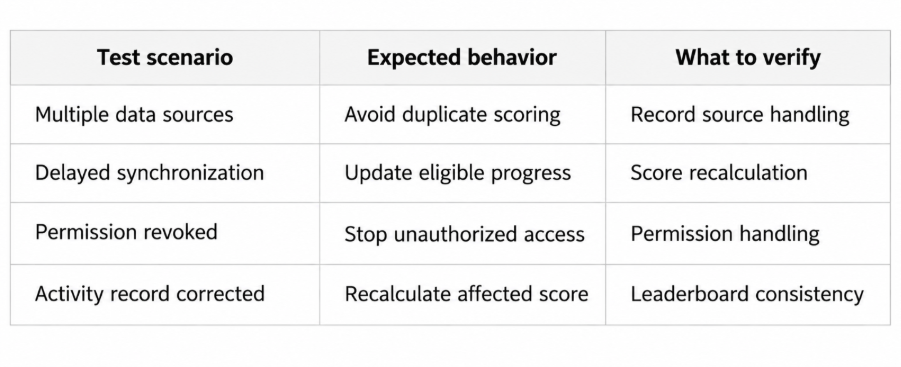
The mobile interface and scoring backend should be tested together. Cross-platform app development can share interface and business logic, but native health-data access still requires platform-specific permissions and integration testing.
Frequently Asked Questions
1. How does a wearable fitness challenge app collect activity data from smartwatches?
A wearable fitness challenge app can access supported activity data through Apple HealthKit, Android Health Connect, manufacturer APIs, or compatible Bluetooth Low Energy connections. The integration method depends on the device and platform. Users must grant the required permissions before the application can access protected activity information.
2. Can users with different wearable brands participate in the same fitness challenge?
Yes, a fitness platform can support participants using different wearable brands when compatible data integrations are available. The application needs to normalize supported activity measurements and apply consistent challenge rules. However, differences in device algorithms, available data types, and synchronization behavior mean that measurements are not guaranteed to be identical across devices.
3. How can a fitness challenge platform prevent duplicate step counts?
The platform should identify overlapping activity sources and use supported data aggregation methods where appropriate. For example, Android Health Connect provides aggregation capabilities for step data. Developers must also define rules for source selection, eligible activity periods, and repeated synchronization so that the same qualifying activity is not added to a challenge score multiple times.
4. How are scores and leaderboards calculated in a fitness gamification platform?
A scoring engine processes eligible activity records according to the challenge rules. Scores may be based on steps, distance, completed workouts, personal goals, or team achievements. The platform then calculates rankings using the defined scoring method. Delayed or corrected activity records may require score recalculation and leaderboard updates.
5. What happens when a user revokes wearable activity data permissions?
When a participant revokes access, the application must stop accessing data covered by that permission. The platform should update its synchronization status and explain how participation may be affected. Previously collected data must be handled according to the applicable privacy requirements, disclosed retention policy, and any valid deletion requests.
Developing Wearable Fitness Platforms with Theta Technolabs
A useful fitness challenge product begins with defined rules, supported activity sources, and a transparent scoring process. Development then brings those requirements into the wearable integration layer, backend APIs, challenge engine, mobile experience, and testing workflow.
Theta Technolabs works with BLE, Flutter, and cloud-based backend services for connected mobile applications where those technologies suit the requirements. The result should be a platform whose scores, participation rules, and privacy choices can be understood by the people using it.
For a wearable fitness development discussion, contact us at sales@thetatechnolabs.com.


_How%20Cloud%20Solutions%20Are%20Enhancing%20Remote%20Patient%20Monitoring%20in%20Healthcare_Q4_25.jpg)
_Streamlining%20Appointment%20Scheduling%20with%20Cloud%20Computing%20in%20Dallas%20Healthcare_Q4_25.jpg)
_The%20Impact%20of%20Cross-Platform%20Apps%20on%20Real%20Estate%20Market%20Trends%20in%20Dallas_Q3_24-1.jpg)
_How%20AI%20is%20Enhancing%20Construction%20Site%20Surveillance%20and%20Security%20in%20Dallas_Q3_24-1.jpg)
_Web%20Apps%20for%20Retail%20and%20eCommerce_%20Streamlining%20Operations%20and%20Reducing%20Costs_Q3_24.jpg)
_Enhancing%20Driver%20Safety%20and%20Compliance%20with%20Web%20Apps%20in%20the%20Logistics%20Sector_Q3_24.jpg)


_Integrating%20Chatbots%20Into%20Your%20Application.jpg)
_How%20much%20does%20it%20cost%20to%20create%20an%20android%20app%20in%202024%20for%20Startups_%20A%20detailed%20guide_Q2_24.jpg)
_Key%20Trends%20in%20Healthcare%20Software%20Development%20for%20the%20Future_Q2_24.jpg)
_Best%20iOS%20App%20Development%20Company_%20Enhancing%20User%20Engagement%20with%20Push%20Notifications_Q2_24.jpg)
_Chatbots%20for%20Event%20Management%20and%20Hospitality%20Services_Q1_24.jpg)
_Choosing%20the%20Right%20App%20Development%20Company_%20A%20Comprehensive%20Guide_Q1_24.jpg)