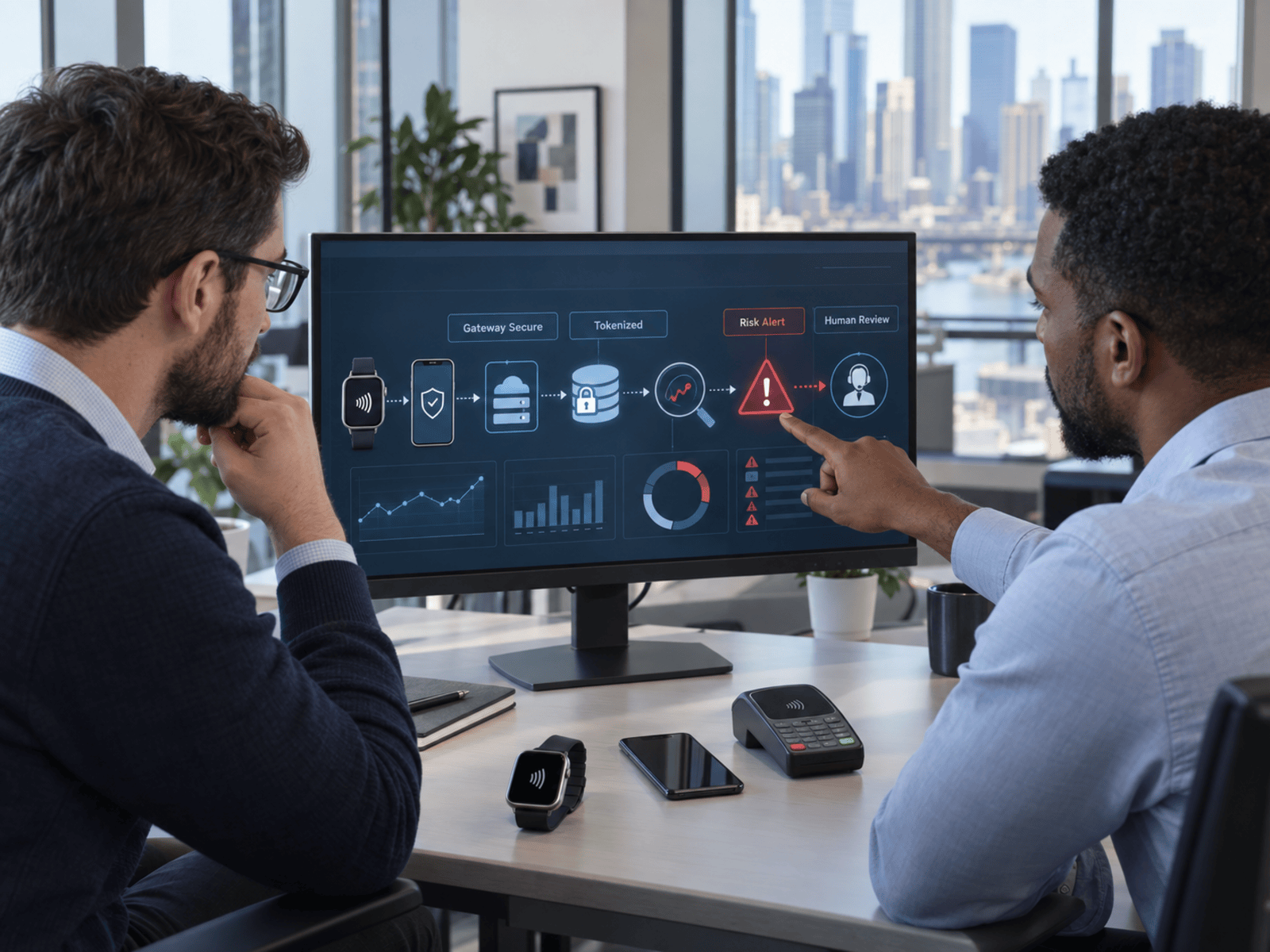


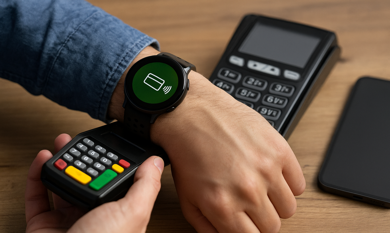
Wearable payments have quietly become routine. A smartwatch tap at checkout, a payment ring at a transit gate, a fitness band settling a coffee order, none of it feels remarkable anymore. But every one of those taps adds a fraud surface that most fintech teams haven't fully mapped, and the pace of adoption is outrunning the pace at which security thinking has caught up.
This piece focuses on how contactless payment fraud actually happens in wearable transactions, and what prevention controls genuinely work, not the underlying Bluetooth architecture that moves data between a wearable and its paired device. If you're looking for that deeper technical layer, our earlier post on securing wearable payment apps and BLE biometrics covers it in detail. What follows here is about catching and stopping fraud once a transaction is already in motion.
How Fraud Actually Happens in Contactless and Wearable Transactions
Fraud in this space rarely looks like a dramatic hack. It's usually opportunistic and mundane. A lost or stolen wearable that hasn't been remotely deactivated can be tapped at a terminal before the owner even notices it's missing. On legacy terminals or non-EMV fallback modes, relay attacks can still extend the effective range of a contactless signal, letting an attacker attempt a transaction from a device that was never physically near the terminal. On modern EMV-tokenized wearable stacks, distance-bounding checks and dynamic cryptograms make this far harder to pull off, but poorly configured offline processing or outdated terminal software can still reopen that gap.
None of this is exotic. Industry groups working on payment security standards have long emphasized that protecting wearable payment security depends on multiple layers working together: device-level protections, network validation, and issuer-side checks, rather than any single safeguard carrying the full load. According to guidance published by the Secure Technology Alliance, contactless payment protection has always relied on combining several independent measures rather than one dominant control. That layered thinking matters even more for wearables than for cards, simply because a watch or a ring gets far less user attention than a wallet. People notice a missing wallet within minutes. A missing smartwatch might not register for hours.
Why Mobile Gateways Are the Real Fraud Control Point
A lot of security conversations stop at the wearable and the card network, as if fraud is either stopped at the point of tap or not stopped at all. In practice, the mobile gateway security layer, the app and backend infrastructure sitting between the wearable and the payment processor, is where most fraud actually gets caught, because it's the only layer with full context. It knows the device's transaction history, its typical location patterns, how often it's been re-paired, and whether a given transaction fits the account's normal behavior.
This is also where connected-device architecture matters. A gateway that only relays device telemetry and encrypted transaction tokens forward, without inspecting device pairing events or transaction velocity, is leaving fraud signals on the table before they ever reach a detection model. Building that gateway layer correctly is core to the IoT app development company work we deliver for connected-device products, where telemetry has to be captured cleanly enough for fraud logic further up the stack to actually use it. Behavioral biometrics fraud signals, how a device is worn, moved, and tapped, only become useful once the gateway is set up to pass that context along instead of discarding it.
AI and Real-Time Behavioral Detection
Static, rule-based fraud checks, flagging any transaction over a fixed dollar amount or blocking anything from an unrecognized merchant category, were built for card-present fraud and don't hold up well against wearable-specific patterns. AI fraud detection fintech systems work differently. They build a behavioral baseline per device and account, then flag deviations from that baseline rather than deviations from a fixed rule.
What makes wearable tap-to-pay fraud detection different from card fraud detection? A card can be swiped by anyone who has it. A wearable is usually worn continuously by one person, which means its transaction pattern is tighter and more predictable: similar commute stops, consistent transaction sizes, familiar time-of-day patterns. That tighter baseline actually makes anomalies easier to spot, but only if the detection model is built around wearable-specific behavior instead of reused card-fraud logic.
Real-time transaction monitoring is what makes this actionable rather than theoretical. A model that flags fraud a day later, after the funds have already cleared, isn't much of a defense. The harder, less-discussed problem is false positives. A detection system that blocks too aggressively creates friction that pushes legitimate users away from contactless payments altogether. Reducing false positives while still catching genuine fraud is usually the real engineering challenge, more than building the detection model itself. Tokenization payment data at the point of authorization remains a baseline requirement underneath all of this. Detection catches what tokenization doesn't prevent outright.
Practical Fraud-Prevention Checklist for Fintech Teams
For teams building or hardening this stack, a few practices consistently make the biggest difference:
- Tokenize early and often. Replace raw payment credentials with tokens as close to the point of transaction as possible, not somewhere further up the pipeline.
- Monitor device pairing anomalies. A sudden re-pairing event or a new device claiming an existing account is often a stronger fraud signal than the transaction amount itself.
- Apply velocity limits per device, not just per account, since a compromised wearable often shows unusual transaction frequency before unusual transaction size.
- Keep gateway-side logging separate from app-side logging. If both layers log identically, a compromise at one level can obscure fraud signals that would otherwise show up in the other.
- Tune models specifically to balance fraud-catch rate against false-positive rate, treating authorization friction as its own deliberate metric rather than a side effect of tightening fraud rules.
Getting this right is something mobile app development company teams in the USA increasingly need to think through at the architecture stage, not retrofit after a fraud incident forces the issue. Our mobile app development work builds this kind of fraud-aware gateway logic in from the start rather than bolting it on later.
Why Location and Local Context Matter
Cities with dense, high-frequency contactless adoption raise the stakes on getting this right. Chicago is a good example. Transit, retail, and food service all lean heavily on tap-to-pay, which means transaction volume per device is high and the window for catching anomalous behavior is short. Fintech teams operating in markets like this benefit from detection systems tuned to real transaction density rather than assumptions built on lower-volume test data.
As an AI development company in Chicago businesses turn to for this kind of work, we build detection logic that holds up under real transaction volume, not just clean lab conditions.
Frequently Asked Questions
Is wearable payment fraud more common than card fraud?
Not inherently. Wearables actually tend to produce tighter, more predictable transaction patterns than cards, which can make anomalies easier to catch, but only if the detection system is tuned for that pattern rather than reused from card-fraud rules.
Can AI fully replace manual fraud review?
No. AI models are strong at flagging anomalies at scale, but edge cases and disputed transactions still benefit from human review, particularly where false positives carry real customer friction.
Does tokenization alone stop wearable fraud?
No. Tokenization protects stored and transmitted credentials, but it doesn't catch behavioral fraud signals like unusual velocity or device pairing anomalies. The two need to work together.
How does this differ from BLE-level security?
BLE security protects the connection between the wearable and its paired gateway device. Fraud prevention, as covered here, operates one layer up, at the transaction and behavioral level, after the BLE handoff has already happened.
Conclusion
Preventing fraud in contactless and wearable transactions isn't a single control. It's tokenization, gateway-level context, and real-time behavioral detection working together, with false-positive management treated as seriously as fraud-catch rate. Teams that build this as a layered system from the start tend to avoid the retrofit scramble that follows a real incident.
Let's Build This Right
Fraud prevention in wearable and contactless payments isn't something you bolt on after launch. It works best when it's part of the architecture from day one, alongside the mobile gateway, the tokenization flow, and the detection logic that watches transactions in real time. At Theta Technolabs, this is the kind of groundwork we like to be involved in early, whether you're building a new wearable payment product or hardening an existing one after a security review flagged gaps. The earlier this thinking gets involved, the less rework it takes later.
If your team is architecting fraud detection for a wearable or contactless payment product, we'd be glad to walk through the approach with you. Reach out to us at sales@thetatechnolabs.com, and let's talk through what a fraud-resistant gateway looks like for your specific product.













.png)
.png)






.png)
.png)
.png)
.png)


.png)
.png)
.png)
.png)

.png)








.png)





_How%20Cloud%20Solutions%20Are%20Enhancing%20Remote%20Patient%20Monitoring%20in%20Healthcare_Q4_25.jpg)
_Streamlining%20Appointment%20Scheduling%20with%20Cloud%20Computing%20in%20Dallas%20Healthcare_Q4_25.jpg)
_The%20Impact%20of%20Cross-Platform%20Apps%20on%20Real%20Estate%20Market%20Trends%20in%20Dallas_Q3_24-1.jpg)
_How%20AI%20is%20Enhancing%20Construction%20Site%20Surveillance%20and%20Security%20in%20Dallas_Q3_24-1.jpg)
_Web%20Apps%20for%20Retail%20and%20eCommerce_%20Streamlining%20Operations%20and%20Reducing%20Costs_Q3_24.jpg)
_Enhancing%20Driver%20Safety%20and%20Compliance%20with%20Web%20Apps%20in%20the%20Logistics%20Sector_Q3_24.jpg)


_Integrating%20Chatbots%20Into%20Your%20Application.jpg)
_How%20much%20does%20it%20cost%20to%20create%20an%20android%20app%20in%202024%20for%20Startups_%20A%20detailed%20guide_Q2_24.jpg)
_Key%20Trends%20in%20Healthcare%20Software%20Development%20for%20the%20Future_Q2_24.jpg)
_Best%20iOS%20App%20Development%20Company_%20Enhancing%20User%20Engagement%20with%20Push%20Notifications_Q2_24.jpg)
_Chatbots%20for%20Event%20Management%20and%20Hospitality%20Services_Q1_24.jpg)
_Choosing%20the%20Right%20App%20Development%20Company_%20A%20Comprehensive%20Guide_Q1_24.jpg)