

Los Angeles has a strong food manufacturing ecosystem, from beverage brands and packaged snack companies to frozen food producers, bakeries, co-packers, and private-label food businesses. In this environment, packaging quality is not only about appearance. It directly affects product safety, customer trust, retail acceptance, and brand reputation.
This is where AI-based packaging quality control is becoming more useful. By using AI and computer vision, manufacturers can inspect fill levels, labels, seals, printed codes, and visible packaging defects faster and more consistently than manual checks alone.
For Los Angeles food manufacturers, the real question is not simply whether AI sounds advanced. The important question is what this technology can actually check, how it works on a packaging line, where it fits best, and what should be reviewed before implementation.
What AI-Based Packaging Quality Control Means in Food Manufacturing
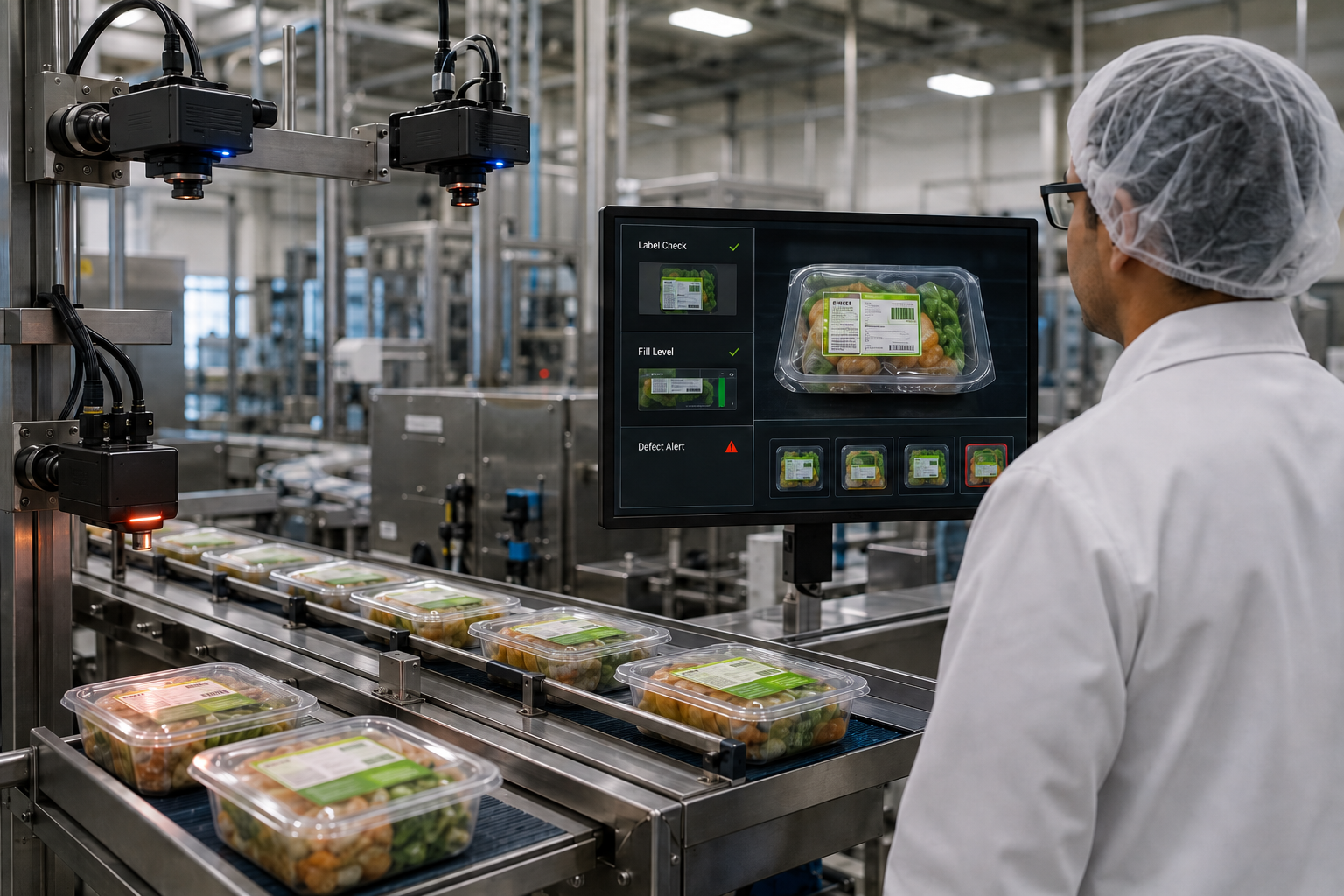
AI-based packaging quality control is a visual inspection method that uses cameras, computer vision models, OCR, and AI-based defect detection to check packaged food products on production lines. Instead of relying only on human inspectors to catch every packaging issue, the system captures product images and analyzes them against approved quality standards.
In food packaging quality control, this can help check whether a product is filled properly, labeled correctly, sealed safely, coded clearly, and visually acceptable before it moves further in the production or distribution process.
AI-based inspection can help monitor:
- Fill-level accuracy
- Label placement
- Product-label matching
- Barcode and QR code readability
- Expiry dates and batch codes
- Seal and cap condition
- Visible packaging defects
Computer vision for packaging inspection is especially useful when products move quickly across production lines. It does not remove the need for quality teams, but it gives them a stronger system for identifying repeated or hard-to-catch packaging problems.
Packaging Quality Challenges Los Angeles Food Manufacturers Should Know
For food manufacturers, packaging mistakes can create problems beyond simple rework. A wrong label, unreadable code, damaged seal, or inconsistent fill level can affect customer satisfaction, retailer confidence, and compliance risk.
Common packaging quality issues include:
- Underfilled or overfilled products
- Wrong or missing labels
- Damaged seals
- Loose caps
- Unreadable barcodes
- Incorrect expiry dates
- Missing batch codes
- Torn pouches or damaged containers
- Poor print quality
In a competitive market like Los Angeles, food and FMCG companies often need to serve retailers, distributors, restaurants, direct-to-consumer customers, and private-label partners. Packaging consistency becomes important because every product that leaves the facility represents the brand.
This is why many food manufacturers are exploring custom AI systems that can support stronger packaging defect detection and improve inspection visibility across production lines.
What AI Can Check on a Food Packaging Line
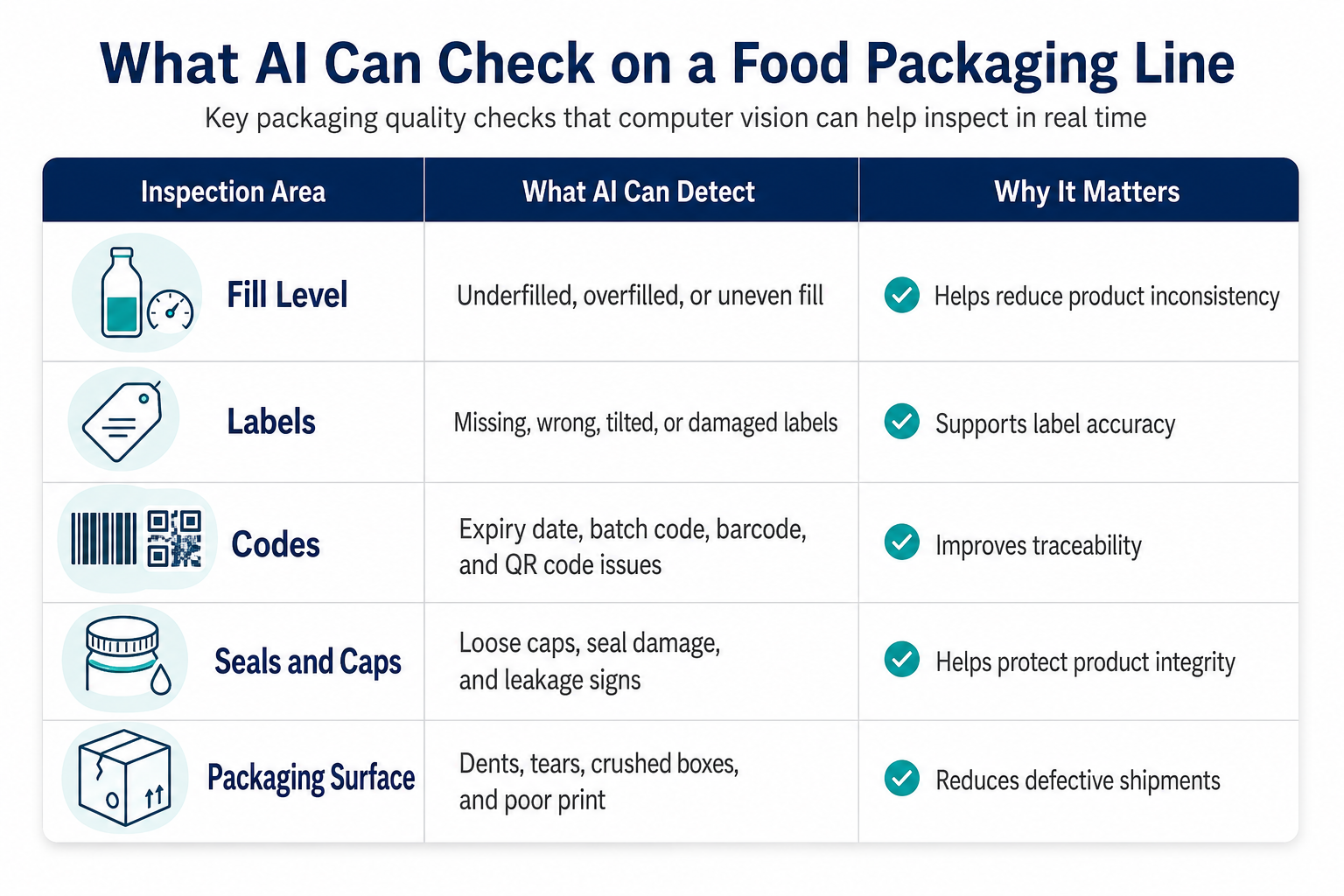
AI inspection is useful because it can focus on specific packaging risks instead of treating every product the same. For food manufacturers, the highest-value checks usually involve fill levels, labels, codes, seals, and visible package damage.
Fill-Level Accuracy
A fill-level inspection system can help identify underfilled, overfilled, or unevenly filled products in bottles, jars, cups, trays, and some pouch formats. This is useful for beverages, sauces, dairy products, ready meals, and similar packaged food items.
For example, a beverage manufacturer running a high-speed bottling line may use camera-based inspection after filling to flag bottles that appear underfilled or overfilled before they move to capping, labeling, or case packing.
The accuracy depends on packaging visibility, lighting, camera angle, and how well the AI model is trained.
Label Placement and Label Matching
A label validation system can check whether the right label is applied to the right product. It can also detect missing labels, tilted labels, damaged labels, unreadable barcodes, and mismatched product-label combinations.
Packaging Defects and Seal Issues
AI can support packaging defect detection by identifying visible issues such as torn pouches, crushed boxes, dented containers, poor print quality, cap problems, broken seals, and possible leakage signs.
How AI and Computer Vision Inspect Packaging in Real Time
AI packaging inspection works through a structured visual workflow. The goal is to detect packaging problems early, ideally before defective products reach case packing, shipment, or retail distribution.
A typical automated food packaging inspection process works like this:
- Cameras capture product images on the packaging line.
- Lighting helps make labels, seals, codes, and edges clearly visible.
- Computer vision models analyze each product image.
- OCR reads printed details such as expiry dates, batch codes, barcodes, or QR codes.
- The system compares the product with approved packaging standards.
- Defects are flagged for review, rejection, or operator action.
- Dashboards or connected systems show alerts, reports, and inspection records.
For Los Angeles food manufacturers, this type of workflow can often be designed around existing production lines. However, camera placement, lighting, line speed, and packaging format must be reviewed carefully before deployment.
Before choosing a computer vision solution, manufacturers should first identify the exact packaging checks they want to automate, such as label matching, fill-level inspection, barcode reading, or seal defect detection.
AI-Based Label Checks for Safer Food Packaging
Label validation is one of the most important parts of AI packaging inspection for food manufacturers. A food label carries product identity, ingredient information, allergen details, nutrition information, expiry details, batch numbers, and scannable codes.
The FDA mandates strict compliance for ingredient declarations on packaged foods and beverages, alongside distinct legal requirements for major food allergens. According to the official FDA Food Labeling Guide, missing or inaccurate labels represent immediate compliance failures, directly impacting consumer safety and product traceability.
A label validation system can help check:
- Product name and label match
- Ingredient and allergen text visibility
- Barcode and QR code readability
- Expiry date and batch code presence
- Nutrition label placement
- Missing, tilted, damaged, or mismatched labels
AI packaging inspection for food manufacturers should not be described as a guarantee of compliance. A better way to understand it is this: AI can support food packaging quality control by helping teams catch visible label issues earlier and create more consistent inspection workflows.
What Food Manufacturers Should Know Before Implementation
Before adopting automated food packaging inspection, food manufacturers should clearly define what problem they want to solve. A system designed for fill-level checks may need a different camera setup from a system built for label OCR or seal inspection.
Before implementation, manufacturers should review:
- Most common packaging defects
- Product and packaging formats
- Production line speed
- Camera placement options
- Lighting conditions
- Number of SKUs and label variations
- OCR needs for batch codes and expiry dates
- Dashboard and alert requirements
- ERP, MES, or PLC integration needs
- Edge or cloud deployment preference
- Pilot testing plan
This section is important because computer vision models work best when they are trained on real production conditions, not only ideal sample images. Reflective packaging, transparent containers, flexible pouches, changing labels, lighting shifts, and fast-moving products can all affect inspection accuracy.
A practical approach is to begin with one high-risk inspection point and run a controlled pilot using both acceptable products and real defective packaging samples from the production floor. Once the model is tested against actual packaging conditions, the system can be improved, scaled, and connected with dashboards, reports, alerts, ERP, MES, or PLC workflows.
Where AI Packaging Quality Control Works Best in Food Manufacturing
AI packaging inspection for food manufacturers is most useful in operations where packaging quality directly affects safety, shelf appeal, traceability, or retailer acceptance.
It can be useful for:
- Beverage bottling lines
- Sauce and condiment packaging
- Dairy cups and containers
- Frozen food trays
- Snack pouches
- Bakery packaging
- Ready-to-eat meal packaging
- Private-label food packaging
- Co-packing operations
It can be placed at different inspection points, depending on the production line:
- After filling
- After sealing
- After labeling
- Before case packing
- Before shipment
For example, a beverage manufacturer may use a fill-level inspection system after filling and before capping. A snack brand may focus more on seal quality, pouch damage, and label placement. A co-packer may need packaging defect detection across multiple SKUs and label formats.
For production plants across Los Angeles and Southern California, AI quality control systems should be planned around the real packaging environment, not a generic inspection template.
Conclusion
Los Angeles food manufacturers should know that computer vision for packaging inspection is not just about adding cameras to a production line. It requires clear inspection goals, good image data, proper lighting, suitable camera placement, AI model training, OCR where needed, dashboards, and integration planning.
When designed properly, it can support fill-level checks, label validation, seal inspection, code verification, and packaging defect detection. It can also help quality teams work with better visibility and more consistent inspection records.
For food and FMCG companies that deal with high-volume packaging, multiple SKUs, strict label requirements, and retail distribution pressure, AI quality control solutions in Los Angeles can become a practical step toward smarter packaging inspection.
Improve Food Packaging Quality With AI and Computer Vision
Theta Technolabs helps food manufacturers build custom AI and computer vision systems for packaging quality control. This can include visual defect detection, fill-level inspection, label validation, OCR for batch codes and expiry dates, real-time quality alerts, edge AI deployment, inspection dashboards, and integration with production-line systems.
If you are planning to improve packaging inspection with AI and computer vision, contact the team at sales@thetatechnolabs.com to discuss a custom solution for your production environment.
Frequently Asked Questions
1. Can AI-based packaging quality control detect wrong labels?
Yes. A properly trained label validation system can identify missing labels, wrong labels, label misalignment, unreadable barcodes, QR code issues, expiry date errors, and product-label mismatch.
2. Can computer vision check food package fill levels?
Yes. A fill-level inspection system can check visible fill levels in bottles, jars, trays, and some pouch formats. Accuracy depends on packaging transparency, camera angle, lighting, and model training.
3. Is AI packaging inspection useful for small and mid-sized food manufacturers?
Yes, especially when repeated packaging errors create waste, rework, customer complaints, or compliance risks. A pilot on one production line is often a practical starting point.
4. Does AI packaging inspection replace human quality teams?
No. Automated food packaging inspection supports quality teams by handling repetitive visual checks, flagging defects faster, and creating inspection records. Human teams still manage exceptions, audits, and process improvements.
5. What data is needed for AI-based packaging inspection?
Manufacturers usually need images or videos of acceptable and defective packaging, different SKUs, label types, lighting conditions, package shapes, and real defect examples.















.png)
.png)





.png)

.png)
.png)
.png)


.png)
.png)
.png)
.png)

.png)









.png)





_How%20Cloud%20Solutions%20Are%20Enhancing%20Remote%20Patient%20Monitoring%20in%20Healthcare_Q4_25.jpg)
_Streamlining%20Appointment%20Scheduling%20with%20Cloud%20Computing%20in%20Dallas%20Healthcare_Q4_25.jpg)
_The%20Impact%20of%20Cross-Platform%20Apps%20on%20Real%20Estate%20Market%20Trends%20in%20Dallas_Q3_24-1.jpg)
_How%20AI%20is%20Enhancing%20Construction%20Site%20Surveillance%20and%20Security%20in%20Dallas_Q3_24-1.jpg)
_Web%20Apps%20for%20Retail%20and%20eCommerce_%20Streamlining%20Operations%20and%20Reducing%20Costs_Q3_24.jpg)
_Enhancing%20Driver%20Safety%20and%20Compliance%20with%20Web%20Apps%20in%20the%20Logistics%20Sector_Q3_24.jpg)


_Integrating%20Chatbots%20Into%20Your%20Application.jpg)
_How%20much%20does%20it%20cost%20to%20create%20an%20android%20app%20in%202024%20for%20Startups_%20A%20detailed%20guide_Q2_24.jpg)
_Key%20Trends%20in%20Healthcare%20Software%20Development%20for%20the%20Future_Q2_24.jpg)
_Best%20iOS%20App%20Development%20Company_%20Enhancing%20User%20Engagement%20with%20Push%20Notifications_Q2_24.jpg)
_Chatbots%20for%20Event%20Management%20and%20Hospitality%20Services_Q1_24.jpg)
_Choosing%20the%20Right%20App%20Development%20Company_%20A%20Comprehensive%20Guide_Q1_24.jpg)