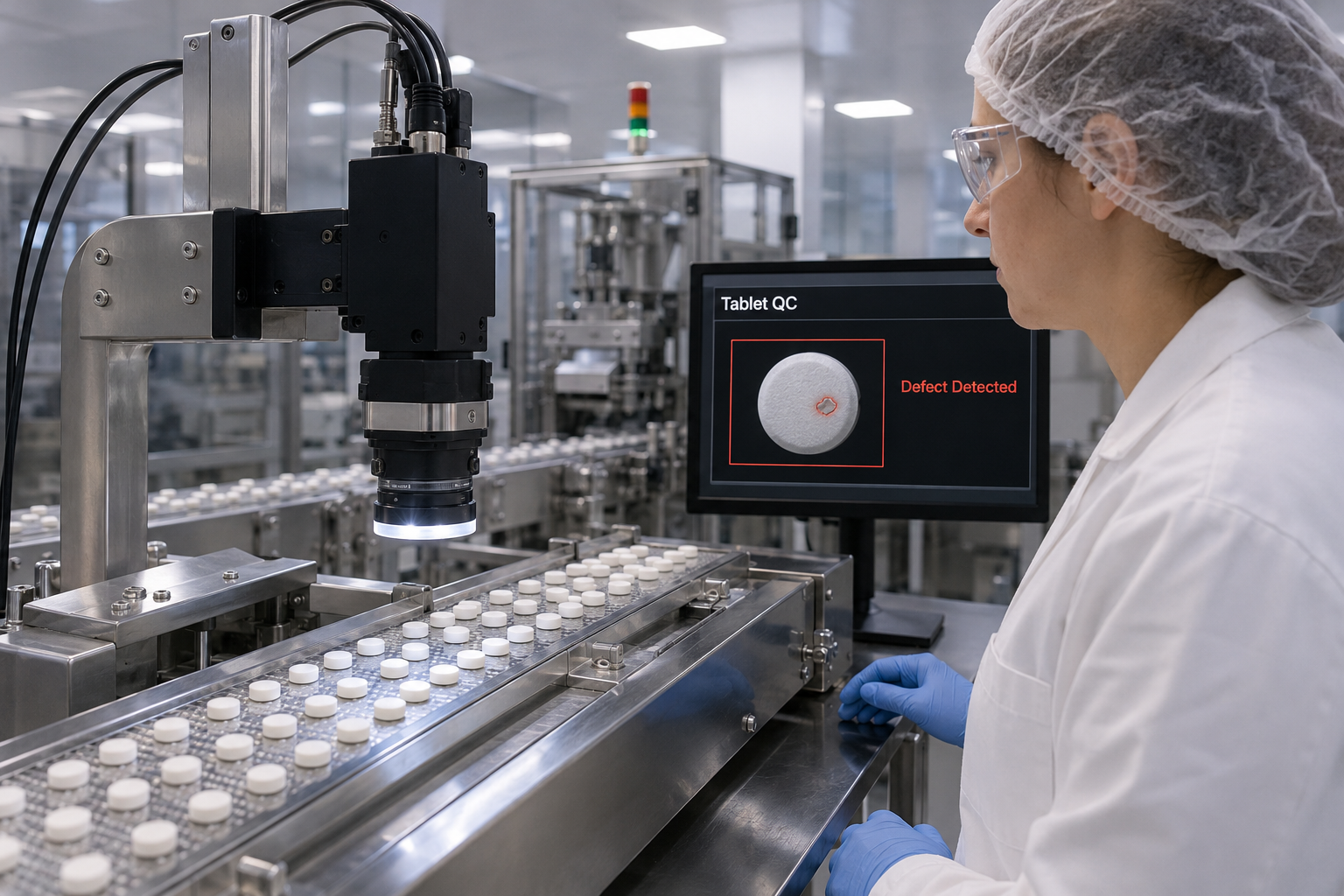


Picture a tablet line in a Houston plant running thousands of units an hour. A single tablet leaves the press with a hairline crack. The inspector, three hours into a shift, blinks at the wrong moment, and it moves on toward packaging. Most days nothing comes of it. Some days it becomes a customer complaint, a deviation, or the first thread in a recall. For pharmaceutical manufacturers, that thin margin between caught and missed is where reputation and compliance live. Computer vision tablet inspection is now a practical way to close that gap. This article explains how it works, where it fits on your line, and how it stays audit-ready.
The Real Cost of a Missed Tablet Defect
A defective tablet that reaches the market is rarely a small problem. By the time it surfaces, the damage has usually spread well beyond that one tablet. This lands especially hard for pharmaceutical manufacturing in Houston. The region has grown into a serious life-sciences and contract-manufacturing hub, and much of that work runs through CDMOs contract development and manufacturing organizations that make many different products for many clients rather than one blockbuster at scale. That high-mix, frequent-changeover reality leaves very little room for error, and even less for a quality miss that resurfaces in a client's audit and puts the next contract at risk.
Weak tablet defect detection usually shows up as:
- Rejected or held batches, and the lost yield that comes with them
- Recalls, and the liability and remediation that follow
- FDA observations during inspection, and the corrective burden they trigger
- Erosion of customer and prescriber trust that took years to build
None of this assumes a catastrophic failure. Even a steady trickle of small escapes — a chip here, a color variation there — adds up to scrapped batches, rework, and a quality record that looks shakier than it should. On a contract line, where a single client audit can decide whether a contract renews, that record is not a back-office detail; it is the business.
Why Manual and Older Inspection Methods Fall Short
For decades, tablet inspection leaned on human eyes and, later, on rule-based machine vision. Both have real limits. Human inspectors are skilled, but attention drifts over a long shift, and no two people judge a borderline defect quite the same way. Manual checks also cannot keep pace with a line producing thousands of tablets a minute.
Older automated visual inspection systems helped, but they were rigid. Rule-based systems have to be told in advance what every defect looks like, and they are easily thrown off when ambient lighting shifts, a tablet's coating varies from batch to batch, or a new product comes through. Their usual defense is to tighten thresholds and over-reject — and that is where the hidden cost lives. When a minor lighting or coating change pushes even a few percent of perfectly good tablets into the reject bin, a line running tens of thousands of units a shift is quietly scrapping hundreds, sometimes thousands, of sellable doses. Multiply that across frequent changeovers and the math turns ugly: the quality team ends up babysitting thresholds while yield walks out with the rejects. Fast, but brittle — and expensive in ways that never show up as a defect.
How Computer Vision Detects Tablet Defects
Modern computer vision takes a different approach. Instead of being told what every defect looks like, the system learns the difference between good and bad tablets from examples, which lets it handle the variation that breaks older setups.
The defect types it catches
A well-built vision system inspects each tablet's surface, edges, and shape in real time. It can flag:
- Chips, cracks, and broken or fragmented tablets
- Missing tablets in a blister pocket
- Color and coating variation
- Shape and dimensional deviations
- Surface contamination or foreign matter
How the models are trained
Behind that is imaging plus learning — the foundation of machine vision in pharmaceutical manufacturing. Multiple cameras and engineered lighting capture each tablet from several angles. Those images train deep learning models to recognize what a good tablet looks like and to spot the subtle deviations a fixed rule would miss. Over time, with more labeled examples, detection sharpens. This is where the underlying machine learning and deep learning services do the real work, turning a camera feed into a clear accept-or-reject call. Worth being clear, though: the model supports the quality team's judgment, it doesn't replace human accountability for product release.
Beyond the Tablet - Label and Lot Validation
Tablet quality is only half the problem. A correct tablet in the wrong package, or under a mislabeled lot, is still a defect — and often a more dangerous one. But these two checks do not happen at the same place on the line. Tablet surface, edge, and shape are inspected upstream, right after compression. Label, lot, and barcode validation happens downstream, at secondary packaging. Treating them as two disconnected machines is exactly where mix-ups slip through.
Using optical character recognition, label validation and OCR inspection covers:
- Label text and product identity
- Lot and batch numbers
- Expiration dates
- Barcode and DataMatrix readability
- Missing, skewed, or wrinkled labels
Treating tablet inspection and label checks as one quality system, rather than two separate steps, is where pharmaceutical quality control automation actually pays off. One pass, one record, fewer mix-ups.
Staying Compliant - Validation and FDA 21 CFR Part 11
For any system that touches product release, the first question a quality leader asks is whether it will survive an audit. It can, but only when it is treated as a validated system, not a gadget bolted onto the line.
That means qualifying it the way you qualify any critical equipment, through installation, operational, and performance qualification (IQ/OQ/PQ), and configuring it to produce the electronic records and audit trails regulators expect. The relevant standard is FDA 21 CFR Part 11, which sets the criteria under which electronic records and signatures are considered trustworthy and reliable. Computer vision for pharmaceutical quality control does not create a new rule here; it has to meet the one that already exists.
One point to be clear about: a vision system can support compliance, but it cannot guarantee it. The manufacturer remains accountable for validation, for maintaining the system in a validated state, and for the decisions made on its output. Any vendor who promises compliance in a box is overselling.
Buying a Box vs Building for Your Line
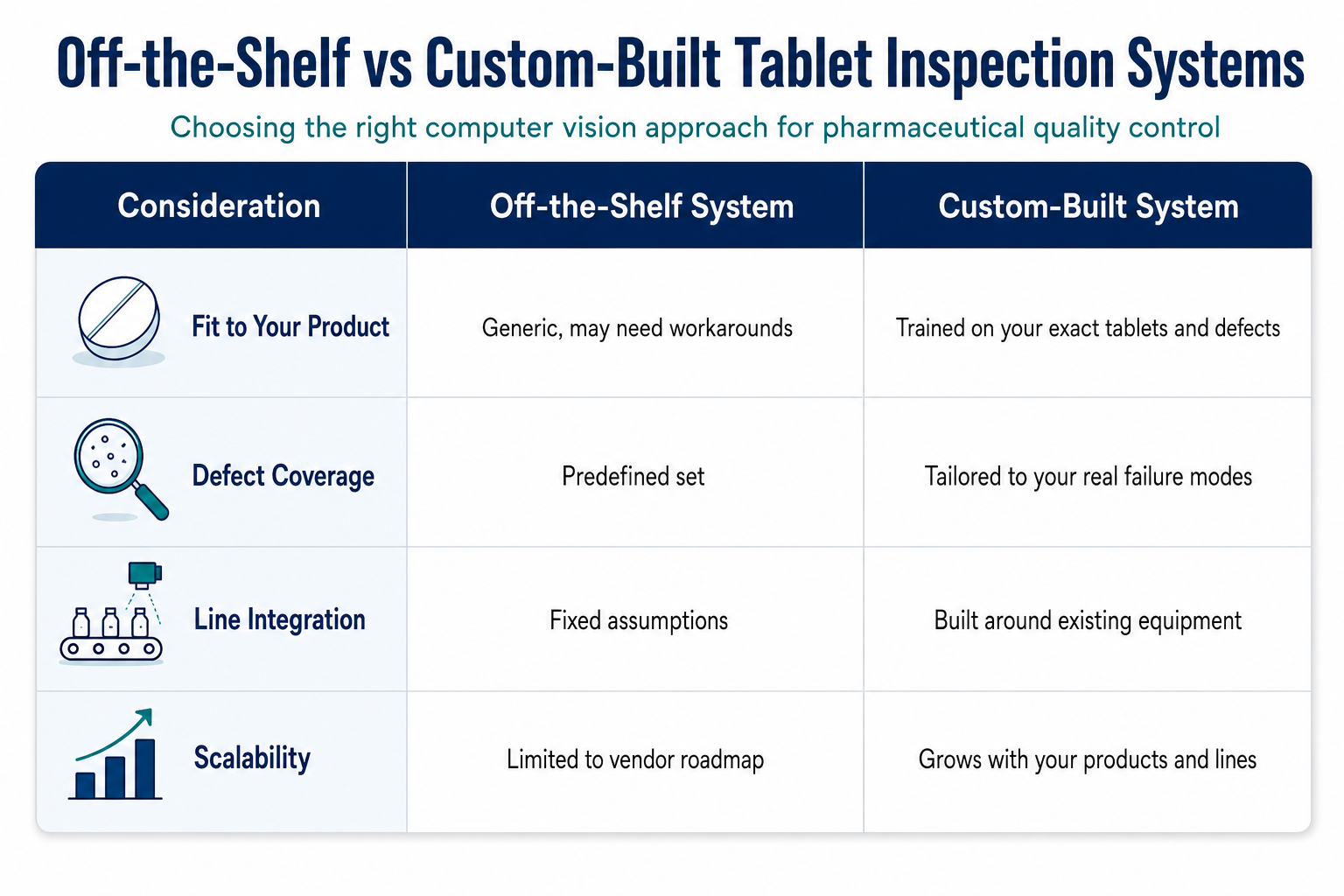
Off-the-shelf inspection systems have their place. For a common tablet, a standard format, and a well-understood defect set, a packaged system may be enough. The trouble starts when your product, your defects, or your line do not match what the box was designed for.
A custom-built system works the other way round. Instead of bending your line to fit the product, the model is trained on your tablets, your defect history, and your labels, and it integrates with the equipment you already run. This matters most on the high-mix CDMO lines common around Houston, where products change over constantly. A packaged system tuned for one tablet has to be re-tuned every time the format, coating, or imprint changes — and fights you at every changeover. A model built to be retrained on new products absorbs those changeovers instead, which is the difference between vision that slows your line down and vision that keeps up with it.
This is where experienced computer vision development services matter, and why fit with a partner who understands manufacturing software solutions often beats a faster, shallower deployment.
What Adoption Looks Like on a Houston Line
Bringing computer vision onto a working line does not mean tearing it apart. A sensible rollout moves in stages:
- Assess the line, the products, and the defect set you actually need to catch.
- Collect and label image data from your own tablets and labels.
- Train and test the model against that data.
- Run it alongside existing QC to compare results, not replace them overnight.
- Validate the system (IQ/OQ/PQ) and confirm the audit trail.
- Move to live inspection once it has earned the team's trust.
For pharmaceutical manufacturing in Houston, this phased path keeps production moving while the system proves itself, with real-time in-line inspection arriving as the last step, not a risky first one.
Frequently Asked Questions
1. Can computer vision inspect every tablet at full production speed?
Yes. Modern vision systems inspect 100% of units inline at line speed, checking each tablet individually rather than sampling. That level of coverage is something manual inspection simply cannot match on a high-volume line.
2. Will an AI inspection system pass an FDA audit?
It can, when it is validated through IQ/OQ/PQ and configured to meet 21 CFR Part 11 expectations for electronic records and audit trails. The system supports compliance; the manufacturer remains accountable for it.
3. Does computer vision over-reject good tablets the way older systems do?
Properly trained models reduce false rejects compared with rule-based systems, because they learn genuine defects instead of relying on rigid thresholds. That means less good product scrapped and less batch waste.
4. How long does setup take for our specific tablets and labels?
It depends on the range of defects and how much image data is available. A custom build typically progresses through data collection, training, validation, and then live use — staged rather than instant.
Catching Defects Before They Catch You
The question for a Houston pharmaceutical manufacturer is no longer whether computer vision works; it does. The real question is whether it is built and validated for your line, your tablets, and your labels. A system trained on your reality, qualified properly, and integrated without disruption is what turns computer vision tablet inspection from a good idea into quality you can count on, shift after shift.
A build like this draws on a familiar stack: deep learning frameworks such as TensorFlow or PyTorch to train the models, libraries like OpenCV for image processing, object-detection models like YOLO for spotting defects, and OCR engines for reading lot numbers and expiry dates — deployed on edge hardware for real-time inspection on the line.
At Theta Technolabs, we build custom computer vision systems around your products, your defect history, and your existing equipment. If that is what you are weighing for your pharmaceutical manufacturing in Houston, reach us at sales@thetatechnolabs.com.

















.png)
.png)





.png)
.png)
.png)
.png)


.png)
.png)
.png)
.png)

.png)







.png)




_How%20Cloud%20Solutions%20Are%20Enhancing%20Remote%20Patient%20Monitoring%20in%20Healthcare_Q4_25.jpg)
_Streamlining%20Appointment%20Scheduling%20with%20Cloud%20Computing%20in%20Dallas%20Healthcare_Q4_25.jpg)
_The%20Impact%20of%20Cross-Platform%20Apps%20on%20Real%20Estate%20Market%20Trends%20in%20Dallas_Q3_24-1.jpg)
_How%20AI%20is%20Enhancing%20Construction%20Site%20Surveillance%20and%20Security%20in%20Dallas_Q3_24-1.jpg)
_Web%20Apps%20for%20Retail%20and%20eCommerce_%20Streamlining%20Operations%20and%20Reducing%20Costs_Q3_24.jpg)
_Enhancing%20Driver%20Safety%20and%20Compliance%20with%20Web%20Apps%20in%20the%20Logistics%20Sector_Q3_24.jpg)


_Integrating%20Chatbots%20Into%20Your%20Application.jpg)
_How%20much%20does%20it%20cost%20to%20create%20an%20android%20app%20in%202024%20for%20Startups_%20A%20detailed%20guide_Q2_24.jpg)
_Key%20Trends%20in%20Healthcare%20Software%20Development%20for%20the%20Future_Q2_24.jpg)