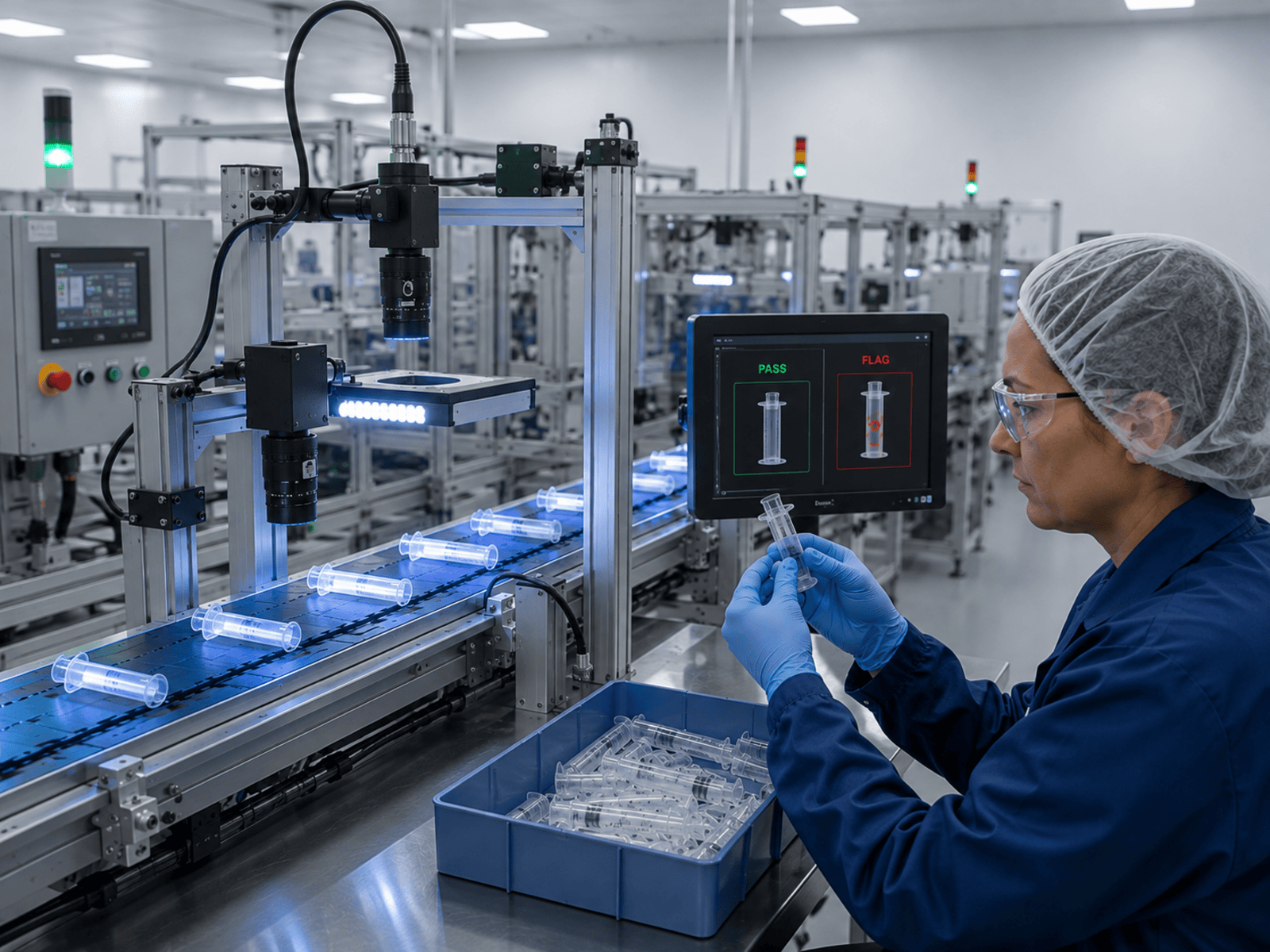


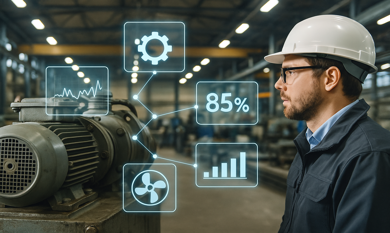
Manual inspection has always been the backbone of medical device quality control, and for a long time, checking parts after they came off the line worked well enough. But as manufacturing volumes grow, that after-the-fact approach is giving way to automated, in-process quality control built directly into the production line itself. Computer vision quality control is increasingly the answer manufacturers turn to, not as a replacement for inspectors, but as backup they can rely on shift after shift. Take a syringe barrel with a hairline crack, or a catheter seal that's just slightly off spec: the kind of flaw a tired inspector might miss three hours into a shift, but a vision system flags with consistent accuracy and repeatability across every unit and every shift. Here's what it actually catches, how it gets deployed on a live line without stopping production, and how it fits into FDA compliance requirements.
Why Manual Inspection Breaks Down as Production Scales
Inspection problems rarely show up on day one. They show up six months in, once volume climbs and the same three inspectors are now covering twice the units per shift. Fatigue creeps in. So does inconsistency, the same crack that one inspector flags on a Monday morning might get waved through on a Friday double shift. For most consumer goods, that inconsistency is a quality metric problem. For a medical device, say, an infusion set or an implant component, it becomes a compliance and patient safety concern, and regulators treat it that way.
This is where medical device assembly line inspection starts to strain under its own process. The inspection step is supposed to be the safety net, but a safety net that depends entirely on human attention span isn't one you can fully rely on as output grows. That's part of why manufacturers across manufacturing operations are rethinking how inspection gets done in the first place, not replacing people, but giving them a more consistent first pass to work from.
What Computer Vision Actually Catches
This is usually the part people underestimate. Computer vision isn't just a camera looking for obvious flaws. When it's set up properly for automated visual inspection medical devices manufacturers rely on, it can pick up on things that are genuinely hard for the human eye to catch consistently, shift after shift:
- Micro-cracks and hairline fractures on barrels, housings, or connectors that aren't visible under standard lighting
- Seal and weld integrity on components where sterility depends on a clean, continuous bond
- Label and UDI (Unique Device Identification) verification: placement, readability, and barcode accuracy
- Dimensional tolerance checks, confirming a part matches spec within fractions of a millimeter
- Surface contamination, discoloration, or foreign particulate that manual inspection tends to miss under time pressure
For defect detection computer vision systems, none of this is about replacing judgment. It's about giving every unit the same level of scrutiny, whether it's the first part off the line or the ten thousandth.
Understanding the Regulatory Requirements Behind AI Inspection
Here's where a lot of vendor content gets thin. Deploying computer vision on a medical device line isn't only a manufacturing decision; it's a regulatory one, because you're touching the quality system itself.
Under FDA compliant AI inspection systems requirements, inspection technology used in a regulated environment falls under the FDA's Quality System Regulation, now consolidated into the Quality Management System Regulation (QMSR) aligned with 21 CFR Part 820. In practice, this means the vision system needs documentation: how it was validated, what "pass" and "fail" criteria it was trained against, and a clear change control process for any time the model gets updated. If a model is retrained to catch a new defect type, that update should be validated against known good and known bad samples before going live, with the previous model version retained in case a rollback is ever needed. Electronic records from the system should also meet Part 11 expectations around audit trails and access control.
None of this is a reason to avoid computer vision. It's a reason to plan for it properly from the start, with a partner who understands that installing the cameras is the easy part of the work.
Rolling It Out Without Shutting Down the Line
Very few manufacturers are building a new assembly line from scratch to accommodate this. Most are retrofitting an existing one, which means the rollout has to be sequenced carefully.
A machine vision assembly line deployment that works in practice usually starts small: one inspection station, running the vision system in parallel with the existing manual check, not replacing it yet. That parallel run gives a real comparison of where the system agrees with inspectors, where it disagrees, and why. Once false positive and false negative rates fall within an acceptable range, the system can start carrying more of the inspection load, station by station, rather than the whole line switching over at once. Most existing PLC and line control infrastructure can integrate with a vision system through standard I/O or network protocols, so this rarely means ripping out what's already there. It's closer to adding a very consistent extra set of eyes.
The result is real-time quality control manufacturing teams can actually trust, without betting an entire production run on a system that hasn't been proven on their specific parts yet.
Human-in-the-Loop, Not Full Automation
It's worth being direct here: the goal isn't a fully automated line with no human inspector in sight. Flagged units still go to a person for final review, especially early on. This matters for two reasons. First, it keeps a human decision maker in the loop on anything ambiguous, which lines up with how the FDA expects oversight to work on regulated production lines. Second, it builds trust with your own quality team; inspectors who see the system flag real defects, not just noise, are far more likely to rely on it instead of working around it.
Over time, as confidence in the system's accuracy grows, the review threshold can shift, but tools aimed at helping reduce manufacturing defects AI deliver the best results when framed as a second set of eyes working alongside your team, not a replacement for it.
Where This Fits for Boston-Based Manufacturers
Boston medical device manufacturing operations tend to sit at a particular intersection: smaller production runs, tighter regulatory scrutiny, and less room to absorb the cost of a recall than a high volume consumer goods line might have. That combination is exactly where a phased, compliance aware AI-powered inspection systems rollout makes sense, not a wholesale line replacement, but a system that plugs into what's already running and earns its place station by station.
Frequently Asked Questions
Is computer vision inspection FDA-compliant for medical devices?
Computer vision itself isn't automatically compliant; the surrounding process is what matters. The system needs to be validated, documented, and maintained under the same quality system expectations (21 CFR Part 820/QMSR) that apply to any other inspection method on a regulated line.
What defects can computer vision catch that manual inspection misses?
Micro-cracks, seal and weld integrity issues, label/UDI errors, dimensional deviations, and surface contamination are common examples, particularly defects that are hard to catch consistently under time pressure or inconsistent lighting.
How long does it take to deploy a vision inspection system on an existing line?
It varies by line complexity, but a phased rollout, starting with one station running in parallel with manual inspection, is the most common and lowest risk approach, rather than a full line cutover.
Does computer vision replace human quality inspectors?
No. Most deployments keep a human-in-the-loop review step for flagged units, particularly in regulated environments where oversight is expected, not optional.
How We Approach This
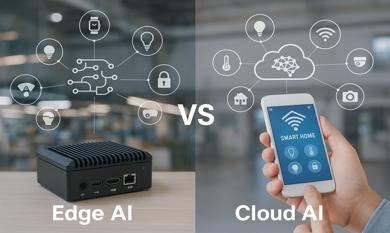
At Theta Technolabs, this is the kind of project we build using computer vision systems trained on specific defect types, paired with a validation process built to hold up under a quality audit, not just a demo. On the technical side, this typically involves convolutional neural network (CNN) models for defect classification, edge computing for low latency inspection directly on the line, and cloud based model versioning so every update stays documented and auditable. If you're a Boston-based device manufacturer scoping this out, you can reach us at sales@thetatechnolabs.com to talk through what a pilot station would look like for your line.


.png)



.png)





















.png)
.png)





.png)
.png)
.png)
.png)


.png)
.png)
.png)
.png)

.png)






.png)