

Manufacturers have run supply forecasting off spreadsheets and monthly sales averages for decades. That approach worked when demand moved slowly and suppliers rarely missed a date. It doesn't hold up anymore. AI-powered supply chain forecasting replaces that static, backward-looking process with one that reads live signals, supplier performance, order patterns, freight delays, and adjusts continuously instead of once a month.
Here's what that looks like when it fails. A plant manager in Garland ordered six weeks of raw aluminum stock based on last quarter's numbers. Three weeks later, a supplier delay in the Gulf shipping lane pushed lead times out by ten days, and a sudden order spike from a new automotive client wiped out safety stock in four days flat. The spreadsheet said everything was fine. The floor said otherwise. This guide breaks down why traditional forecasting keeps falling short, how AI forecasting actually works, what changes on the plant floor once it's running, and a realistic way to start if you don't have a data science team in-house.
Why Forecasting Breaks Down in Manufacturing and Why It's Worse for Dallas Manufacturers
Forecasting has always been a bit of a guessing game dressed up in spreadsheets. Most manufacturing plants still run demand planning off trailing sales averages, seasonal adjustments pulled from last year, and a planner's judgment layered on top. That works fine when demand is stable and suppliers are reliable. It falls apart the moment either one isn't, and lately, neither reliably is.
The core problem is that traditional supply chain forecasting for manufacturers is backward-looking by design. It tells you what happened, not what's about to happen. It can't factor in a supplier's late shipment notice from yesterday, a competitor's stockout sending new orders your way, or a raw material price move that's about to change buying behavior. By the time a spreadsheet forecast catches up to reality, the damage (a stockout, an overstock, a missed delivery window) has usually already happened.
For Dallas manufacturers specifically, this gap tends to show up more often. The DFW corridor sits at the intersection of heavy freight traffic from Gulf ports, cross-border trucking from Mexico, and a dense supplier network spanning automotive, electronics, and industrial equipment. Add in tariff shifts that can move input costs with little warning, and a forecast built on last quarter's averages can go stale fast. Manufacturers here aren't dealing with abstract "global supply chain complexity." They're dealing with a specific freight lane backing up or a specific supplier missing a delivery window, and legacy forecasting tools were never built to react to that in real time.
How AI-Powered Forecasting Actually Works
AI-powered forecasting isn't a single tool. It's a combination of data pipelines and models working together to replace static, periodic forecasting with something that updates as conditions change. Here's what's actually happening underneath it.
Real-Time Data Integration
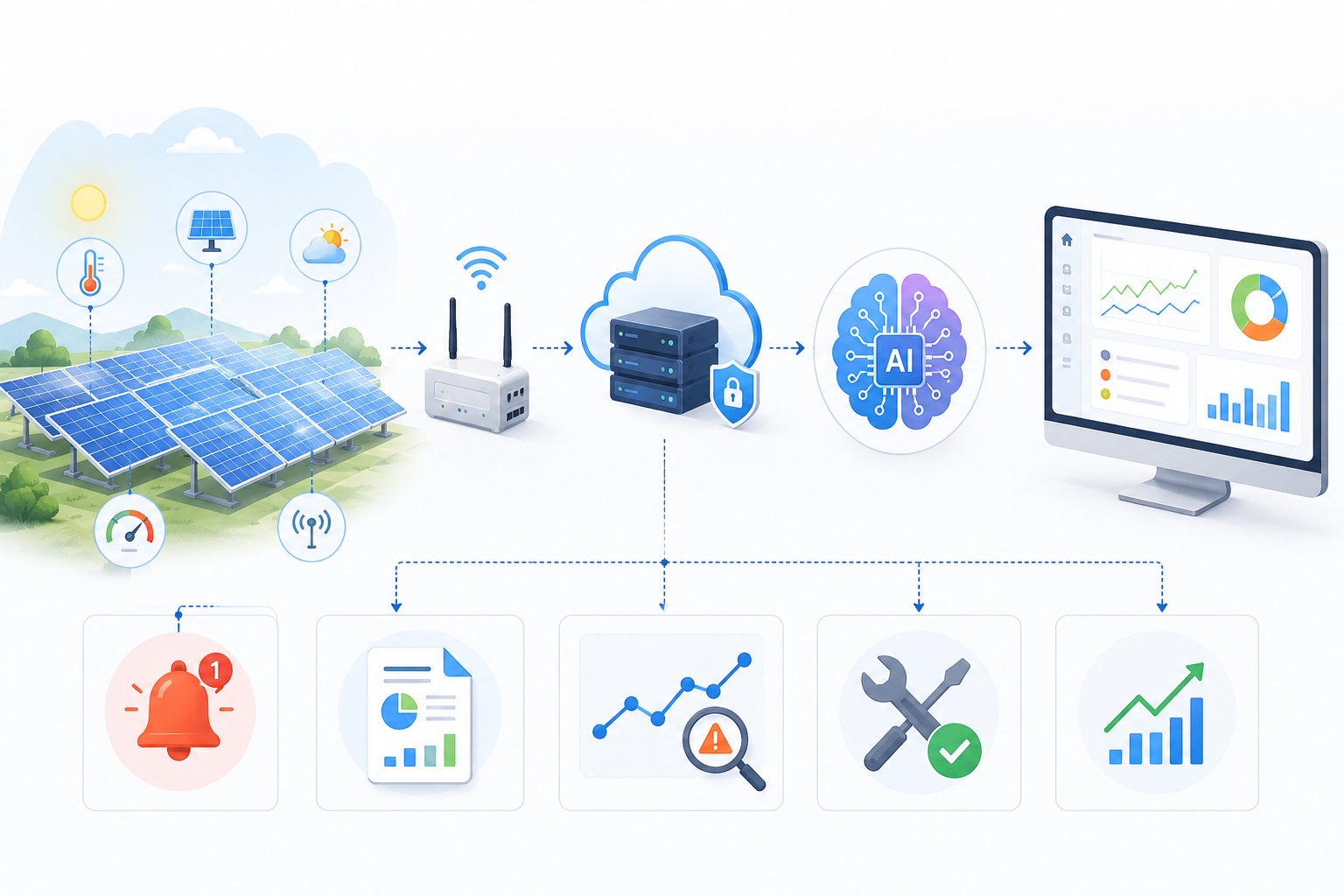
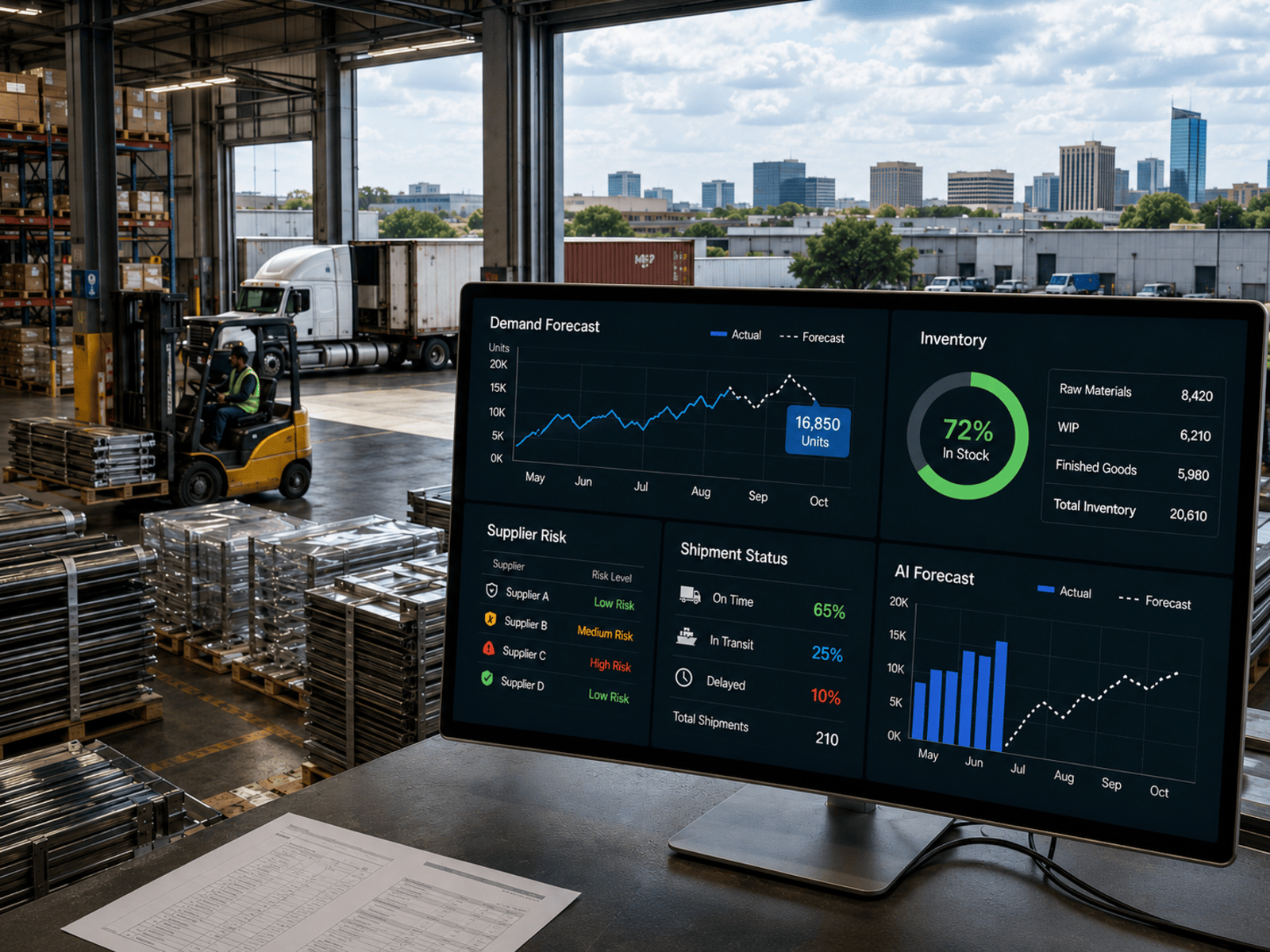
Instead of pulling from one source (usually your ERP's sales history), the system draws from multiple points at once: point-of-sale numbers, supplier delivery performance, logistics tracking, and sometimes external feeds like weather or commodity pricing. This is what makes the forecast forward-looking instead of a rearview mirror.
Pattern Detection Across Historical and External Signals
Machine learning models, commonly time-series approaches like LSTM networks alongside more traditional statistical methods like ARIMA, get trained on your historical demand data, then layered with external variables that a spreadsheet formula simply can't account for. The model learns which combinations of signals tend to predict demand shifts for your specific product lines, not a generic industry curve.
Continuous Re-Forecasting
This is the part that matters most in practice. A traditional forecast gets revised monthly, sometimes quarterly. A demand forecasting AI system recalculates as new data comes in, daily or sometimes closer to real time, so a supplier delay flagged this morning can shift next week's production plan before it turns into a shortage. This shift toward continuous, adaptive forecasting is a big reason more Dallas manufacturers are exploring AI development services in Dallas to build this capability into their existing systems, rather than trying to bolt it onto legacy ERP software alone.
Traditional Forecasting vs. AI Forecasting
It helps to see the difference laid out plainly:
- Data inputs: Traditional forecasting relies mainly on internal sales history. AI forecasting pulls in supplier, logistics, and market signals alongside it.
- Update frequency: Traditional forecasts are typically revised monthly or quarterly. AI-based models can re-forecast daily, sometimes more often.
- Forecast accuracy: Traditional methods tend to lose accuracy quickly once demand becomes volatile. AI models, trained on clean data, generally hold up better under that same volatility.
- Effort required: Traditional forecasting depends on manual review every cycle. AI forecasting automates most of the recalculation, though exceptions still need a human eye.
According to McKinsey's research on AI-driven operations forecasting, applying AI-driven forecasting to supply chain management can reduce errors by 20 to 50 percent, and translate into a reduction in lost sales and product unavailability of up to 65 percent. Results like these depend heavily on data quality and how the pilot is scoped, so they're worth treating as a realistic range to aim for, not a guaranteed outcome for every plant.
What This Means on the Plant Floor
The technical mechanics matter less than what actually changes day to day once this is running.
Inventory stops swinging between too much and too little. When forecasts update continuously, safety stock levels adjust with them, instead of staying fixed until the next manual review catches the mismatch.
Stockouts and overstock both tend to drop. Not disappear, but drop. AI forecasting doesn't eliminate uncertainty, but it narrows the margin of error enough that fewer orders get missed and less capital sits tied up in excess raw material.
Supplier risk becomes visible earlier. Instead of finding out about a delay when the truck doesn't show up, pattern detection across supplier delivery history can flag a slipping vendor well before the actual disruption hits.
Building this kind of system properly requires the right foundation: model design, data pipeline architecture, and integration with whatever ERP or MES system a plant already runs. That's the kind of work that falls under proper machine learning and deep learning services, where models are trained specifically on a plant's own production and supplier data rather than a generic template. If this is a capability gap on your end, our machine learning and deep learning services are built around exactly this kind of plant-specific model work.
How to Actually Start: A Realistic Roadmap
This is usually where plants get stuck, not because the technology doesn't work, but because nobody lays out a practical starting point. Here's one.
Start with a data readiness check. Before any model gets built, you need to know what you actually have: ideally a year or more of clean sales history, supplier lead-time records, and inventory movement logs. If that data is scattered across systems that don't talk to each other, that's the first problem to solve, not the forecasting model itself.
Pilot on one product line, not the whole plant. Pick a SKU category with enough historical volume to train a model properly, and enough volatility that improvement is actually measurable. Trying to forecast an entire catalog on day one tends to stall projects before they prove any value.
Set an honest timeline. A working pilot model can often be built and validated within a couple of months once data is in reasonable shape, though this varies by plant. Full integration across broader operations, connecting forecasting to production scheduling and procurement, usually takes longer, often several months. Be cautious of anyone promising a full plant-wide rollout in a couple of weeks.
Decide on in-house vs. partner-built. Most mid-size manufacturers don't have a data science team sitting idle, and building one just for this project rarely makes financial sense. Working with an experienced development partner to build and hand off the pilot is often the more practical route, particularly since forecasting accuracy directly feeds into inventory forecasting decisions down the line. We've covered a related case in our piece on agentic AI for smart inventory forecasting in Dallas supply chains.
Common Mistakes That Derail These Projects
A few patterns show up repeatedly in forecasting rollouts that don't deliver.
Skipping the data cleanup step and expecting the model to compensate for messy, inconsistent records rarely works. The model is only as good as what it's trained on. Scoping the pilot too broadly, trying to forecast every product line at once instead of proving value on one first, is another common one. And underestimating change management causes just as many stalls as bad data. Planners who've trusted their own judgment for years won't hand decisions over to a model overnight, and a rollout plan needs to account for that adjustment period, not just the technical build.
Frequently Asked Questions
How much does AI supply chain forecasting cost for a mid-size manufacturer?
Costs vary depending on data readiness and scope, but a focused pilot on one product line generally costs far less than a full enterprise rollout. Most manufacturers start with a scoped pilot specifically to keep costs contained before committing to anything larger.
How long does it take to see results from AI forecasting?
A validated pilot model can often take shape within a couple of months if historical data is reasonably clean, though this depends on the plant and data quality. Measurable improvement in forecast accuracy is usually noticeable within the first few forecasting cycles after deployment.
What data do I need before starting?
At a minimum, a solid stretch of sales history (ideally 12 months or more), supplier lead-time records, and inventory movement data. The cleaner and more centralized this data is, the faster and more reliable the resulting model tends to be.
Is AI forecasting worth it for smaller manufacturers, not just large enterprises?
Often, yes, when scoped correctly. A single-product-line pilot doesn't require enterprise-level infrastructure, and mid-size plants frequently see meaningful accuracy gains precisely because their current forecasting is manual and inconsistent to begin with.
Where This Fits Together
AI-powered forecasting isn't a plug-and-play fix, and it isn't magic. It's a combination of clean data, the right models, and a realistic rollout plan. For Dallas manufacturers dealing with freight volatility and supplier unpredictability that generic forecasting tools were never built for, that combination is what tends to move the needle.
We build these systems using Python-based modeling pipelines, along with TensorFlow and PyTorch for the underlying deep learning models, and time-series architectures like LSTM networks suited to demand and inventory forecasting. Theta Technolabs works with manufacturers on exactly this kind of forecasting build, from the data readiness stage through pilot and rollout. If you're evaluating where to start, reach out to us at sales@thetatechnolabs.com.


.png)



.png)



















.png)
.png)





.png)
.png)
.png)
.png)


.png)
.png)
.png)
.png)

.png)






.png)