

If you are planning a telemedicine product, you have probably already noticed how confusing pricing can be. One agency says a basic app is affordable. Another gives a much higher number after mentioning compliance, integrations, and infrastructure. For healthtech founders, that gap is where early budgeting mistakes usually begin.
The honest answer is simple. Telemedicine app development cost can vary widely because the product is not just another booking app with video calling. It often includes clinical workflows, privacy controls, patient scheduling, provider management, secure communication, and in many cases, deeper system integrations.
For most early-stage teams, the cost to build a telemedicine app usually starts around the MVP level and grows based on complexity. A focused startup version may fall in the range of roughly $30,000 to $60,000. A more advanced platform with compliance layers, custom workflows, and EMR connectivity can move much higher. That is why the better question is not only “what is the price?” but “what exactly is driving the price?”
What usually changes the cost most?
The biggest factor is feature scope. A founder may begin with a simple idea: video visits between doctor and patient. But once the planning starts, the product often expands into patient onboarding, appointment management, doctor availability, medical notes, notifications, admin control, analytics, payments, and documentation workflows.
That is where telehealth app development cost starts rising.
A few areas usually have the strongest impact:
- secure video consultation platform setup
- patient appointment app development
- EMR integration for telehealth app
- user roles for patients, doctors, admins, and support teams
- compliance and security work
- cloud hosting and data protection architecture
A simple app demo and a production-grade HIPAA compliant telemedicine app are two very different products. Founders who understand this early usually budget better and launch faster.
A practical way to think about pricing
Instead of asking for one flat number, it helps to break the product into layers.
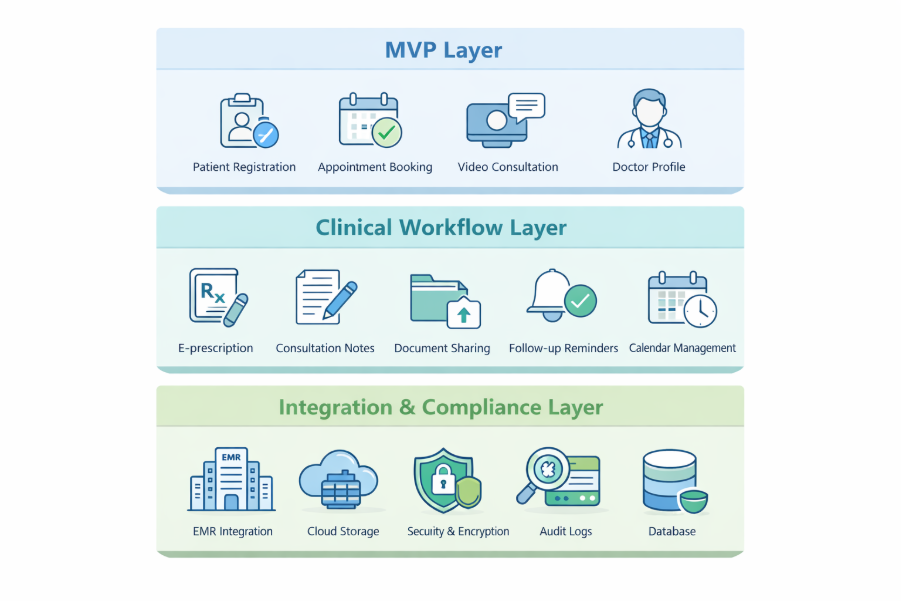
Fig.: Telemedicine app development cost breakdown across MVP, clinical workflow, and compliance layers
Core MVP layer
- patient registration and login
- doctor profile and availability
- appointment booking
- secure video consultation
- basic admin panel
Clinical workflow layer
- e-prescription support
- consultation summaries
- document sharing
- follow-up reminders
- provider calendar management
Integration and compliance layer
- EMR integration
- audit logs
- encryption and access controls
- secure cloud architecture
- HIPAA-ready healthcare software processes
This is why doctor consultation app development can look inexpensive at first and then become more expensive once real healthcare operations are considered.
The part many founders underestimate
The most common mistake is not overspending on design or development hours. It is underestimating compliance and workflow complexity.
A telemedicine product in healthcare usually needs more than a polished interface. It may require identity management, role-based permissions, secure data storage, protected communication, session logging, and controlled access across different user types. These are not optional extras when the goal is a serious healthcare product.
If you are estimating cost to build a HIPAA compliant telehealth app, you should expect compliance-related work to influence both timeline and budget. Even when using standard tools, security reviews, infrastructure planning, and privacy-safe architecture take time.
Another cost driver is EMR connectivity. Many founders initially plan for a standalone app, but once provider workflows are discussed, EMR integration for telehealth app becomes a priority. That one decision can significantly affect scope.
A realistic startup scenario
Imagine a Houston-based startup building a telemedicine MVP for independent clinics. The goal is to launch fast, validate demand, and avoid building too much too early.
The first version includes:
- patient onboarding
- appointment scheduling
- secure video consultation platform
- doctor dashboard
- admin controls
- basic reporting
At this stage, the startup delays deeper EMR integration and advanced automation. That helps control the initial telemedicine app development cost in Houston, especially when the team wants to test demand before committing to a larger build.
Now compare that with a second scenario where the product also includes:
- EMR sync
- advanced billing workflows
- provider note templates
- compliance reporting
- custom workflow rules for multi-location clinics
That version is no longer a lightweight MVP. It is moving toward a broader virtual care platform, and naturally the telehealth app development cost becomes much higher.
What should founders build first?
This is where good product decisions matter more than ambitious feature lists.
For most startups, the better path is to begin with the telehealth MVP features that support the actual care experience:
- patient booking
- clinician availability
- secure consultation flow
- post-visit follow-up
- admin visibility
That is usually enough to test the model, show traction, and learn how real users behave.
A lot of founders ask, how much does telemedicine app development cost when the answer really depends on whether they are funding a validation-stage product or a larger digital care platform. Those are different business decisions.
If budget discipline matters, start with:
- one user journey
- one care model
- one admin logic
- one integration decision at a time
That is where MVP development services for startups can help keep the roadmap realistic.
One short technical note that matters
A strong telemedicine product usually depends on clean backend planning, not just front-end screens. The team should think about telemedicine platform architecture early, especially if future scale is part of the business plan.
That includes:
- secure cloud deployment
- modular APIs
- protected patient data handling
- video service integration
- future-ready support for EMR connectivity
This is also where healthcare app development solutions become more valuable than general app delivery. In healthcare, the technical structure affects not just performance but also compliance readiness and long-term maintainability.
So how should you approach budgeting?
A better budgeting process looks like this:
- define the first usable care journey
- list the must-have telehealth MVP features
- separate optional features from launch-critical ones
- identify whether EMR integration is needed now or later
- estimate security and compliance work early
- choose a build path that supports growth without bloating the first release
This approach gives founders a clearer view of what features increase telehealth app development cost and where spending is actually justified.
Conclusion
For early-stage digital health teams, telemedicine app development cost should never be treated as a single number pulled from a rough quote. It is a result of feature decisions, compliance needs, clinical workflow depth, and platform architecture choices.
If your goal is to launch intelligently, the smartest move is to build a lean but credible product first, validate demand, and expand carefully. That approach reduces waste, improves planning, and creates a stronger foundation for growth. For startups evaluating partners, the right telemedicine app development services approach is the one that balances speed, compliance, and long-term product clarity.
Build Your Telehealth Solution
If you are planning a telemedicine MVP or trying to estimate the real cost of a secure healthcare platform, Theta Technolabs can help you map the scope clearly before development begins. Our team works on Web, Mobile, and Cloud-based healthcare products with a strong focus on compliance, architecture, and realistic execution.
Reach out at sales@thetatechnolabs.com to discuss your telemedicine product roadmap.






















.png)
.png)






.png)
.png)
.png)
.png)


.png)
.png)
.png)
.png)

.png)










.png)





_How%20Cloud%20Solutions%20Are%20Enhancing%20Remote%20Patient%20Monitoring%20in%20Healthcare_Q4_25.jpg)
_Streamlining%20Appointment%20Scheduling%20with%20Cloud%20Computing%20in%20Dallas%20Healthcare_Q4_25.jpg)
_The%20Impact%20of%20Cross-Platform%20Apps%20on%20Real%20Estate%20Market%20Trends%20in%20Dallas_Q3_24-1.jpg)
_How%20AI%20is%20Enhancing%20Construction%20Site%20Surveillance%20and%20Security%20in%20Dallas_Q3_24-1.jpg)
_Web%20Apps%20for%20Retail%20and%20eCommerce_%20Streamlining%20Operations%20and%20Reducing%20Costs_Q3_24.jpg)
_Enhancing%20Driver%20Safety%20and%20Compliance%20with%20Web%20Apps%20in%20the%20Logistics%20Sector_Q3_24.jpg)