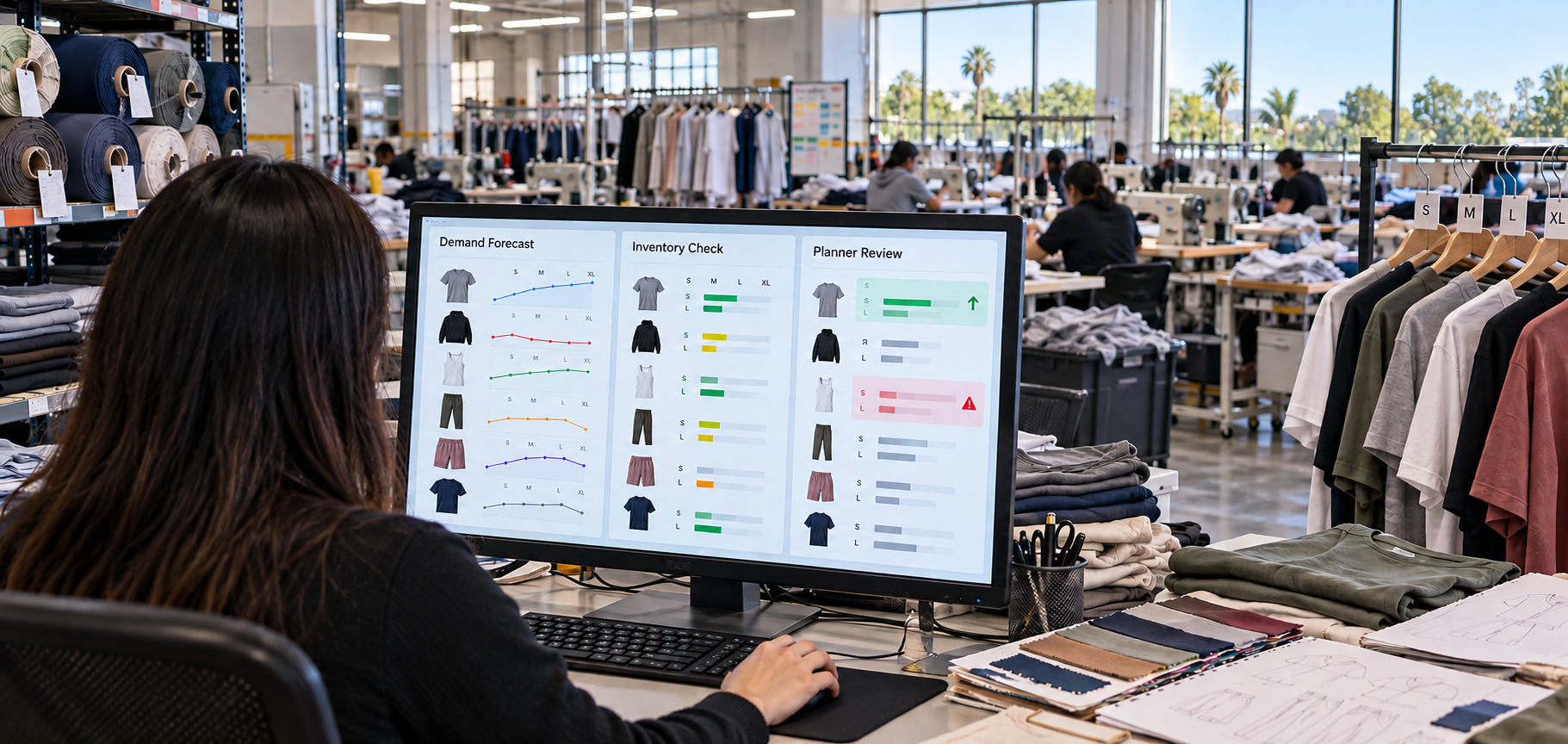


Apparel manufacturers often need to commit fabric, trims, production capacity, and labor before they know exactly what customers will buy. Demand can also vary by style, size, color, season, channel, and promotion. For Los Angeles apparel manufacturers, broad historical sales alone may not give production teams enough detail.
AI demand planning for apparel manufacturers can combine sales, product, inventory, seasonal, and operational data to estimate likely demand before production quantities are finalized. Used correctly, it can help teams reduce apparel overproduction by giving planners better evidence for what to make, when to make it, and which products need closer review. It supports the decision rather than replacing the planner.
This article explains the data, forecasting workflow, production context, system integration, and human review needed to make that approach practical.
Why Apparel Overproduction Often Starts Before Production Begins
Overproduction is not only a factory-floor issue. The risk can begin earlier, when forecasts, inventory positions, purchase commitments, and production plans do not reflect the same picture of demand.
Traditional apparel demand forecasting may become less useful when it looks only at total historical sales. A product can perform differently by size, color, sales channel, season, or promotion. Stockouts can also distort the historical record because sales show only what was available to buy.
New collections create another difficulty. A carryover item may have useful sales history, while a new style may have little direct history. Planners may also need to account for open orders, work in progress, available materials, and production capacity before deciding whether additional manufacturing is justified.
Research from NC State University’s Wilson College of Textiles explains that forecast-based, inventory-driven fashion supply chains can create gaps between predicted and actual customer demand. These gaps may contribute to excess inventory and markdowns. The university also identifies AI-enabled demand forecasting as one approach for addressing demand uncertainty and improving inventory management. For apparel manufacturers, this supports the need to connect more accurate demand forecasts with inventory and production planning before committing to additional production.
Apparel Demand Is More Detailed Than a Single Sales Forecast
A useful apparel forecast needs to reflect the level at which production and inventory decisions are made.
Forecasting by Style, Size, Color, and Channel
Total category demand may look healthy while individual variants behave differently. SKU-level demand forecasting can help planners identify those differences when the underlying data is reliable enough.
Demand for the same garment may vary by color, size, wholesale account, direct-to-consumer channel, or season. The right forecasting level depends on the manufacturer's product structure, data quality, sales volume, and planning process.
For this reason, demand forecasting for garment manufacturing should focus on the decisions the business needs to make rather than creating more detailed predictions simply because the technology allows it.
Carryover Products and New Styles Need Different Treatment
Carryover products can often use their own historical patterns as one input. New styles may have little or no direct sales history.
A forecasting workflow for a new item may use comparable products, category performance, product attributes, seasonality, launch information, and early order or sell-through signals. These inputs can support an estimate, but they do not remove uncertainty. New-product forecasts should be reviewed as fresh demand data becomes available.
What Data an AI Demand Planning System Actually Uses
An apparel demand planning system is useful only when its inputs represent both customer demand and the company's current inventory and production position.
Demand and Sales Signals
Historical orders and sales can provide a baseline, but machine learning demand forecasting can also incorporate returns, promotions, seasonality, channel performance, current orders, and selected external factors when they have a clear relationship with demand.
Data quality matters more than volume alone. Duplicate records, missing product attributes, inconsistent SKU definitions, or disconnected channel data can weaken the forecast. A practical project therefore starts with data review and preparation.
Machine learning development services can support the full forecasting workflow, from data preparation and feature engineering to model validation, deployment, and ongoing monitoring. Technologies such as TensorFlow, PyTorch, and Scikit-learn can be used to build forecasting systems that learn from historical and operational data.
Product and Inventory Context
A demand estimate does not tell planners how much new production is required until it is compared with what the business already has.
Useful context can include style, size, color, category, inventory on hand, committed stock, open orders, and work in progress. Combining these inputs supports apparel inventory optimization because teams can distinguish expected demand from demand already covered by stock or committed supply.
Manufacturing Constraints
Planning also needs operational constraints such as supplier lead times, fabric and trim availability, sourcing conditions, production schedules, and capacity.
Forecasted demand is not automatically the quantity that should be manufactured. A forecast is one input to a production decision.
How AI Forecasts Become Practical Production Decisions
The value of a forecast appears when it becomes part of apparel production planning rather than remaining a separate analytics output.
A practical workflow may follow this sequence:
Demand signals → Forecast → Inventory check → Open-order check → Production requirement → Material and capacity review → Planner review → Production plan
The exact flow will vary by manufacturer, but the principle is consistent. The system should compare predicted demand with current operational reality before recommending an action.
If expected demand strengthens for one color and weakens for another, the planning workflow should first check available inventory, work in progress, open orders, material availability, lead times, and capacity.
Forecast confidence also matters. New styles, unusual promotion periods, incomplete data, or unstable historical patterns can be flagged for closer review rather than treated like routine items.
Connecting Demand Forecasting with Apparel Manufacturing Systems
A forecast has limited operational value if planners need to copy results manually between disconnected tools.
A custom workflow can connect relevant information from ERP, inventory systems, ecommerce platforms, wholesale order systems, production planning tools, warehouse applications, or purchasing data. Not every input needs to update in real time. The right frequency depends on production cycles, sales velocity, and the decisions being supported.
This is where manufacturing software development becomes important. Forecast outputs can be integrated into existing planning dashboards or operational applications so teams can review predicted demand alongside inventory, open orders, production schedules, and supply-chain conditions. This makes the forecast more useful in day-to-day production planning.
Integration can use APIs, database connections, scheduled data pipelines, or other methods supported by the existing architecture. The objective is not to replace every system, but to put useful forecasting information where planners can act on it.
A Practical Implementation Path for Los Angeles Apparel Manufacturers
A demand-planning project should start with one clearly defined production decision rather than a broad goal to add AI.
- Define which planning decision the forecast should support.
- Audit sales, product, inventory, and production data.
- Select a useful forecasting level, such as product, style, or SKU.
- Establish a baseline using the current planning or forecasting process.
- Build and validate the forecasting workflow.
- Connect forecasts with inventory, open orders, materials, and capacity.
- Pilot the workflow with planners before wider rollout.
- Monitor forecast errors as demand patterns change.
Working with an experienced AI development company in Los Angeles can help manufacturers connect forecasting models with their existing inventory, ERP, and production planning systems. This allows demand insights to become part of the operational workflow instead of remaining as a separate analytics output.
Forecast performance should also be reviewed over time because product mixes, sales channels, promotions, and buying patterns change.
Where Human Planners Still Matter
AI can process patterns across many products, but planners often know business context that is not represented in historical data.
Upcoming assortment changes, supplier issues, customer commitments, planned promotions, sourcing changes, and capacity constraints may affect a production decision.
The system should allow planners to review recommendations, see important inputs, make justified adjustments, and record significant overrides. The goal is better decision support, not automatic replacement of apparel planners.
Frequently Asked Questions
How can AI demand planning reduce apparel overproduction?
It can estimate likely demand using relevant sales, product, inventory, seasonal, and operational signals. Planners can then compare that forecast with existing stock, open orders, materials, and capacity before approving additional production.
Can AI forecast demand for a completely new apparel product?
It can estimate demand using comparable products, product attributes, category patterns, seasonality, launch information, and early demand signals. However, uncertainty is usually higher when direct historical data is limited.
How often should an apparel demand forecast be updated?
There is no single correct frequency. Timing should reflect product cycles, sales velocity, promotions, production lead times, data availability, and how frequently planners make production or replenishment decisions.
Can AI demand forecasting work with an existing ERP system?
Often, yes. Forecasting systems can connect with existing ERP and operational software through APIs, database connections, scheduled data pipelines, or other supported methods. The right approach depends on the current architecture.
Conclusion
Reducing apparel overproduction requires more than predicting future sales. A useful demand-planning workflow connects expected demand with available inventory, open orders, materials, production capacity, and human review before manufacturing quantities are finalized.
Theta Technolabs can design this type of forecasting and integration workflow around existing apparel operations. Depending on the project, Python, TensorFlow, and PyTorch can support data preparation and forecasting, while APIs or cloud services connect predictions with operational systems.
For Los Angeles apparel manufacturers, this type of project can be delivered through structured remote collaboration, clear development milestones, and regular coordination with internal planning, production, and technology teams.
For custom AI demand planning and manufacturing software solutions, contact Theta Technolabs at sales@thetatechnolabs.com



.png)

























.png)
.png)






.png)

.png)
.png)
.png)


.png)
.png)
.png)
.png)

.png)











.png)





_How%20Cloud%20Solutions%20Are%20Enhancing%20Remote%20Patient%20Monitoring%20in%20Healthcare_Q4_25.jpg)
_Streamlining%20Appointment%20Scheduling%20with%20Cloud%20Computing%20in%20Dallas%20Healthcare_Q4_25.jpg)