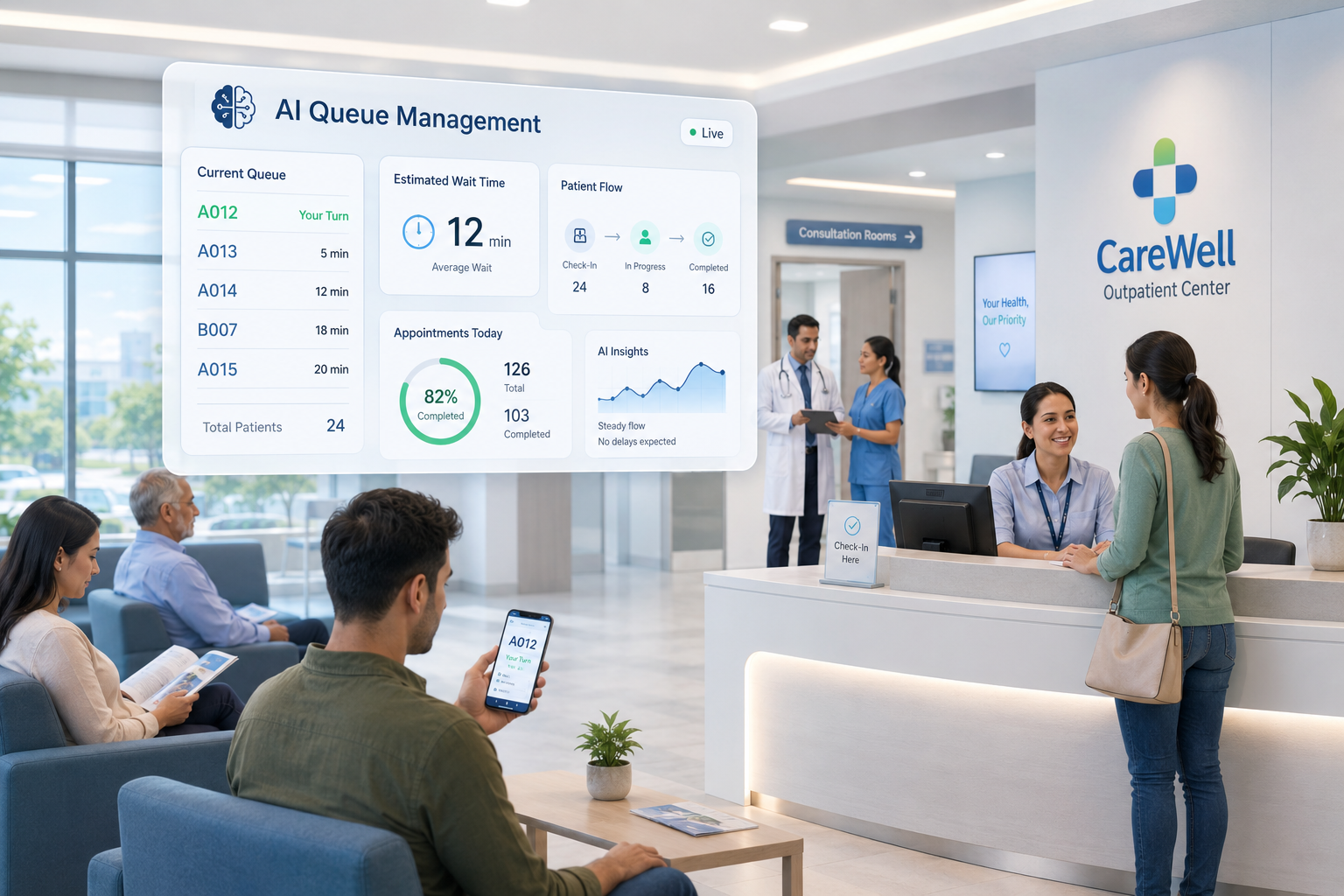


Outpatient care is one of the busiest parts of any healthcare facility. Patients come in for consultations, follow-ups, lab tests, diagnostics, billing, and reports, often on the same day. When these steps are not managed properly, waiting rooms become crowded, staff feel pressured, and patients do not know how long they need to wait.
This is why many clinics and hospitals are looking at AI queue management in healthcare. It helps outpatient teams manage appointments, check-ins, waiting times, patient routing, and staff coordination in a more organized way. With the right outpatient queue management system, healthcare providers can improve daily workflow and give patients a smoother visit without depending only on manual queue handling.
What Is AI Queue Management in Outpatient Care?
AI patient flow management uses real-time data from appointment records, check-ins, expected consultation times, and doctor availability to manage how patients move through outpatient departments. The system sequences patients, predicts wait times, and flags bottlenecks before they affect the full department.
The goal is not to replace clinical staff. Human judgment still drives care decisions. The system gives staff and administrators accurate, live information so they can coordinate more effectively. For clinics handling high daily volumes, smart queue management for clinics provides operational visibility that manual coordination simply cannot deliver. When teams know where delays are forming, they can respond with intention.
Why Outpatient Departments Face Persistent Queue Challenges
Patient delays rarely come from a single source. They build from multiple overlapping problems throughout the day. Patient wait time reduction software and healthcare workflow automation tools are designed to address these gaps.
Common causes include:
- Walk-in patients arriving alongside pre-scheduled appointments
- Emergency or priority cases requiring immediate attention
- Late arrivals disrupting planned consultation sequences
- Doctor schedule changes with no real-time queue update
- Slow manual registration creating front-desk congestion
- Lab and billing departments working without queue visibility
- No central view of patient progress across departments
How AI Optimizes Patient Flow Step by Step
Here is how AI-powered appointment scheduling and AI solutions for outpatient care management work in a typical outpatient setting:
- The patient checks in through the front desk, a kiosk, or a mobile app.
- The system reads appointment type, expected consultation time, assigned doctor, and current department load.
- A predicted wait time is generated from this data.
- Patients are sequenced based on urgency, appointment type, and doctor availability.
- Staff receive live queue updates on a dashboard, reducing manual coordination.
- Patients get their estimated wait through SMS, an app, or a waiting area display screen.
- Managers view real-time bottlenecks and adjust staffing or routing before delays worsen.
This reduces guesswork for both staff and patients throughout the visit.
Figure: AI queue management workflow showing how outpatient clinics can manage check-ins, scheduling, wait time prediction, patient routing, staff dashboards, notifications, and analytics.
Key Features Healthcare Providers Should Look For
Choosing the right solution means evaluating features that genuinely support outpatient workflows. Custom healthcare software development in San Francisco allows providers to configure capabilities for their specific environment. Well-designed systems support patient experience optimization in outpatient care at every stage of the visit.
Key features to evaluate:
- Real-time patient check-in and status tracking
- Estimated wait time prediction with live updates
- Doctor and room availability monitoring
- Priority-based queue handling for urgent cases
- SMS and app notifications for patients
- Staff-facing live queue dashboard
- Patient journey tracking across departments
- EHR and HMS integration
- Analytics and reporting
- Role-based access control
Where Practice Management Solutions Fit in the Workflow
AI queue management works best when it connects to the clinic's broader operational environment. Outpatient care involves appointment scheduling, patient records, billing, staff planning, and reporting. Running a queue system as a standalone tool creates information gaps and adds overhead.
Healthcare providers can connect AI queue systems with practice management solutions to manage appointments, patient records, billing workflows, staff schedules, and outpatient operations from one connected system. This gives administrators a full view of the patient journey from booking to discharge, supporting faster and better-informed operational decisions.
Benefits of AI Queue Management for Outpatient Care
When implemented with the right data, workflow planning, and staff adoption, AI queue management can support measurable operational improvements. Patient experience optimization in outpatient care and operational efficiency improve together when the system connects to real workflow data.
- Reduced avoidable wait time: AI identifies where delays form and supports faster routing between departments.
- Better patient communication: Automated updates keep patients informed and reduce front-desk inquiries.
- Improved staff productivity: Less manual queue work means more time focused on patient care.
- Faster department routing: Patients reach the right area based on real-time availability.
- Better doctor utilization: Smarter sequencing reduces idle time between appointments.
- Lower front-desk pressure: Automated check-in and notifications reduce manual coordination volume.
- Improved administrator visibility: Real-time dashboards let managers act before problems grow.
AI queue management in healthcare delivers stronger results when connected to real workflow data and a clear implementation plan.
Compliance, Data Privacy, and Trust in Healthcare AI
Healthcare AI systems handle sensitive patient information, so privacy and compliance must be central to any implementation. Systems should be designed with HIPAA-aware principles in mind, though actual compliance depends on software design, policies, and data handling practices together. For U.S. healthcare providers, the HHS HIPAA Privacy Rule explains the need for appropriate safeguards and sets limits on how protected health information can be used or disclosed. Read more
Key considerations include:
- HIPAA-aware system architecture and data handling
- Encrypted data storage and secure transmission
- Role-based access limiting data to authorized staff
- Audit logs for tracking data and system activity
- Consent-based patient communication workflows
- Secure EHR and HMS integration with access controls
- Human oversight retained for clinical priority decisions
A Practical Use Case from an Outpatient Setting
Consider a multi-specialty outpatient clinic in San Francisco managing high volumes across general medicine, diagnostics, and specialist consultations. Without a connected system, staff handle check-ins manually, queues build unevenly, and patients wait without useful timelines.
With an outpatient queue management system in place, the clinic can predict peak arrival windows, route patients to the right department after check-in, display live wait times, and alert coordinators when one area becomes overloaded.
AI patient flow management lets managers review daily reports showing where delays occurred, building a clearer picture of operational patterns over time.
Development ROI and Commercial Benefits
Here is how healthcare workflow automation and patient wait time reduction software support trackable ROI:
- Less manual coordination frees staff for higher-value tasks
- Better schedule utilization reduces idle time between appointments
- Improved patient communication supports better retention and return visits
- Real-time reporting provides actionable data for resource planning
- Reduced peak-hour crowding improves the overall clinic environment
- Consistent data enables better long-term staffing and allocation decisions
Why Custom Software Development Matters
Generic queue tools often carry fixed workflows that do not fit how a specific clinic operates. Every outpatient provider has its own patient journey design, EHR environment, appointment logic, billing process, compliance requirements, and reporting needs.
Custom healthcare software development in San Francisco allows organizations to build a system that fits their actual operations. AI solutions for outpatient care management built on a custom foundation can work more effectively because they align with real team processes, existing systems, and reporting needs.
- Fits existing EHR, HMS, and billing systems
- Supports clinic-specific appointment and patient journey logic
- Built around the clinic's compliance requirements
- Allows a phased rollout starting from one department
How to Plan an AI Queue Management System
A structured plan reduces risk and clarifies priorities before deployment.
- Map the full outpatient patient journey from booking to discharge.
- Identify the waiting points causing the most delays.
- Review existing appointment, check-in, and service time data.
- Define staff roles and access levels for the system.
- Plan integrations with EHR, HMS, and billing platforms.
- Select patient communication channels such as SMS, app, or display screen.
- Build analytics dashboards aligned with reporting needs.
- Review privacy and compliance requirements with your legal team.
- Start with one department before scaling across the clinic.
Conclusion
Outpatient care has many moving parts, and managing them manually creates delays that affect both patients and staff. AI queue management helps outpatient teams reduce avoidable delays, improve patient communication, and give frontline staff better coordination tools. The technology works best when it connects to real clinic workflows, integrates with existing systems, and is designed with privacy and compliance as priorities from the start.
Theta Technolabs supports healthcare organizations with Web, Mobile, Cloud, and AI-driven software solutions. As an AI development company in San Francisco, Theta Technolabs can help healthcare providers build secure, scalable, and workflow-friendly queue management systems for outpatient care.
Ready to Improve Your Outpatient Operations?
If you want to reduce avoidable patient wait times, improve care coordination, and give your team better operational tools, Theta Technolabs can help. We design and develop custom healthcare software covering AI queue management, web, mobile, and cloud platforms, with support for practice management integrations and healthcare workflow automation. Every solution is built to match your clinic's specific processes, patient journey, and compliance environment. Contact our team at sales@thetatechnolabs.com to discuss your requirements and explore what a tailored outpatient queue management system could look like for your practice.



.png)





















.png)
.png)






.png)
.png)
.png)
.png)


.png)
.png)
.png)
.png)

.png)







.png)




_How%20Cloud%20Solutions%20Are%20Enhancing%20Remote%20Patient%20Monitoring%20in%20Healthcare_Q4_25.jpg)
_Streamlining%20Appointment%20Scheduling%20with%20Cloud%20Computing%20in%20Dallas%20Healthcare_Q4_25.jpg)