

In 2026, enterprise mobile apps are judged in seconds, sometimes milliseconds.
We are operating in what many product leaders now call the Retention Economy. Users do not uninstall because a feature is missing. They leave because the experience feels slow, drains battery, or behaves unpredictably in the background.
For CTOs and Product Managers managing high-stakes B2B platforms in San Francisco and beyond, mobile app performance optimization 2026 is no longer a technical afterthought. It is a board-level metric tied directly to revenue, adoption, and operational efficiency.
Sub-10ms API latency expectations.
Zero tolerance for background battery drain.
Real-time AI decisioning at the edge.
These are no longer experiments. They are operational standards.
This blog outlines how to optimize enterprise mobile applications in a world dominated by Agentic AI, 5G app responsiveness, and edge computing.
The New Performance Baseline in 2026
What CTOs Must Assume by Default
In 2026, enterprise apps are expected to:
- Deliver sub-10ms perceived interaction latency
- Load core screens under 1.5 seconds
- Maintain CPU usage under 30 percent during active sessions
- Avoid Google Play “Excessive Wake Lock” warnings
- Sustain AI processing without visible UI lag
Failure in any of these areas directly impacts user trust and contributes to Reducing app churn 2026 becoming a strategic initiative across industries.
This is where Enterprise app latency fixes move beyond simple caching strategies and into architectural decisions.
Optimizing Agentic AI Background Tasks
Agentic AI is now embedded into enterprise workflows. Autonomous agents handle predictive routing, fraud detection, resource allocation, and live analytics inside mobile apps.
However, unmanaged AI agents create serious performance risks.
Common Agentic AI performance bottlenecks
- Continuous background polling
- Poorly optimized on-device inference
- Excessive wake locks
- Overuse of GPU acceleration
- Redundant model loading
How to optimize background AI agents in mobile apps
If Agentic AI is part of your strategy, optimization must include:
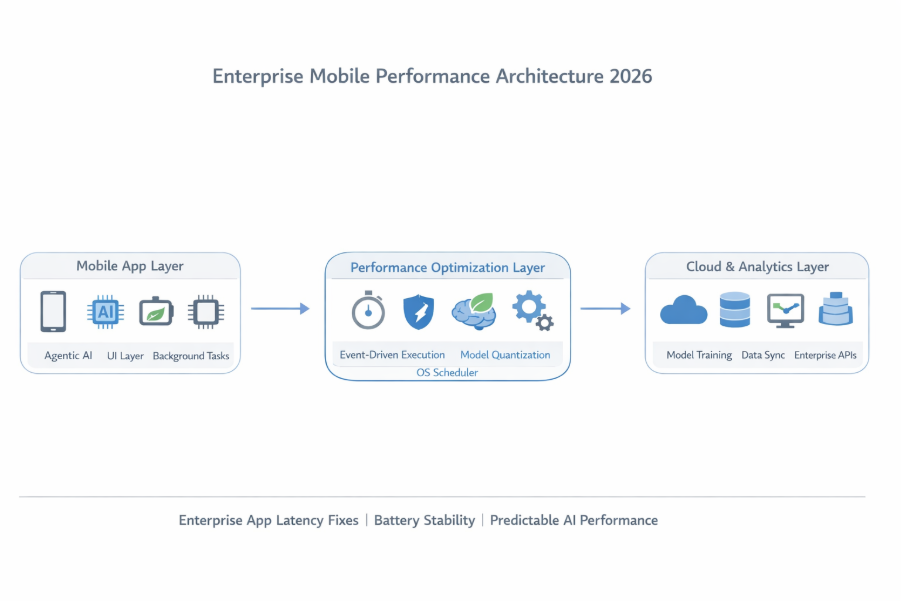
1. Event-Driven Execution
Replace persistent polling with event-based triggers. AI agents should wake only when meaningful thresholds are crossed.
2. Model Quantization
Use 8-bit or lower precision models for on-device inference where feasible. This reduces memory load and improves response times.
3. Edge-Offloading Strategy
Complex reasoning tasks should be offloaded to nearby edge nodes instead of fully cloud-based inference. This reduces latency and conserves battery.
4. Controlled Background Windows
Restrict AI background execution to OS-compliant time windows to avoid Google Play store penalties.
5. Smart Agent Prioritization
Not all AI agents need real-time execution. Classify them into:
- Critical agents (sub-second response required)
- Adaptive agents (batch updates allowed)
- Deferred agents (scheduled runs)
When done correctly, Agentic AI enhances experience instead of degrading it.
Leveraging 5G and Edge Computing for B2B Latency
5G app responsiveness has fundamentally changed expectations.
But simply having 5G connectivity does not guarantee speed.
The Mistake Many Enterprises Make
They build cloud-heavy architectures assuming network speed will compensate for poor backend design.
In 2026, the winning architecture blends:
- 5G transport
- Edge computing for B2B apps
- Lightweight mobile client orchestration
2026 Scenario: Logistics Firm with Edge-Deployed AI
Consider a San Francisco-based logistics enterprise managing fleet tracking and autonomous routing.
Their mobile app runs AI agents that:
- Predict traffic delays
- Suggest dynamic rerouting
- Trigger warehouse preparation workflows
Initial rollout showed:
- 2.3-second route recalculation delays
- High CPU usage during live updates
- Field driver complaints
After implementing edge computing for B2B apps:
- Route AI moved to regional edge nodes
- Only final route updates transmitted to mobile devices
- Background agents optimized with event-driven triggers
Results:
- Perceived latency dropped below 200ms
- CPU load reduced by 35 percent
- Driver adoption increased by 22 percent
This is what Enterprise app latency fixes look like in practice.
Fixing the Hidden Drain in AI-Heavy Apps
Performance is not just about speed. It is about sustainability.
The Hidden Drain Problem
AI-heavy apps often suffer from:
- Silent battery drain
- Background thread leaks
- Memory fragmentation
- Continuous sensor usage
In 2026, both Android and iOS aggressively flag:
- Excessive wake locks
- Background CPU spikes
- Improper thread handling
Fixing battery drain in AI-heavy apps
Practical steps:
- Use OS-native job schedulers instead of custom timers
- Monitor background services via profiling tools
- Implement adaptive refresh rates for dashboards
- Reduce real-time animations during AI processing
- Cache inference outputs where possible
For enterprise apps, battery efficiency is not cosmetic. Field teams, warehouse operators, and executives rely on all-day usability.
Ignoring this leads directly to churn.
Cross-Platform Performance Strategy
Many enterprises choose Flutter for speed of development and unified codebases.
However, performance optimization requires architectural precision.
When implementing Flutter app development services, performance considerations must include:
- Avoiding excessive widget rebuilds
- Managing isolate threads for AI tasks
- Leveraging native platform channels for intensive computations
- Optimizing image and asset caching
Flutter’s rendering engine performs exceptionally well when properly tuned. Poor implementation, however, leads to frame drops and memory overhead.
In 2026, cross-platform apps must meet the same performance standards as native builds.
Mobile App Load Time Benchmarks 2026
Enterprise benchmarks have tightened significantly.
Recommended targets:
- Initial app load: under 1.5 seconds
- Feature module load: under 800ms
- AI response (critical agent): under 300ms
- Background sync completion: under 2 seconds
- Idle battery drain: less than 3 percent per hour
Anything beyond this impacts perception.
Performance is no longer just engineering hygiene. It is strategic positioning.
Retention Begins With App Performance
Feature expansion alone does not secure retention.
It is solved by:
- Eliminating friction
- Maintaining battery stability
- Ensuring predictable AI behavior
- Delivering consistent latency under peak load
Enterprise users expect the same responsiveness from a B2B logistics app as they do from a consumer banking platform.
Performance equality across industries is now standard.
FAQ
1. What are the biggest Agentic AI performance bottlenecks in 2026?
Common issues include persistent background polling, unoptimized on-device inference, excessive wake locks, and improper thread handling. Optimization requires event-driven execution and strategic edge offloading.
2. How does 5G improve enterprise app latency?
5G reduces network transport delays, but true improvement comes when paired with edge computing for B2B apps to process data closer to users.
3. What is the ideal B2B mobile app load time benchmark 2026?
Core screen loads should remain under 1.5 seconds, with AI-triggered interactions under 300 milliseconds for critical operations.
4. How can enterprises fix battery drain in AI-heavy apps?
Use OS-native schedulers, limit background execution windows, quantize AI models, and profile thread usage regularly.
5. Why is mobile performance tied to reducing app churn 2026?
Slow response times and battery drain reduce trust. Enterprise users abandon tools that disrupt workflows, regardless of feature depth.
Conclusion
In 2026, performance is no longer an optimization layer added at the end of development. It is infrastructure.
If your strategy includes Agentic AI, 5G app responsiveness, and edge computing, your architecture must support:
- Intelligent background control
- Latency-aware AI distribution
- Battery-conscious execution
- Sub-second responsiveness
For enterprises evaluating long-term scalability, partnering with a Mobile App Development Company that understands performance architecture is critical.
At Theta Technolabs, our expertise across Web, Mobile and Cloud ensures enterprise platforms are engineered for stability, speed, and sustained growth.
Performance is not just about milliseconds. It is about market credibility.
Optimize Quietly, Deliver Seamless Experiences
If your enterprise mobile platform is integrating Agentic AI or scaling across 5G networks, now is the time to reassess your performance architecture.
Connect with Theta Technolabs to evaluate your mobile stack and implement measurable Enterprise app latency fixes.
Email us at: sales@thetatechnolabs.com
Let’s build enterprise mobile experiences that perform as fast as your business moves.























.png)




.png)
























.png)