


In 2026, the biggest reason why healthtech startup ideas fail is not poor technology, it is lack of validation. Founders still rush into building MVPs without understanding clinical workflows, compliance requirements, or stakeholder alignment. This leads to expensive rebuilds, delayed go-to-market, and loss of investor confidence.
HealthTech is not like SaaS. You are not just solving user problems, you are entering regulated ecosystems where providers, payers, and patients must align.
The smartest founders today are not building faster. They are validating earlier. They focus on clinical fit before code, compliance before scale, and workflows before features.
This blog breaks down a validation-first approach that helps founders reduce risk, control costs, and build solutions that actually get adopted in healthcare environments.
How to validate a healthtech startup idea before building?
Most founders start with a product vision. Very few start with validation. That is where problems begin.
Learn why most healthtech startup ideas fail before MVP. The issue is not lack of demand. It is lack of clarity on who truly needs the solution and how it fits into existing healthcare systems.
A strong validation process includes:
1. Clinical Problem Validation
Talk to real doctors, nurses, and administrators. Not just once, but repeatedly.
Understand:
- Where time is lost
- Where errors happen
- Where decisions are delayed
If your idea does not reduce friction in these areas, adoption will be slow.
2. Workflow Mapping
Healthcare systems run on structured workflows. If your product disrupts them without adding value, it will be rejected.
This is where clinical workflow validation becomes critical. Map how your solution integrates into daily operations.
3. Stakeholder Alignment
Healthcare decisions are not made by one user.
You must align:
- Providers
- Payers
- Patients
If one group benefits while others lose efficiency or revenue, your product will fail.
4. Compliance Feasibility
Before writing a single line of code, validate:
- HIPAA readiness
- Data privacy handling
- Audit requirements
Ignoring this early creates regulatory debt, which is expensive to fix later.
What makes healthtech startup MVPs different from tech MVPs?
Most first-time founders treat healthcare MVPs like typical SaaS MVPs. That is one of the biggest healthtech founder mistakes.
Here is a realistic comparison:
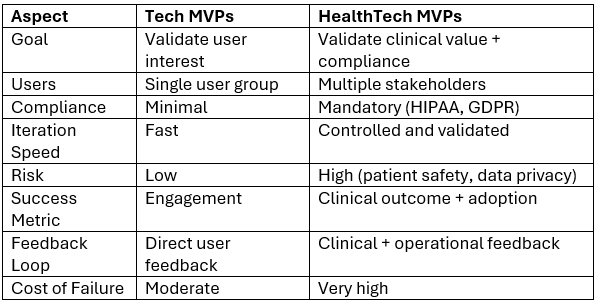
This is why healthtech MVP development requires a different mindset.
Instead of building features quickly, focus on:
- Clinical outcomes
- Integration feasibility
- Regulatory readiness
Why do digital health startup ideas fail in San Francisco and globally?
Understand why digital health startup ideas fail in San Francisco.
Even in one of the most advanced ecosystems, failure patterns are consistent.
The 3 Pillars of Failure
1. Misalignment with Clinical Workflows
Startups often build tools that require doctors to change behavior.
In reality, doctors prefer tools that fit into existing systems like EHRs.
If your product adds extra steps, it will not be used.
2. Regulatory Debt
Founders ignore compliance during early stages.
Later, they realize:
- Data storage is non-compliant
- Security architecture is insufficient
- Audit trails are missing
Fixing this post-MVP can cost more than building the product again.
3. Payer-Provider-Patient Disconnect
Healthcare is an ecosystem, not a single user journey.
Example:
- A patient app improves engagement
- But providers see no workflow benefit
- Payers see no cost reduction
Result: no adoption
This disconnect is one of the biggest reasons behind why healthtech startups fail.
This is a pre-MVP checklist for healthtech founders
Before you move to development, validate your idea using this checklist:
Problem Clarity
- Is the problem urgent and measurable?
- Does it impact cost, time, or outcomes?
Clinical Validation
- Have you spoken to at least 10 healthcare professionals?
- Do they agree the problem exists?
Workflow Fit
- Does your solution integrate with existing systems?
- Does it reduce steps, not add them?
Compliance Readiness
- Have you mapped data flow?
- Are privacy and security considerations defined?
Market Fit
- Who pays for the solution?
- Who uses it daily?
Technical Feasibility
- Can the solution scale securely?
- Can it integrate with EHR or hospital systems?
This is where startup idea validation in healthcare becomes your biggest advantage.
What does a validation-first healthtech MVP strategy look like?
Fig.: Validation-first framework for healthtech startup MVP development, covering clinical validation, workflow mapping, compliance, and stakeholder alignment
A strong pre-MVP healthtech strategy follows three stages:
Stage 1: Discovery
- Interviews with stakeholders
- Workflow mapping
- Problem prioritization
Stage 2: Validation
- Prototype testing (not full development)
- Clinical feedback loops
- Compliance feasibility check
Stage 3: MVP Planning
- Define minimal clinical value
- Build only necessary features
- Ensure regulatory alignment
This approach reduces wasted effort and supports healthcare startup product discovery.
If you are exploring implementation, working with experts in custom healthcare application development can help ensure your product is aligned with real healthcare needs from day one.
Case Study: What if a San Francisco startup chose validation before failure?
Imagine a San Francisco-based digital health startup building a feature-heavy patient engagement app.
The Initial Approach
What if they start with:
- 15+ features including reminders, dashboards, and analytics
- A strong focus on user experience
- Minimal clinical input during development
At first, everything looks promising. The product feels complete. The interface is polished. Investors may even be impressed.
The Problem
But what if, after launch, reality looks different?
- Doctors do not use the platform because it does not fit into their workflow
- Integration with hospital systems becomes complex and slow
- Compliance gaps delay partnerships with healthcare providers
This is where many digital health startup mistakes begin to surface.
The Pivot
Now, what if the founders decide to pause and rethink their approach?
Instead of adding more features, they shift to a validation-first strategy:
- Conduct interviews with hospital administrators and clinicians
- Re-evaluate the actual problem being solved
- Identify one critical issue: delayed patient discharge decisions
- Focus on building a clinical decision support tool instead of a broad app
This is where validate healthtech startup idea becomes a real, actionable step rather than just a concept.
The Result
If they follow this path, the outcomes could look very different:
- Hospital discharge delays reduce by up to 30 percent
- The product aligns better with real clinical workflows
- Partnerships with healthcare providers become easier to secure
- Development costs drop by nearly 40 percent due to focused execution
This is the real impact of digital health product validation.
What role does a technology partner play in validation?
Many founders try to handle validation alone. This leads to blind spots.
A strong technology partner for startup founders helps with:
- Translating clinical needs into technical architecture
- Ensuring compliance readiness from day one
- Designing scalable and secure systems
- Supporting MVP planning for healthcare startups
Instead of just building software, the right partner helps you build the right product.
How to approach healthtech MVP development in 2026?
In 2026, MVP development is no longer about speed. It is about precision.
Key principles:
Build for Clinical Value
Focus on outcomes, not features.
Design for Compliance
Integrate privacy and security into architecture.
Validate Before Scaling
Test with real users before expanding.
Keep It Focused
Solve one problem extremely well.
This approach aligns with modern healthtech startup MVP strategies.
Conclusion:
Most failed startups did not lack innovation. They lacked validation.
Successful founders today understand that healthtech startup ideas are only valuable when they align with clinical workflows, regulatory requirements, and ecosystem stakeholders.
Working with an experienced healthcare software development company can help founders avoid early mistakes, reduce risk, and build solutions that are both scalable and compliant.
In healthcare, the cost of getting it wrong is high. But the impact of getting it right is even higher.
Take the first step toward a validated solution
If you are building a healthtech solution, the smartest step is not development, it is validation.
Start with a structured Product Discovery Session to:
- Validate your idea with real healthcare workflows
- Identify compliance requirements early
- Define a focused MVP roadmap
- Reduce development cost and risk
At Theta Technolabs, we help founders move from idea to validated product with expertise in Web, Mobile, and Cloud solutions tailored for healthcare.
📩 Reach out at sales@thetatechnolabs.com to schedule your discovery session and build a product that healthcare systems will actually adopt.
Meta Description -













.png)






.png)


























.png)

























.png)



.png)



.png)