

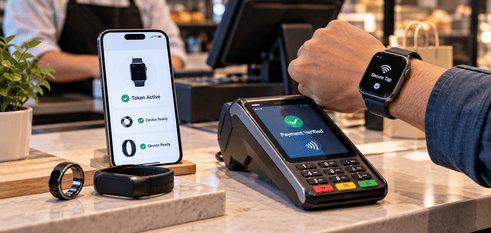
Wearable payments are changing how consumers make everyday transactions. Smartwatches, payment rings, fitness bands, and other connected devices can allow users to make contactless payments without reaching for a phone or wallet.
For fintech startups, however, building a wearable payment product involves more than adding NFC to a device. Startups need to consider payment infrastructure, tokenization, device connectivity, security, mobile applications, backend systems, and user experience.
A focused wearable payment MVP can help validate the concept before investing in a larger product ecosystem. The key is to start with one clearly defined payment experience and expand based on real user feedback.
How Do Wearable Payments Work?
A typical wearable payment experience combines several technologies to securely process a transaction.
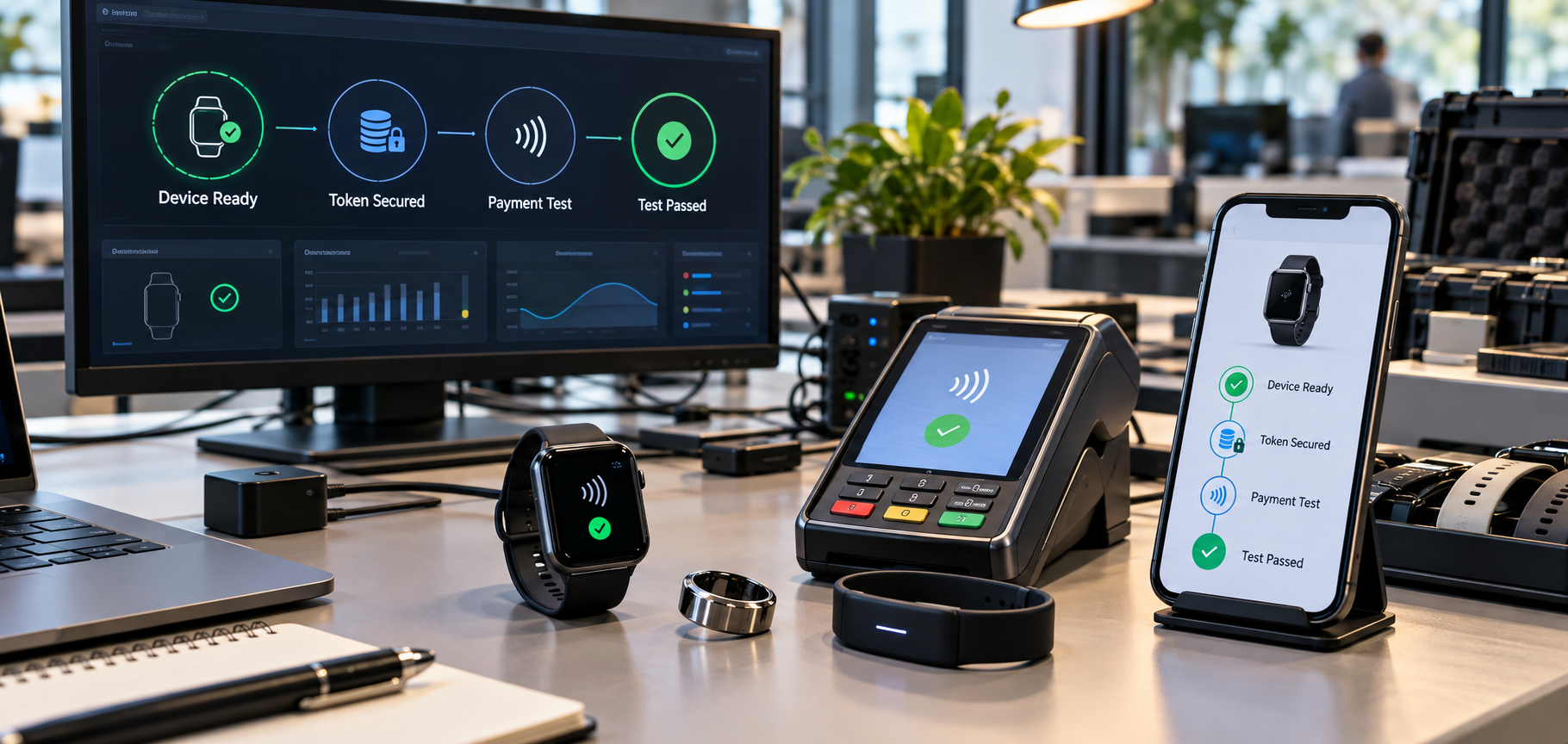
The wearable can use NFC to communicate with a compatible point-of-sale terminal. Instead of exposing the user's actual card credentials during a transaction, payment tokenization can be used to represent the underlying payment card with a secure token.
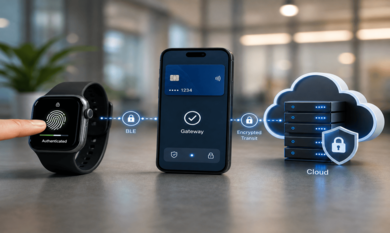
Depending on the product architecture, the wearable may also communicate with a smartphone or companion application using Bluetooth Low Energy (BLE). The mobile application can support device setup, card management, authentication, notifications, and other account functions.
A simplified payment flow can look like this:
User adds card → Card is verified → Payment token is provisioned → Token is securely stored on the wearable → User taps wearable at POS → Payment is processed → Transaction status is returned to the application
This architecture allows fintech startups to create a convenient payment experience while keeping security at the center of the product.
What Should a Wearable Payment MVP Include?
The goal of an MVP is not to build every possible feature. It is to build enough functionality to test whether users actually want and use the product.
A wearable payment MVP may include:
- User registration and login
- Wearable device onboarding
- Device pairing and management
- Card enrollment
- Payment token provisioning
- NFC-based contactless payments
- Transaction history
- Payment notifications
- Device lock or suspension
- Lost-device management
- Basic administration and support functionality
Features such as loyalty programs, advanced analytics, multiple wearable types, international payment support, and complex personalization can usually be considered after the core payment journey has been validated.
A focused MVP helps startups reduce unnecessary development while concentrating on the experience that matters most: enabling users to make payments securely and conveniently.
What Technology Is Required to Build a Wearable Payment MVP?
Building a wearable payment product usually requires multiple technology layers working together.
NFC
NFC can enable contactless communication between the wearable and compatible payment terminals. It is particularly important when the wearable is intended to function as a contactless payment device.
BLE
BLE can be useful for communication between the wearable and a companion smartphone or application. Startups can work with experienced IoT and BLE development services teams to connect devices, applications, and backend systems.
Secure Element
A Secure Element can provide a protected environment for sensitive payment credentials or tokens, depending on the chosen product architecture.
Payment Tokenization
Payment tokenization replaces sensitive payment credentials with a token that can be used within the payment ecosystem. For wearable products, tokenization can help reduce exposure of the underlying card information.
Mobile Application and Backend
A companion mobile application can allow users to register devices, manage cards, review transactions, and control their wearable. The backend can manage APIs, authentication, device information, transaction data, notifications, and integrations with payment services.
For products that require communication between wearable hardware and mobile applications, BLE application development can support secure device connectivity and data exchange.
How to Build a Wearable Payment MVP: Step by Step
1. Define the Target Use Case
Start by identifying the specific problem the wearable will solve. For example, the product could target consumers who want a faster way to make everyday contactless payments or users who prefer payment rings or other minimal devices.
2. Choose the Wearable
Determine whether the MVP will use a smartwatch, payment ring, fitness band, or another form factor. Starting with one device category can keep the initial development scope manageable.
3. Define the Core Payment Journey
Map the complete user journey from registration and card enrollment to token provisioning, payment, transaction confirmation, and device management.
4. Design the Architecture
Define how the wearable, NFC, BLE where applicable, mobile application, backend APIs, tokenization services, payment infrastructure, and administration systems will communicate.
5. Integrate Payment Infrastructure
Payment products require appropriate payment integrations and security considerations. Depending on the market and product model, this can involve payment processors, payment networks, issuers, tokenization services, and other financial infrastructure.
6. Develop the MVP
Build the wearable integration, mobile application, backend services, APIs, user interface, and administrative capabilities required for the selected payment flow.
7. Test Security and Payment Scenarios
Testing should cover successful payments as well as declined transactions, lost devices, device replacement, failed provisioning, connectivity issues, authentication failures, and other edge cases.
8. Launch a Controlled Pilot
Instead of immediately targeting a large user base, launch with a controlled group. Monitor payment success rates, onboarding completion, device issues, user feedback, and recurring usage.
How Can Startups Secure a Wearable Payment Product?
Security should be considered from the beginning rather than added after development.
Depending on the architecture, startups may need to consider payment tokenization, secure elements, encrypted communication, API authentication, secure key management, device authentication, access controls, fraud monitoring, audit logs, and lost-device management.
The product may also need to meet applicable payment-industry, regulatory, network, and certification requirements based on its geography and payment model.
The exact compliance requirements should be evaluated before development because they can affect the architecture, integrations, testing process, and launch timeline.
What Should Startups Leave Out of the First Version?
A common MVP mistake is trying to support every possible scenario from day one.
A more focused approach could be:
One target audience + one wearable + one payment use case + one geography + one core payment flow.
Startups can postpone advanced rewards, multiple device categories, complex analytics, extensive integrations, and additional payment markets until they have evidence that the core product is being used.
This approach makes it easier to identify which features actually contribute to adoption.
How Can a Wearable Payment MVP Scale?
Once the MVP demonstrates product-market potential, startups can expand the ecosystem with additional wearable devices, payment networks, markets, wallets, loyalty programs, analytics, authentication methods, and financial services.
The architecture should therefore be designed with future expansion in mind without unnecessarily building every capability into the first release.
A technology partner experienced in fintech software development can help startups move from an initial payment concept to a more scalable financial product while integrating the required technology and payment infrastructure.
Conclusion
Building a wearable payment product does not require a fintech startup to launch a complete ecosystem on day one. A well-planned wearable payment MVP can focus on one customer group, one device, and one secure payment journey.
The most important components include NFC, appropriate device security, payment tokenization, mobile and backend infrastructure, payment integrations, and effective device management.
By validating the core experience first and using real user feedback to guide future development, fintech startups can build a stronger foundation for scaling their wearable payment product.
Build Your Wearable Payment MVP With the Right Technology Partner
Have an idea for a wearable payment product but not sure where to start? From MVP planning and wearable connectivity to payment integrations, backend development, and security, the right technology approach can help you validate your concept without overbuilding. Partner with a team experienced in fintech, IoT, BLE, and connected-device development to turn your idea into a secure, scalable MVP. Let’s talk about your wearable payment product and define the right technology roadmap for your startup.
Frequently Asked Questions
1. What is a wearable payment MVP?
A wearable payment MVP is the first functional version of a payment-enabled wearable product. It typically focuses on essential capabilities such as device onboarding, card provisioning, secure tokenization, contactless payments, transaction management, and device controls.
2. How does NFC work in wearable payments?
NFC allows a compatible wearable device to communicate with a contactless payment terminal when the user taps the device. The payment system processes the transaction using the appropriate payment credentials or token without requiring the user to physically present a payment card.
3. Is payment tokenization necessary for wearable payments?
Payment tokenization can help protect sensitive card information by replacing the underlying card credentials with a payment token. The exact implementation depends on the payment architecture, network, issuer, device capabilities, and applicable requirements.
4. What features should a wearable payment MVP include?
Core features can include user registration, wearable onboarding, card enrollment, payment-token provisioning, NFC payments, transaction history, notifications, device management, and lost-device controls. Advanced features can be introduced after the core payment experience has been validated.
5. How long does it take to build a wearable payment MVP?
The timeline depends on factors such as the wearable hardware, payment integrations, tokenization requirements, mobile and backend functionality, security requirements, testing, and certification. Defining a focused MVP scope early can help reduce unnecessary development time and complexity.




























.png)






.png)
























.png)




















.png)