

Fintech users do not keep business hours. A user in San Francisco checking a failed transfer at midnight expects the same quality of response as one calling in at noon. For most fintech apps, that expectation collides with a support system built on FAQ bots and ticket queues that can answer simple questions but fall apart the moment a request needs judgment, verification, or an actual action taken on an account.
This is where agentic AI customer support changes the equation. Unlike a standard chatbot that follows scripted decision trees, agentic AI for fintech can understand intent, check relevant data, take a bounded action such as flagging a dispute or updating a record, and hand off to a human only when the situation genuinely calls for one. For fintech apps built and used out of San Francisco, where user expectations and technical talent both run high, this shift from reactive scripts to autonomous, policy governed support is becoming less of an experiment and more of an operating requirement. If you're evaluating an ai software development services san francisco partner for this shift, understanding how agentic AI actually works in practice is the right place to start.
Why Static Support Models Fail Fintech Apps
Most fintech support stacks were not built for the complexity fintech actually involves. A rule based chatbot can tell a user their account balance. It usually cannot explain why a transfer is delayed, verify identity documents, walk through a dispute, or recognize when a query is really a fraud flag in disguise.
The result is a familiar pattern: simple queries get resolved instantly, and everything else gets routed into a ticket queue where a human eventually has to read the conversation history from scratch, ask the same questions the bot already asked, and start over. That gap between what the bot can handle and what the user actually needs is where most AI customer service automation fintech conversations should start, because it is where the real cost and frustration pile up.
Static systems also cannot carry context across a conversation. A user who starts with a balance question and follows up about a suspicious charge is treated as two unrelated queries instead of one connected concern. The bot has no memory of what was just discussed, so the user ends up repeating themselves, and the human agent who eventually picks up the ticket has to piece the story back together from scratch.
There is also a scaling problem baked into static systems. Adding more support volume usually means adding more headcount or more scripted flows, both of which are slow to build and expensive to maintain. Every new product feature or new type of user request means someone has to sit down and write new rules, test them, and hope they cover the edge cases.
What Agentic AI Actually Does Differently
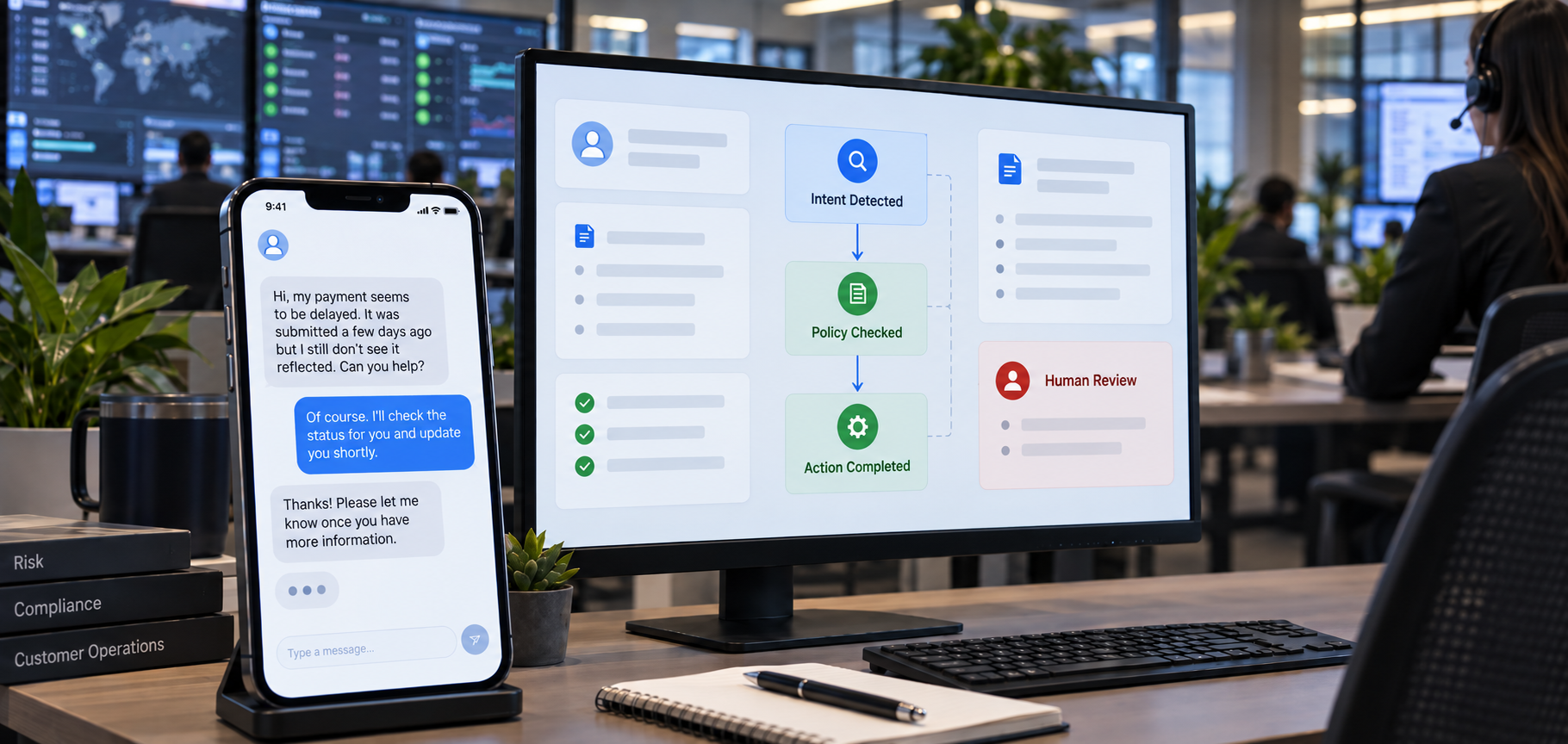
Agentic AI works through what is often called governed AI autonomy fintech teams rely on to keep automation safe. Instead of a fixed script, the system runs an intent detection layer to understand what the user actually needs, checks that request against a policy engine that defines what the AI is allowed to do on its own, executes the bounded action if it falls within those limits, and escalates to a human agent when it does not. Every step is logged, so nothing the AI does is a black box.
This matters for fintech specifically because the actions involved are not trivial. Verifying identity documents, processing a refund, or updating account details are all things that carry real financial and compliance weight. This kind of governed autonomy is what allows AI agents for financial services to act on these tasks without turning into an unsupervised risk. The policy engine is really the core of the whole system. It defines exactly which actions the AI can complete on its own, which ones need a second layer of confirmation, and which ones always go to a human no matter what the AI concludes.
In one documented case, a global fintech company working with Sutherland deployed an agentic AI system across its card servicing operations and reported a 50 to 60 percent reduction in average handle time, along with a projected 30 percent reduction in cost to serve, according to Sutherland's published case study. The results are noted as projected outcomes based on pilot data still being tracked, which is worth keeping in mind since results will vary by organization and implementation.
The audit trail is worth calling out on its own. Because every decision the AI makes is logged along with the reasoning and the data it checked, compliance teams can review exactly why an action was taken after the fact. This is very different from a black box model where a decision happens and no one can reconstruct how it got there.
Real Use Cases for Fintech Apps
Agentic AI is most useful in fintech precisely where static bots struggle. A few concrete examples:
- KYC verification: The system can check submitted documents against required fields and flag mismatches using deterministic, auditable rules, the kind regulators expect for identity verification. This speeds up routine cases significantly, but the final onboarding decision stays within a rules-based compliance framework rather than being left to the AI's own judgment, with clear audit trails for every check. This is the core of what automated KYC and dispute resolution AI is designed to do.
- Transaction dispute resolution: Instead of routing every dispute to a queue, the AI can check transaction logs, confirm the details of the dispute, and initiate a resolution when the case fits established policy. Cases outside policy, like unusually large amounts or repeat disputes from the same account, get escalated automatically.
- Balance and statement queries: Beyond a simple number lookup, the AI can explain why a balance changed by pulling the actual transaction records directly from the account system through a live API connection, rather than calculating or estimating the figures itself, so the numbers the user sees are the real ledger data, not an AI-generated guess.
- Proactive fraud flag conversations: When unusual activity is detected, the AI can reach out directly and confirm with the user whether the activity was legitimate. If the activity is confirmed suspicious, the system triggers a hard-coded security rule to lock the account, rather than the AI making that call on its own judgment. This keeps the higher-risk action behind fixed rules while still moving faster than waiting for the user to notice and report it themselves. This shifts fraud response from reactive to proactive, which matters a great deal in fintech where minutes can determine how much damage occurs.
Each of these tasks involves judgment and data access that a scripted bot cannot handle safely. This is where conversational AI fintech support and true agentic decision making start to diverge, because the AI operates within defined boundaries rather than guessing.
Build vs. Partner: What Implementation Looks Like
Building this kind of system is not a matter of connecting a chatbot to a knowledge base. A working AI-driven customer support platform needs a few core pieces working together: an LLM layer for understanding and generating natural responses, an orchestration layer that decides what actions are permitted, integration with existing systems like CRMs and ticketing platforms so the AI has real data to act on, and audit logging so every decision the AI makes can be reviewed after the fact. A serious implementation also has to test against prompt injection, where a user tries to manipulate the conversation to trick the AI into taking an action it should not, which is another reason the policy engine's rules need to sit outside the AI's own reasoning rather than inside it.
Getting the orchestration layer right is usually the hardest part. It is one thing to build a system that sounds conversational. It is another to build one that knows exactly where its authority ends and correctly hands off a case rather than guessing its way through something it should not be deciding alone. This is where a lot of agentic AI projects fall short, not because the language model is weak but because the governance layer around it was an afterthought.
This is also where the compliance side matters most. A fintech app operating in California has to work within both federal KYC and AML requirements and the state's additional privacy rules. A well built agentic AI system handles this cleanly because its autonomy is bounded by policy from the start, not bolted on afterward. This is generally why fintech teams work with a partner experienced in this exact intersection of AI and financial services rather than building it from scratch internally.
If you're comparing options, look closely at how a custom ai development company san francisco team approaches the policy and escalation layer specifically, since that is what determines whether the system is actually safe to deploy for financial support, not just impressive in a demo. Ask how they log decisions, how they define escalation triggers, and how they test the system against edge cases before it ever touches a real user account. Teams that specialize in this space, such as an ai development company in san francisco with dedicated experience in generative and agentic AI, typically bring both the conversational layer and the governance framework needed to make autonomous support work in a regulated environment.
Frequently Asked Questions
Is agentic AI safe for regulated fintech support?
It can be, as long as its autonomy is governed by clear policy rules and every action is logged for review. The higher-risk actions, like KYC onboarding decisions or account lockouts, stay behind deterministic, hard-coded rules rather than the AI's own judgment. The risk is not the AI acting independently within its allowed scope. It is AI acting independently without defined limits.
How is agentic AI different from a chatbot?
A chatbot follows scripted responses and cannot take real action beyond answering a question. Agentic AI can check data, make a decision within its permitted scope, and complete a task, such as resolving a dispute or updating a record, rather than simply describing what the user should do next.
How much can agentic AI reduce support costs for a fintech app?
Results vary by organization, but documented deployments have reported meaningful reductions in handle time and cost to serve, as seen in the Sutherland fintech case study referenced above. It is not a fixed number every company should expect, but the direction of the results is consistent across reported cases.
Does agentic AI replace human support agents entirely?
No. It handles routine, well defined tasks and escalates anything outside its policy boundaries to a human. The goal is to free human agents for the cases that actually need judgment, not to remove them from the process.
The Bottom Line
Fintech apps built for today's users need support systems that can do more than answer simple questions. Agentic AI, built with proper governance and compliance boundaries, gives fintech teams a way to automate the routine work while keeping humans in the loop where it counts. The technology itself is not the hard part anymore. The governance layer around it, the part that decides what the AI can and cannot do on its own, is what separates a system that works safely from one that creates new risk.
If your team is exploring what this could look like for your product, Theta Technolabs can help you think through the governance and implementation details before a single line of code gets written. Reach out to sales@thetatechnolabs.com to talk through what an implementation would take.





























.png)





.png)


























.png)

























.png)


.png)



.png)