

When a clinical report depends on notes, forms, device outputs, and previous records, completing it involves more than writing. Someone must collect the information, check its context, prepare the document, and route it for approval.
For Boston hospitals and clinical software teams, AI-assisted clinical reporting should address that preparation work without removing clinical oversight. Evidence on AI clinical documentation suggests that drafting support can help, but accuracy and editing requirements vary across settings.
The practical question is where assistance belongs. This article explains how to structure the workflow, preserve clinician review, connect existing systems, and measure whether reporting improves.
Where Clinical Reporting Delays Actually Begin
Information arrives from several clinical sources
Start by mapping the inputs required for a particular report. Identify which details come from the electronic health record (EHR), diagnostic systems, clinician notes, or device files. Distinguish unavailable information from information that staff have not yet retrieved.
Staff prepare information before review
Clinical reporting automation should target clearly defined preparation tasks: collecting permitted inputs, applying report templates, and checking required fields. First establish whether the delay comes from these tasks or from an approval queue.
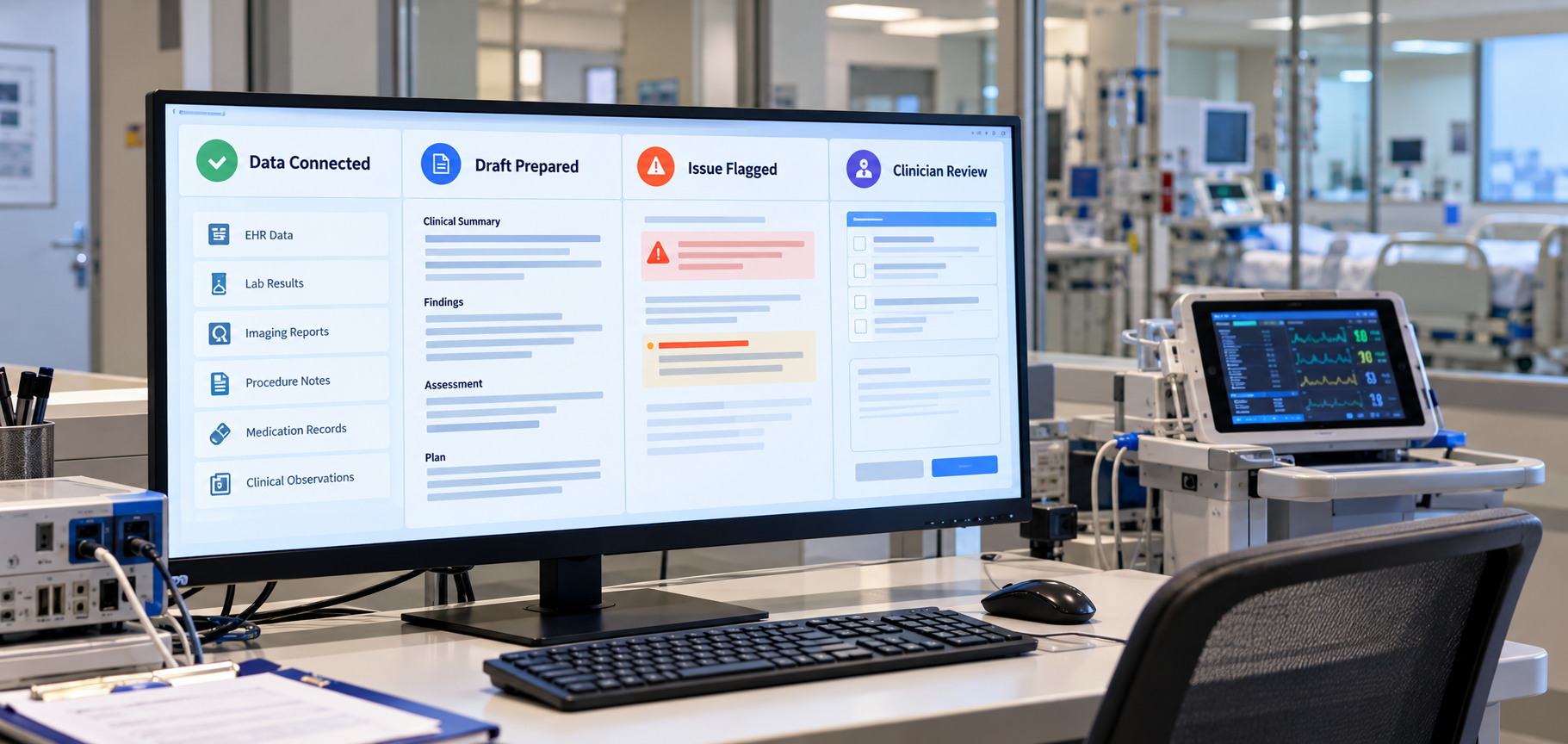
For example, a ready-to-review draft and a report waiting for a device file need different actions. The workflow should distinguish these statuses so staff do not chase a clinical approval before the required inputs exist.
For teams evaluating AI-driven healthcare services, this is a workflow design question before a technology selection question.
Incomplete information creates additional review cycles
Map who resolves missing details and how the report returns to its reviewer. Clinical workflow automation should make ownership visible rather than simply move incomplete drafts between departments.
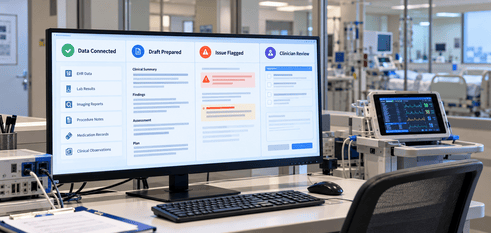
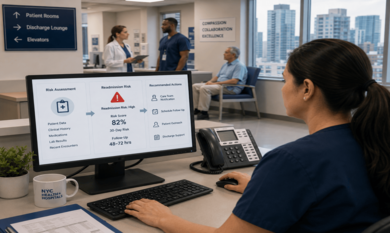
What AI Should Do Before a Clinician Reviews the Report
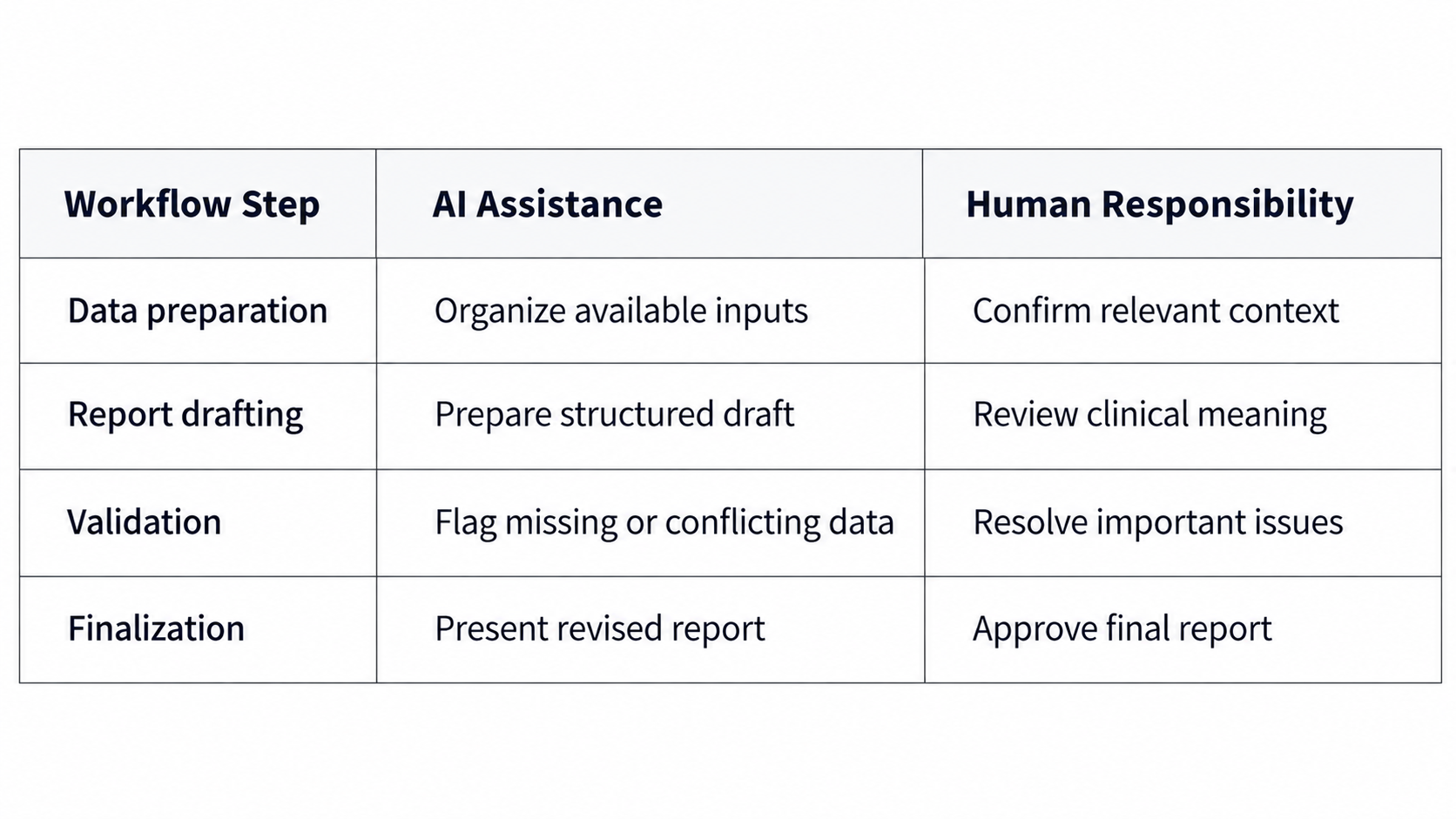
Organize incoming information
Define which sources the system may use and how each item maps to the approved template. Preserve patient and encounter identifiers, timestamps, and measurement units. Do not combine records merely because their wording appears similar.
Prepare a draft from available information
Configure AI clinical documentation software to summarize supplied content without adding unsupported findings. AI-generated clinical reports should remain visibly marked as drafts.
Flag missing or conflicting details
Combine required-field checks with AI assistance. A missing source value should remain unresolved, not become an assumed normal finding. Conflicting entries should remain visible until an authorized person resolves them.
Present the supporting context
An AI-assisted healthcare workflow should let clinicians compare the draft with its source information instead of reviewing polished text alone.
The proposed division of responsibilities is:
Human Review Should Be Part of the Workflow, Not an Afterthought
Keep approval under clinical control
In human-in-the-loop clinical documentation, generated content should remain provisional until an authorized clinician reviews and approves it.
A systematic review in BMC Medical Informatics and Decision Making found variable performance across AI speech-recognition tools and noted that summaries produced by large language models often required human review for clinical safety. Its findings concern speech-based documentation, not an evaluation of this proposed reporting platform.
Give reviewers more than an Approve button
Meaningful human review of AI-generated clinical notes needs an interface that supports source comparison, corrections, and returning incomplete reports.
The reviewer should be able to check patient identity, clinical context, negation, units, and omitted information. Show the source passage or structured value beside any flagged statement where technically supported. Preserve the original draft and subsequent edits so reviewers can understand what changed.
Highlighting exceptions should guide attention, not limit the scope of review. A report with no flags should not bypass clinical approval.
Define routes for unresolved issues
Assign missing-data requests and clinical questions to appropriate roles. Record who changed the draft and who approved the final version.
For significant conflicts, pause finalization until the responsible clinician resolves them. Keep a manual reporting route available when the automated service or its source connections are unavailable.
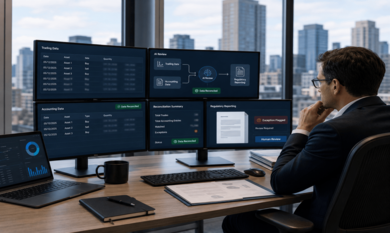
Connect the Reporting Tool With Existing Hospital Systems
Confirm what each connection supports
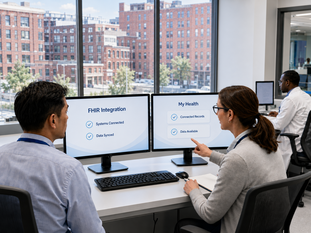
Plan EHR integration for AI documentation around supported interfaces, access permissions, and the destination for approved reports. Confirm separately whether an interface can retrieve source information, store a draft, or submit an approved document.
Do not assume that reading EHR data automatically enables report submission. Specify how duplicate submissions, rejected messages, and later amendments will be handled. A connection failure should create a visible task for the responsible team, not silently discard the report or generate another copy.
Preserve access controls and traceability
When designing AI clinical documentation for hospitals, specify role-based access, encryption, audit logs, retention rules, and permitted uses of patient information. Review these arrangements with the hospital’s privacy and security teams before deployment.
Avoid another disconnected application
An AI-powered clinical workflow and reporting platform provides an implementation reference combining device-data parsing, AI-assisted summaries, approval workflows, and role-based access. The published case study concerns surgical reporting; it does not establish a Boston deployment.
Apply the relevant design principles without assuming identical systems or outcomes. Record delivery status so an approved report is not mistaken for one successfully received by the EHR.
A Practical Reporting Workflow for a Boston Hospital
Consider a hypothetical Boston hospital preparing reports from clinician-entered information and procedure-monitoring files. This illustrates a proposed workflow, not a reported customer outcome.
The system first matches incoming files to the correct patient and encounter. It checks required inputs and identifies missing information before requesting a draft.
AI then prepares the approved report sections using available sources. A conflicting entry remains visible with its source context rather than being silently reconciled.
The assigned clinician reviews the complete draft, resolves outstanding questions, and approves the report. The system records revisions and approval, then confirms delivery to the destination system.
For teams considering healthcare AI development in Boston, this sequence offers a useful starting point for scoping. Begin with a bounded reporting workflow, agreed review responsibilities, and an existing manual alternative rather than attempting hospital-wide automation immediately.
How to Tell Whether the Workflow Is Actually Improving
Measure the entire reporting process, not only draft-generation speed. Evidence from speech-based documentation studies shows that editing work can offset potential time savings.
Establish a baseline for preparation time, waiting time, clinician review time, and final delivery. Compare similar report types and case complexity during the pilot.
Track how often reports return because information is incomplete, which corrections recur, and whether important omissions escape automated checks. Separate cosmetic edits from changes that affect clinical meaning.
Also examine the approval queue. Faster drafting does not solve a shortage of available reviewers. Review results with clinical, operational, and software teams together, since a faster interface does not necessarily resolve staffing or source-data problems.
Agree on acceptance criteria before expansion. Continue only when clinical reviewers consider draft quality acceptable and operational measurements support a useful improvement. The objective is less avoidable preparation work, not more reports awaiting correction.
Questions Hospital Teams Should Resolve Before Development
Define the project in terms of reports, responsibilities, and exceptions.
Which report types are suitable for assisted drafting? Which source systems are authoritative? What information must be present before drafting begins?
Specify who may edit and approve each report, how unresolved information is handled, and where the approved document belongs.
Also decide what the audit trail must capture, how long source material is retained, and how staff will work during an outage.
Before release, test the proposed workflow with representative cases, including incomplete records, conflicting inputs, and incorrect patient matches. Use approved test data and clinical reviewers. Capture corrections for evaluation without automatically reusing patient information for training.
Frequently Asked Questions
How does AI-assisted clinical reporting work?
It organizes approved source information and prepares a structured draft. Validation checks and clinician review precede final approval in the proposed workflow.
Should clinicians review AI-generated clinical reports?
Yes. Research on AI documentation identifies errors and omissions that justify human review before generated content is accepted into clinical records. Springer
Can AI clinical documentation integrate with an EHR?
Integration should be assessed against the EHR’s supported interfaces, permissions, and document workflows. Confirm retrieval and submission capabilities separately.
What happens when information is missing or uncertain?
The workflow should flag the issue, preserve its context, and route it to the responsible person rather than inventing an answer.
What should hospitals consider before implementation?
Define suitable reports, data access, review responsibilities, security controls, integration requirements, and pilot acceptance criteria before development begins.
Reduce Preparation Work Without Removing Clinical Oversight
The goal is not to replace clinical judgment with faster text generation. It is to organize source information, prepare usable drafts, and give reviewers the context needed to finalize reports responsibly.
Our development approach can combine Python, REST APIs, and an appropriately configured Azure environment around existing hospital systems. These technologies are included in our published AI development stack; the final architecture depends on the hospital’s requirements.
To discuss an AI-assisted reporting workflow with defined human review, contact Theta Technolabs at sales@thetatechnolabs.com.


























.png)





.png)






















.png)

























.png)