

Most large hospital networks run into the same problem. Different parts of the organization use different systems. The emergency department has one, the labs have another, imaging keeps its own records, and a hospital added through a merger often runs software that was never built to connect with the rest. When these systems cannot share data, staff waste time looking for information, records get duplicated, and answering a simple question about a patient takes longer than it should.
FHIR based integration is one of the most common ways networks are solving this. It gives separate systems a shared way to exchange patient data so information can move where it is needed. This blog explains how that approach works for a hospital network, what it takes to connect fragmented systems, and how it fits with compliance, written in plain terms for the people making the decision.
The fragmented systems problem for Boston hospital networks
Fragmentation is rarely the result of a bad plan. It builds up over time. A network grows through mergers and acquisitions, each bringing its own electronic health record system. Departments buy specialized software over the years to solve their own needs. Eventually a single parent network is running a mix of EHR vendors and older interfaces that were never designed to share data cleanly. The result is fragmented healthcare systems that store overlapping information in different formats, which makes true hospital system integration difficult.
Boston is a good example of why this matters. It is one of the densest hospital-network markets in the country, home to large academic medical centers and community hospitals that often sit under the same parent organization. When those facilities cannot exchange records smoothly, the cost shows up as delays, repeated tests, and staff time spent reconciling data by hand. For networks weighing custom software work, Theta Technolabs supports Boston healthcare organizations with software built around how their systems actually operate. Solving fragmentation is less about buying one more tool and more about giving the systems already in place a common way to communicate, which is where healthcare data interoperability becomes the real goal.
What FHIR based integration actually does
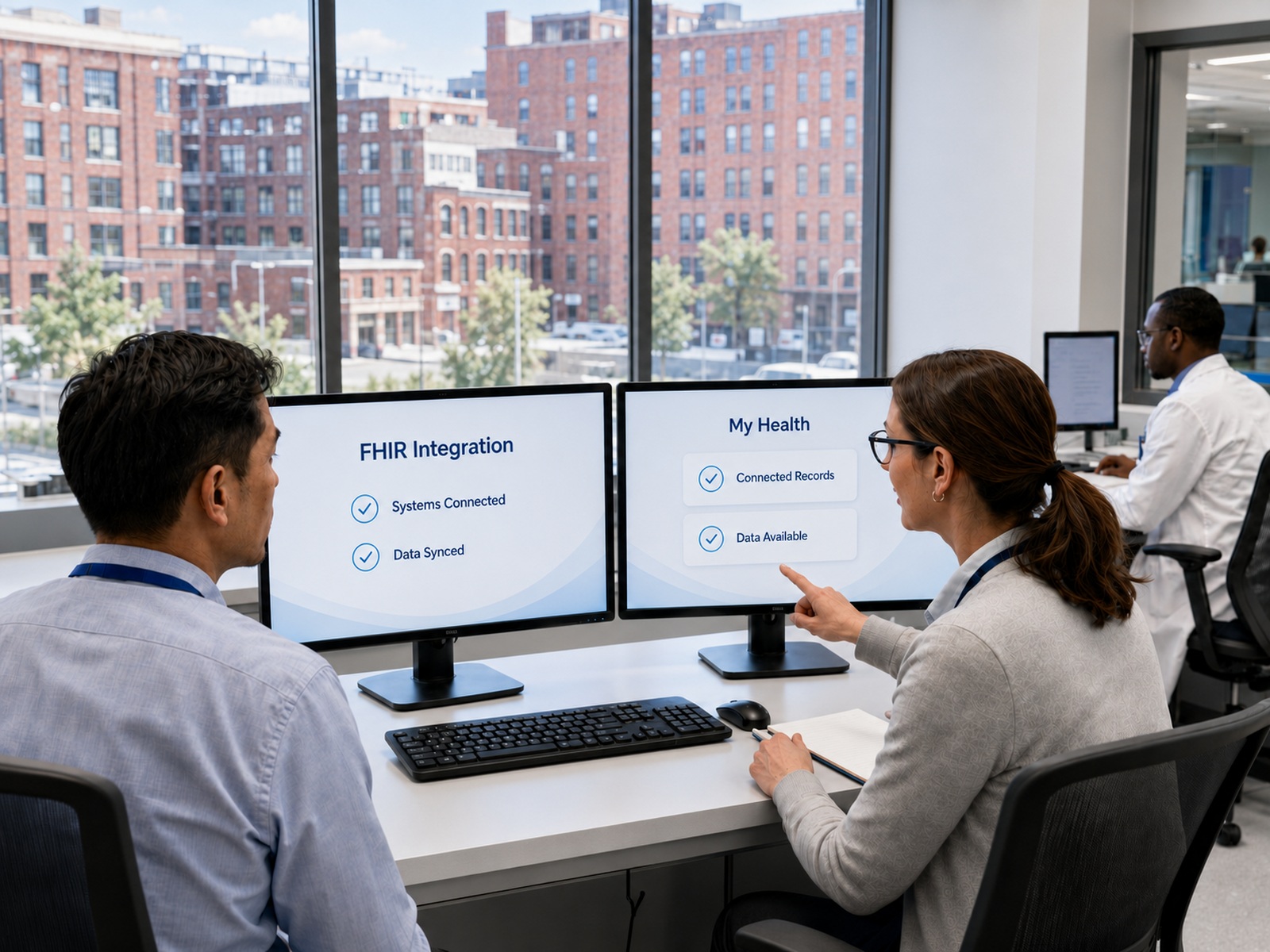
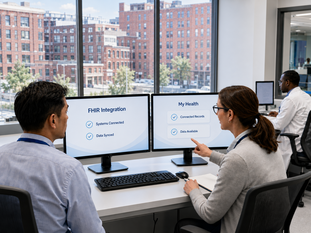
FHIR stands for Fast Healthcare Interoperability Resources, a standard maintained by HL7. In plain terms, it gives different healthcare systems a shared language and a set of APIs so they can exchange patient data consistently and close to real time. Instead of building a fragile custom connection between every pair of systems, a network can use FHIR as a common layer that many systems plug into. That shift is what makes modern EHR interoperability practical at scale.
Many networks still rely on older HL7 v2 messaging, which works but tends to be rigid and harder to extend. Moving from HL7 to FHIR is an upgrade in flexibility, because FHIR is built around web standards that developers already understand, which makes healthcare API integration faster to build and easier to maintain over time.
At a basic level, FHIR helps connect three things that often live in separate silos:
- The EHR systems used across different facilities and departments
- Patient-facing apps and portals
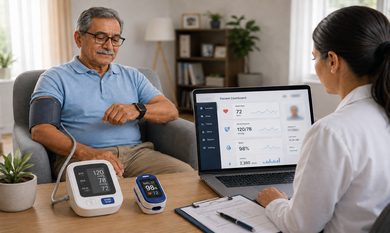
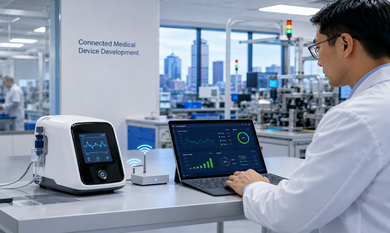
- Connected medical devices and monitoring tools
Once those pieces speak the same language, information can flow between them without a custom bridge for every connection.
Connecting mixed EHR systems without ripping out legacy infrastructure
One worry comes up in almost every conversation with a network. Does this mean replacing the systems we already have. In most cases, no. A sensible integration approach lets FHIR run alongside existing HL7 v2 messaging and legacy interfaces during a transition, rather than forcing a rip-and-replace. This is usually done through an integration layer, sometimes called middleware, that sits between systems and translates data into FHIR resources so older and newer systems can work together.
It is worth being honest that running two approaches side by side can add operational overhead while the transition is underway. There is more to monitor and maintain during that window. A phased plan is what keeps that manageable, retiring older connections only as the FHIR layer proves itself. That integration layer and its APIs also need somewhere secure to run, and cloud consulting services can help host the integration engine in an environment built for reliability and scale. Because all of this involves protected health information, the environment has to handle PHI carefully in line with HIPAA, and the responsibility for meeting those obligations rests with the hospital network itself. Done well, this coexistence approach means a network can modernize connected hospital systems steadily instead of gambling everything on a single cutover.
Where compliance fits for US hospital networks
Fragmentation is not only an operational headache. It can also create regulatory exposure. Under the 21st Century Cures Act and the rules issued by the Office of the National Coordinator for Health Information Technology, hospitals and health IT are expected to support standardized access to electronic health information and to avoid practices that count as information blocking. FHIR-based APIs are central to how that expectation is generally met, which is one reason healthcare interoperability compliance and integration strategy have become closely linked.
None of this should be read as legal advice, and the specific obligations that apply to a given network depend on its systems and circumstances. Rules in this area also continue to evolve, so it is wise to confirm current requirements rather than assume last year's guidance still holds. The authoritative reference point is the regulator itself, and the ONC Cures Act Final Rule sets out how the information blocking provisions and certification requirements fit together. The practical takeaway is that improving EHR interoperability can support a network's compliance posture, while leaving fragmented data in place can quietly work against it.
What a phased custom integration path looks like
For a multi-system network, an off-the-shelf connector rarely covers everything, which is why custom healthcare software development tends to fit these projects better. A realistic engagement usually moves through a clear sequence rather than trying to do everything at once:
- Assessment of current systems, data sources, and how information flows between them today
- Data mapping, where existing records are matched to FHIR resources so nothing is lost in translation
- Building the API and integration layer that lets systems exchange data
- Validation and testing against real clinical and administrative workflows, not just sample data
- Staged rollout across facilities, starting small and expanding as each stage proves stable
The reason a custom build matters here is that no two networks are fragmented in the same way. The mix of vendors, the age of the interfaces, and the workflows that depend on them are specific to each organization. A partner experienced in custom healthcare software development can shape FHIR integration services around that reality instead of forcing the network to bend to a generic product. Each stage also builds confidence, since testing against actual workflows surfaces the gaps that only appear once real users touch the system. By the end of the sequence, the network has a maintainable integration layer rather than another one-off connection to worry about.
What Boston hospital networks can expect
The point of all this work is not the technology for its own sake. When systems connect properly, a network can expect fewer data silos, quicker access to more complete patient records across sites, and clinical teams spending less time hunting for information that should already be in front of them. Smoother workflows tend to follow, along with a stronger position on the interoperability expectations that apply to US healthcare organizations.
These outcomes depend on the specifics of each network, and progress is usually steady rather than instant. Still, for a Boston hospital network dealing with the daily friction of disconnected systems, EHR integration Boston projects built on FHIR offer a realistic path toward hospital system integration that actually holds up over time.
Bringing it together
Fragmented systems feel permanent when you are living with them, but they are a solvable problem. A phased, compliance-aware FHIR approach can connect a hospital network's systems without the disruption of tearing everything out at once, and without overpromising on how quickly it happens. The work rewards a careful partner who understands both the technology and the clinical reality it has to support, where the qualified clinical and IT teams remain the decision-makers and the software exists to support them.
If your network is weighing how to connect its systems, Theta Technolabs would be glad to talk it through. Reach out at sales@thetatechnolabs.com to start the conversation.
FAQs
What is the difference between HL7 and FHIR for hospital integration
HL7 v2 is an older messaging standard that many hospitals still use, and it works well for established connections but can be rigid to extend. FHIR is a newer HL7 standard built around web APIs, which generally makes it more flexible and easier to maintain for modern integration.
How long does a FHIR integration project usually take for a hospital network
There is no fixed answer, because timelines depend on the number of systems, the age of the existing interfaces, and how complex the workflows are. A phased approach helps, since each stage can be planned and validated before the next begins.
Does FHIR based integration help with Cures Act and information blocking expectations
It can support a network's compliance posture, because FHIR-based APIs are central to how standardized data access is commonly enabled. The specific obligations depend on the organization, so confirming current requirements with the relevant regulator is always sensible.
Can FHIR integration work without replacing our existing EHR systems
In most cases, yes. An integration layer can let FHIR run alongside existing HL7 v2 and legacy systems during a transition, so a network can modernize gradually rather than replacing everything at once.






























.png)




.png)























.png)